Gas turbine blade defects extraction and analysis method based on region segmenting detection

A gas turbine blade and region segmentation technology, which is applied to the use of radiation for material analysis, etc., can solve problems such as heavy workload, high operating cost, and complicated detection process

CN104730091AInactive Publication Date: 2015-06-24XI AN JIAOTONG UNIV
10 Cites 25 Cited by

Patent Information

Authority / Receiving Office
CN · China
Current Assignee / Owner
Publication Date
2015-06-24
Estimated Expiration
Not applicable · inactive patent

Smart Images

  • Figure 1
    Figure 1
  • Figure 2
    Figure 2
  • Figure 3
    Figure 3
Patent Text Reader

Abstract

The invention discloses a gas turbine blade defects extraction and analysis method based on region segmenting detection, comprising the following steps: firstly segmenting a gas turbine blade into several regions by a lead wire, and carrying out defect detection on the segmented regions through a DR (Digital Radiography) device to obtain a blade whole gray level image A; then, moving the lead wire for certain distance to carry out defect detection inside each region, and thus obtaining a blade whole gray level image B; fusing the images A and B together to obtain a whole X-ray gray level original image without a lead wire; preprocessing the whole X-ray gray level original image and thus obtaining an X-ray detection image of the blade; further processing the X-ray detection image to obtain a binary image with outstanding defects, and building a two-dimensional coordinate system on the binary image, and carrying out location analysis on the existing internal defects; and finally, calculating amount of perimeter pixels and amount of area pixels of the defects in the binary image, thus obtaining actual defect size through conversion, and carrying out qualitative and quantitative analysis on the existing internal defects. The method provided by the invention realizes rapid and automatic extraction and analysis on internal defects of the blade.
Need to check novelty before this filing date? Find Prior Art

Description

Technical field

[0001] The invention belongs to the technical field of nondestructive testing, and specifically relates to a gas turbine blade defect extraction and analysis method based on region segmentation detection. Background technique

[0002] A gas turbine is a rotary power machine that uses a continuous flow of fuel-air mixture as a working medium to convert thermal energy into mechanical work. Gas turbines are the core power equipment of energy efficient conversion and clean utilization systems in the 21st century and beyond. At present, my country is weak in independent innovation and highly dependent on foreign countries in the manufacturing of large power equipment such as gas turbines. Therefore, carrying out research work in this field has great and far-reaching strategic significance for breaking through relevant technical bottlenecks and breaking the technological blockade of developed countries, and is closely related to the development of the national economy....

Examples

Embodiment Construction

[0057] The present invention will be described in detail below with reference to the drawings and embodiments.

[0058] The gas turbine blade defect extraction and analysis method based on region segmentation detection includes the following steps:

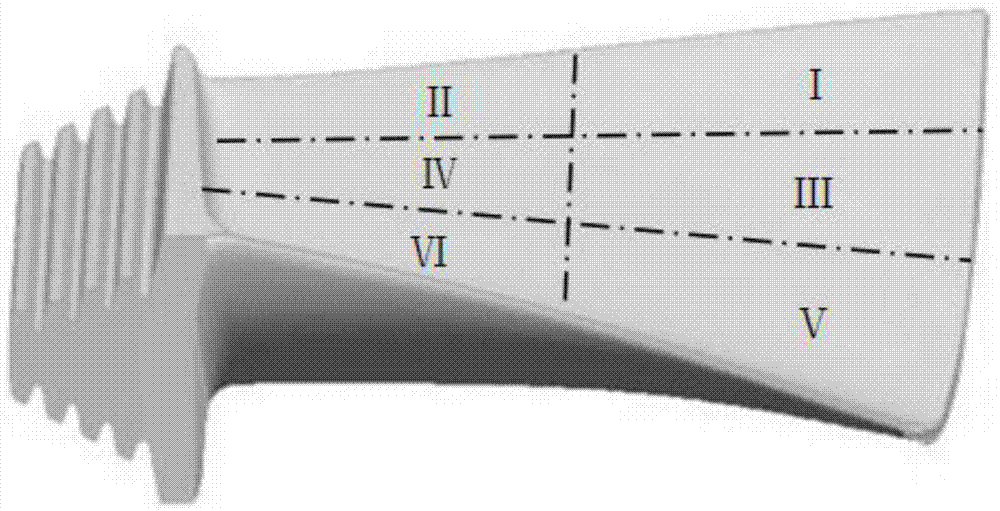
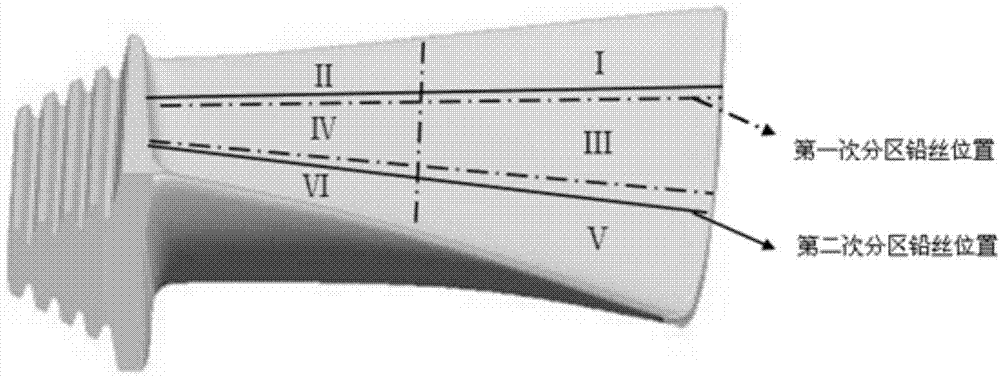
[0059] 1) Due to the irregularity of the shape of the gas turbine blade, the unevenness of the thickness and the size limitation of the flat panel detector, it is necessary to use different transmission powers and different exposure times for different positions of the gas turbine blades. Partition inspection, each area needs to be inspected with appropriate exposure parameters. Larger and smaller exposure parameters will affect the imaging quality of digital radiography, so first, according to the size and thickness of the blade, the blade is divided into 6 areas with lead wire Carry out zoning inspection, such as figure 1 As shown, the black dotted line is the location of the lead wire. Because the lead wire can absorb X-rays well, ...