Lotus corniculatus AP2/ERF transcription factor and encoding gene and application thereof
What is AI technical title?
AI technical title is built by Patsnap AI team. It summarizes the technical point description of the patent document.
A technology for transcription factors and coding genes, which can be used in applications, genetic engineering, plant genetic improvement, etc. It can solve the problem of few reports of individual subfamily literature, and achieve the effect of improving salt tolerance.
Inactive Publication Date: 2015-12-23
SHENZHEN TECHAND ECOLOGY & ENVIRONMENT CO LTD +2
View PDF2 Cites 4 Cited by
Summary
Abstract
Description
Claims
Application Information
AI Technical Summary
This helps you quickly interpret patents by identifying the three key elements:
Problems solved by technology
Method used
Benefits of technology
Problems solved by technology
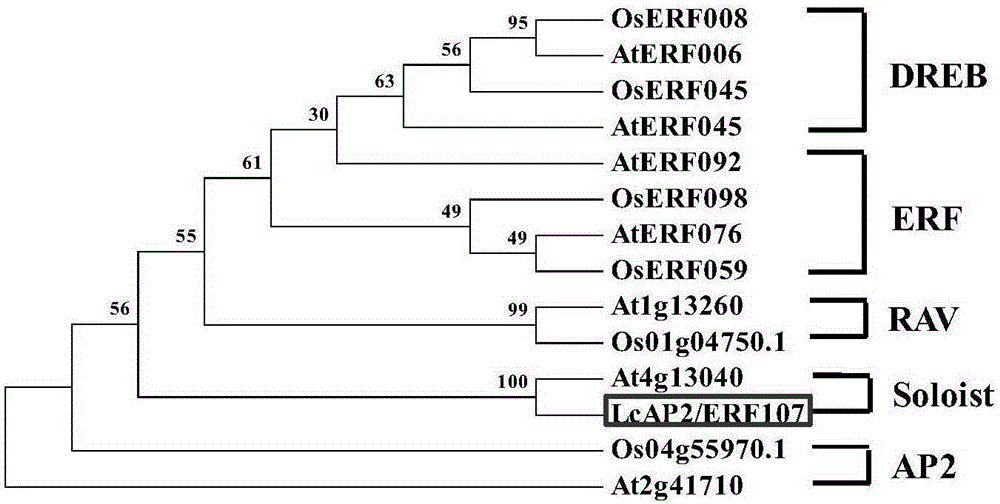
The AP2 / ERF superfamily is divided into five subfamilies: AP2, DREB, ERF, RAV, and Soloist. At present, a large number of literatures have reported the research on the function and molecular mechanism of the DREB and ERF subfamily genes, but the individual subfamily (Soloist) There are few reports in the literature
Method used
the structure of the environmentally friendly knitted fabric provided by the present invention; figure 2 Flow chart of the yarn wrapping machine for environmentally friendly knitted fabrics and storage devices; image 3 Is the parameter map of the yarn covering machine
View more
Image
Smart Image Click on the blue labels to locate them in the text.
Viewing Examples
Smart Image
Click on the blue label to locate the original text in one second.
Reading with bidirectional positioning of images and text.
[0067] 1.1.1 Plant material cultivation and stress treatment
[0068] Use japonicus 'Leo' as the material, select mature and plump seeds that are free from diseases and insect pests, soak them in 2% NaClO for 15-20 minutes, wash them with sterile water for 3 times, dry them, and put the sterilized seeds on the B5 medium , cultured in a light incubator for 30 days, treated with 150mM sodiumchloride for 0h, 3h, 12h, and 24h, collected leaves were immediately frozen in liquid nitrogen, and stored in a -80°C refrigerator for later use.
[0069] Analysis of tissue expression specificity: The roots, stems, leaves, flowers, and seeds of J. japonicus were taken, quick-frozen in liquid nitrogen, and stored at -80°C until use.
[0070] Hormone-treated japonicus japonicus, the seedlings cultivate...
[0131] Arabidopsis thaliana Columbia (Col-0) ecotype: preserved in the inventor's laboratory.
[0132] 1.1.2 Strain and carrier
[0133] Agrobacterium tumefaciens strain GV3101 was preserved in the inventor's laboratory; gateway entry vector pDNOR201 and expression vector pH7WG2D were purchased from Invitrogen.
[0134] 1.1.3 Medium
[0135] (1) YEB medium (1L)
[0136] Peptone 5g, yeast extract 1g, sucrose 5g, MgSO 4 ·7H 2 O0.5g, dilute to 1L with deionized water, if it is a solid medium, add 15g agarpowder, and sterilize under high temperature and high pressure at 121°C for 15min.
the structure of the environmentally friendly knitted fabric provided by the present invention; figure 2 Flow chart of the yarn wrapping machine for environmentally friendly knitted fabrics and storage devices; image 3 Is the parameter map of the yarn covering machine
Login to View More
PUM
Property
Measurement
Unit
Molecular weight
aaaaa
aaaaa
Login to View More
Abstract
The invention discloses a lotus corniculatus AP2 / ERF transcription factor and an encoding gene and application thereof and belongs to the field of AP2 / ERF transcription factors and application. The invention discloses the gene of an AP2 / ERF transcription factor separated from lotus corniculatus. The nucleotide sequence of the gene is shown as SEQ ID NO.1. The amino acid sequence of protein encoded by the gene of the transcription factor is shown as SEQ ID NO.2. The invention further discloses an AP2 / ERF transcription factor structural domain which can be combined with a cis-acting element to start adverse-resistant response gene expression, and the amino acid sequence of the structural domain is shown as SEQ ID NO.3. Function conversion experiments prove that the gene of the AP2 / ERF transcription factor in a plant can improve salt tolerance of the transgenic plant remarkably, and it shows that the protein encoded by the gene of the transcription factor has a function of the AP2 / ERF transcription factor. The gene of the AP2 / ERF transcription factor has an important application prospect in improving resistance of the plant to adversity stress.
Description
technical field [0001] The present invention relates to transcription factors, in particular to an AP2 / ERF transcription factor related to stress resistance isolated from Lotus corniculatus L., and the present invention also relates to the application of said transcription factors in improving plant stress resistance, The invention belongs to the field of AP2 / ERF transcription factor and its application. Background technique [0002] The problems of soil salinization and secondary salinization are widespread in the world, especially in arid and semi-arid areas. Soil drought and salinization seriously hinder the growth of crops and reduce the yield of crops, which have become important factors restricting the sustainable development of irrigated agriculture in the world and affecting the ecological environment. [0003] Lotus corniculatus L. is an excellent perennial leguminous forage widely planted in the world. It has the advantages of rich nutrition, tolerance to barrenne...
Claims
the structure of the environmentally friendly knitted fabric provided by the present invention; figure 2 Flow chart of the yarn wrapping machine for environmentally friendly knitted fabrics and storage devices; image 3 Is the parameter map of the yarn covering machine
Login to View More
Application Information
Patent Timeline
Application Date:The date an application was filed.
Publication Date:The date a patent or application was officially published.
First Publication Date:The earliest publication date of a patent with the same application number.
Issue Date:Publication date of the patent grant document.
PCT Entry Date:The Entry date of PCT National Phase.
Estimated Expiry Date:The statutory expiry date of a patent right according to the Patent Law, and it is the longest term of protection that the patent right can achieve without the termination of the patent right due to other reasons(Term extension factor has been taken into account ).
Invalid Date:Actual expiry date is based on effective date or publication date of legal transaction data of invalid patent.


 Login to View More