Bus bunching predication method based on IC card data

A forecasting method and bus technology, applied in forecasting, data processing applications, traffic control systems for road vehicles, etc., can solve the problems of inconsistent waiting time, low positioning accuracy, large storage space, etc., to achieve low cost and improve travel efficiency. , the effect of high prediction accuracy

CN105206040AActive Publication Date: 2015-12-30BEIHANG UNIV
7 Cites 10 Cited by

Patent Information

Authority / Receiving Office
CN · China
Current Assignee / Owner
Publication Date
2015-12-30

Smart Images

  • Figure 1
    Figure 1
  • Figure 2
    Figure 2
  • Figure 3
    Figure 3
Patent Text Reader

Abstract

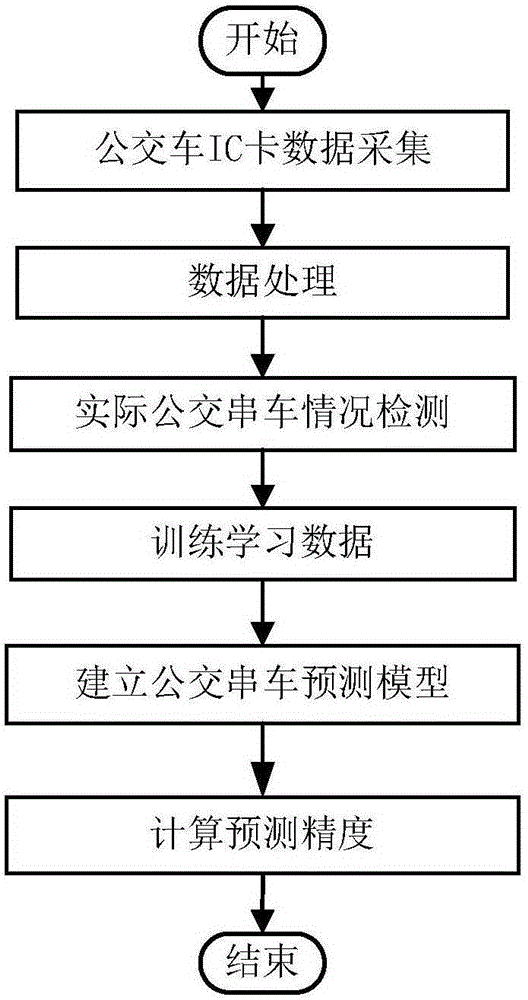
The invention discloses a bus bunching prediction method based on IC card data, and belongs to the technical field of public transport information processing. The prediction method comprises the steps of bus IC card data collection, data processing, practical bus bunching state detection, data training and learning and bus bunching prediction, wherein bus bunching prediction uses a least square support vector machine (LS-SVM) algorithm. IC card data of buses is combined, a lot of passenger information is extracted from multiple buses, a vehicle-mounted GPS system is not needed, operation is convenient and rapid, and the data processing cost is reduced; the LS-SVM algorithm can be used to realize bus bunching prediction more rapidly and more effectively, passengers can better understand operation state of buses and regulate travel time reasonably, and a public transport operation department can adjust the departure interval of buses timely and improve the service level of public transport; and data processing is simple, the cost is low, and the prediction precision is higher.
Need to check novelty before this filing date? Find Prior Art

Description

technical field

[0001] The invention relates to the technical field of public transport information processing, in particular to a bus train prediction method based on IC card data. Background technique

[0002] In the actual bus operation process, due to factors such as traffic congestion, station stop time, and changes in the number of people getting on and off the bus, the arrival of buses is irregular. Especially during peak hours, passengers often wait at the bus station for ten minutes or more without seeing a bus coming, but once they arrive, they find that it is not just one car, but several cars arrive at the same time, and the bus arrives at the same time. Passenger loads tend to be uneven. Reduced bus service levels, causing safety hazards.

[0003] In fact, the delay of a bus at a certain station may lead to an increase in the time it takes to reach the next station, and at the same time cause an increase in the number of passengers and waiting time at the next...

Examples

Embodiment

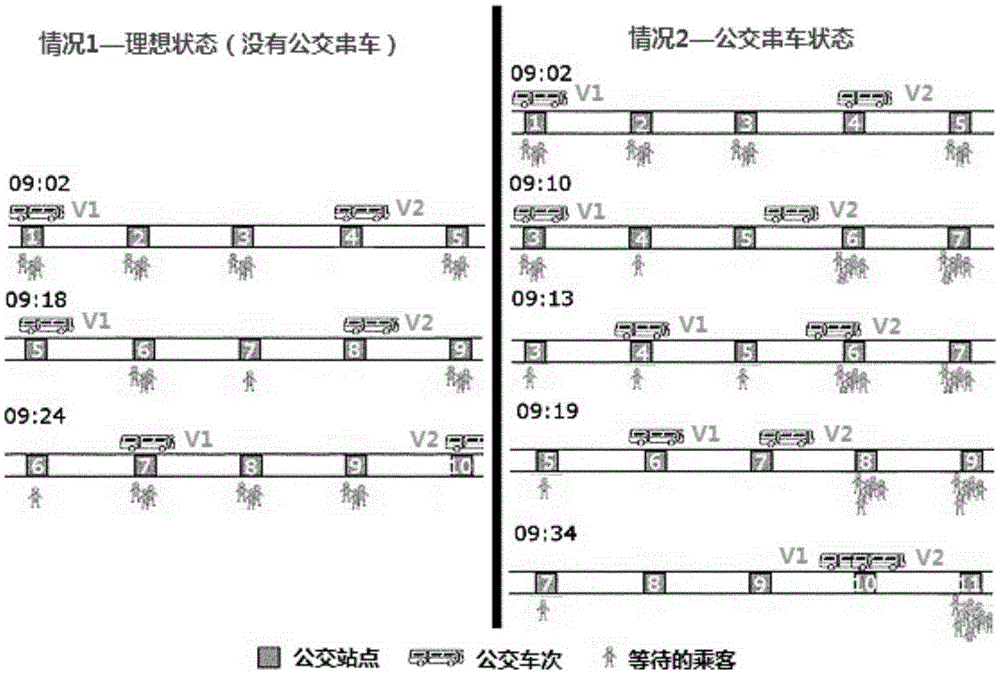
[0049] like figure 1 As shown, two adjacent buses V1 and V2 are divided into two situations in the process of driving on the same line: Situation 1: The ideal state without bus strings: First, at 9:02, the bus V1 and V2 are at the 1st and 4th stations respectively; at 9:18, buses V1 and V2 arrive at the 5th and 8th stations respectively; then at 9:24, V1 arrives at the 7th Station, V2 reached the 10th station. The two buses V1 and V2 have always maintained a distance of about three stops, and the number of passengers waiting at each stop is basically average, and there is no encounter or crossing.

[0050] Situation 2: The status of the bus string: First, at 9:02, buses V1 and V2 are at the first stop and the fourth stop respectively, and the passengers waiting at each stop are basically average; at 9:10, V1 arrives At the 3rd station, V2 arrives between the 5th and 6th stations, the distance between the two buses begins to shorten, V2 travels slowly and arrives at the stati...