
Sparse-representation-LBP-and-HOG-integration-based pedestrian detection method
A sparse representation, pedestrian detection technology, applied in character and pattern recognition, instruments, computer components, etc., can solve the problems of insufficient pedestrian description, high dimension, sparseness, etc., to overcome the lack of description ability, strengthen the description ability, and reduce the dimension. Effect
- Summary
- Abstract
- Description
- Claims
- Application Information
AI Technical Summary
Problems solved by technology
Method used
Image


Examples
specific Embodiment approach
[0061] In order to further illustrate the technical solution of the present invention, in conjunction with the accompanying drawings, the specific implementation of the present invention is as follows:
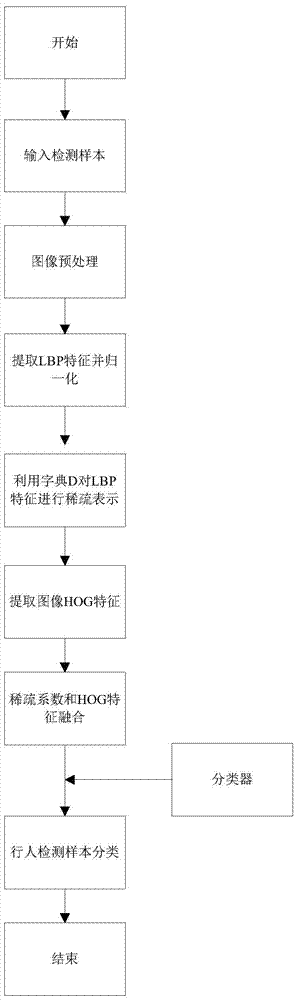
[0062] The invention discloses a pedestrian detection method based on the fusion of sparse representation LBP and HOG. The method first uses training samples to train a classifier model, and then uses the classifier model to identify and detect samples. in:
[0063] like figure 1 As shown, the specific steps of using the training samples to train the classifier model are as follows:
[0064] A1: Input training sample group picture I train ;
[0065] A2: Since the extraction process of LBP features is based on grayscale images, it is judged whether the training sample group pictures are grayscale images, if not, convert them into grayscale images;
[0066] A3: Extract the LBP features of the training sample pictures and perform normalization processing; the specific steps a...
PUM
 Login to View More
 Abstract
Description
Claims
Application Information
 Login to View More