Fluorescent probe based on fluorescence quenching effect of coumarin on NO2, preparation method and application thereof
A fluorescent probe, fluorescence quenching technology, used in fluorescence/phosphorescence, chemical instruments and methods, luminescent materials, etc.
- Summary
- Abstract
- Description
- Claims
- Application Information
AI Technical Summary
Problems solved by technology
Method used
Image

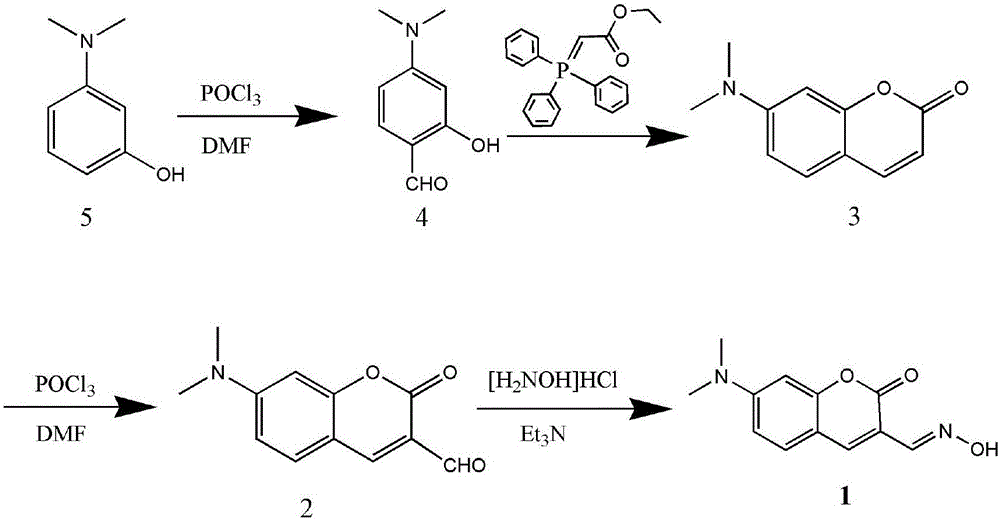


Examples
Embodiment 1
[0026] Example 1 Preparation of 4-N,N-dimethylamino-2-hydroxyl-benzaldehyde
[0027] 3-N,N-Dimethylaminophenol (10.5 g, 0.075 mol) was dissolved in 20 mL of dry DMF, and was added dropwise at room temperature to a mixture of phosphorus oxychloride (8.2 mL, 0.09 mol) and anhydrous DMF (17 mL, 0.22 mol) was added to freshly prepared Vilsmeier Haack reagent, then stirred at room temperature for 20 min, heated to 40° C. for 20 min, and then heated to 80° C. for 30 min. After cooling to room temperature, the reaction mixture was quickly poured into a large amount of ice water, and the above solution was washed with NaHCO 3 After neutralization, the precipitate was collected and filtered, washed with water and dried to obtain 8.8 g of the target product with a yield of 65%.
Embodiment 2
[0028] Example 2 Preparation of 7-N, N-dimethylamino-coumarin
[0029] 4-N,N-Dimethylamino-2-hydroxy-benzaldehyde (5g, 30mmol) and ethyl triphenylphosphinyl acetate (12g, 35mmol) were heated to 180°C for 1h under the protection of argon, then cooled After reaching room temperature, the crude product was separated and purified by silica gel column chromatography to obtain 5.5 g of the target product with a yield of 62%.
Embodiment 3
[0030] Example 3 Preparation of 7-N, N-dimethylamino-3-formyl coumarin
[0031] 7-N,N-Dimethylamino-coumarin (0.75g, 4.0mmol) was dissolved in dry 30mL of DMF, and added dropwise to phosphorus oxychloride (1.8mL, 20mmol) at room temperature and anhydrous DMF (4.0mL, 50mmol) in the newly prepared VilsmeierHaack reagent, then heated to 55°C for 4h, cooled to room temperature and stirred for 12h, then poured the reaction mixture into a large amount of ice water, filtered after standing, and collected the precipitate After drying, 0.30 g of the target product was obtained with a yield of 30%.
PUM
 Login to View More
 Abstract
Description
Claims
Application Information
 Login to View More