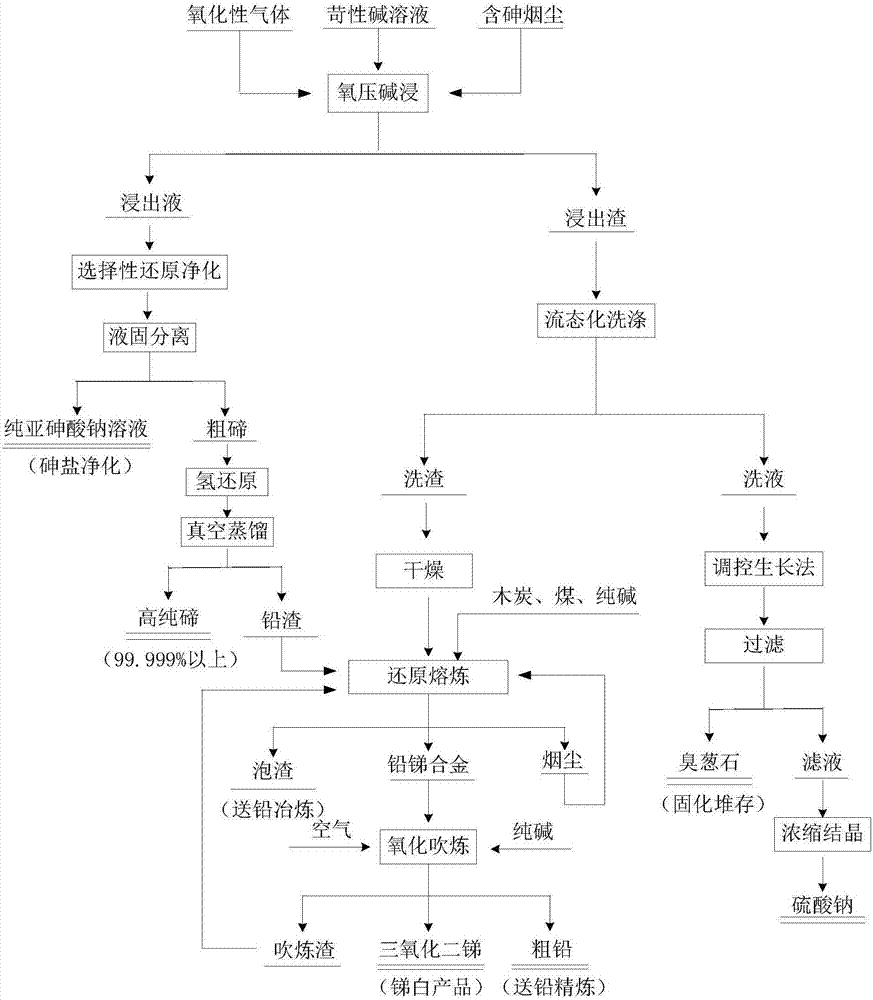
A method for recovering valuable metals from arsenic-containing fumes and harmless disposal of arsenic resources

A technology for valuable metals and arsenic dust, applied in the direction of improving process efficiency, etc., can solve the problems of unrecovered valuable metals, high arsenic content in leaching slag, and low purity, so as to achieve a wide range of raw materials and a high comprehensive utilization rate of resources , the effect of solving the pollution problem

A technology for valuable metals and arsenic dust, applied in the direction of improving process efficiency, etc., can solve the problems of unrecovered valuable metals, high arsenic content in leaching slag, and low purity, so as to achieve a wide range of raw materials and a high comprehensive utilization rate of resources , the effect of solving the pollution problem

CN106834676BActive Publication Date: 2017-11-14CENT SOUTH UNIV

Image

Smart Image Click on the blue labels to locate them in the text.
Viewing Examples
Smart Image
  • A method for recovering valuable metals from arsenic-containing fumes and harmless disposal of arsenic resources

Examples

Experimental program
Comparison scheme
Effect test

Embodiment 1

[0049] Taking arsenic-containing soot from a lead-zinc smelter in China as an example, the main components of the raw materials are Pb 1.57%, As 48.56%, Sn 0.51%, Sb 21.24%, Zn 0.73%, Te 0.35%, Se 0.25%. Take the following steps to process:

[0050] (1) Oxygen pressure leaching of caustic alkali solution: Weigh a certain quality of high arsenic and antimony fume in the reaction kettle, in the liquid-solid volume mass ratio of 10:1, the concentration of sodium hydroxide is 3mol / L, the stirring speed is 300r / min, leaching Leach under the conditions of temperature 160°C, oxygen partial pressure 2Mpa, and leaching time 2h. After leaching, remove the slurry and filter and separate to obtain leaching liquid and leaching residue;

[0051] After testing, the arsenic leaching rate was 41.53%, and the concentration of each element in the leachate was 709.60ppm Pb, 31.02ppm Se, 65.38ppm Sn, 8.20ppm Sb, 123.28ppm Te, and 20.17g / L As.

[0052] (2) Selective reduction purification of leach...

Embodiment 2

[0062] Taking arsenic-containing soot from a lead-zinc smelter in China as an example, the main components of the raw materials are Pb 6.88%, As 36.51%, Sn 1.11%, Sb 29.77%, Zn 0.54%, Te 0.24%, Se 0.05%. Take the following steps to process:

[0063] (1) Oxygen pressure leaching of caustic alkali solution: Weigh a certain quality of high arsenic and antimony fume in the reaction kettle, in the liquid-solid volume mass ratio of 10:1, the concentration of sodium hydroxide is 3mol / L, the stirring speed is 300r / min, leaching Leach under the conditions of temperature 200°C, oxygen partial pressure 1.5Mpa, and leaching time 2.5h. After leaching, remove the slurry and filter and separate to obtain leachate and leach residue;

[0064] After testing, the arsenic leaching rate was 41.29%. The concentration of each element in the leaching solution is 515.20ppm Pb, 31.56ppm Se, 46.27ppm Sn, 9.40ppm Sb, 122.26ppm Te, and 15.07g / L As.

[0065] (2) Selective reduction purification of leachi...

Embodiment 3

[0075] Taking arsenic-containing soot from a lead-zinc smelter in China as an example, the main components of the raw materials are Pb 5.46%, As 30.29%, Sn 0.98%, Sb 29.58%, Zn 0.68%, Te 0.26%, Se 0.07%. Take the following steps to process:

[0076] (1) Oxygen pressure leaching of caustic alkali solution: Weigh a certain quality of high arsenic and antimony fumes in the reaction kettle, and leaching at a liquid-solid volume-to-mass ratio of 15:1, a sodium hydroxide concentration of 3mol / L, and a stirring speed of 400r / min. Leach under the conditions of temperature 180°C, oxygen partial pressure 2Mpa, and leaching time 1.5h. After leaching, remove the slurry and filter and separate to obtain leaching liquid and leaching residue;

[0077] After testing, the arsenic leaching rate was 44.52%, and the concentrations of elements in the leaching solution were Pb 956.35ppm, Se 18.91ppm, Sn 57.12ppm, Sb 9.63ppm, Te 144.92ppm, and As 13.49g / L.

[0078] (2) Selective reduction purificat...

the structure of the environmentally friendly knitted fabric provided by the present invention; figure 2 Flow chart of the yarn wrapping machine for environmentally friendly knitted fabrics and storage devices; image 3 Is the parameter map of the yarn covering machine
Login to View More

PUM

No PUM Login to View More

Abstract

The invention provides a harmless treatment method for recycling valuable metal and arsenic resources from arsenic-containing smoke. All valuable elements are recycled and utilized through the procedures of carrying out oxygen pressure leaching via caustic alkali; carrying out selective reduction purification on leachate; during purification, carrying out hydrogen reduction and vacuum distillation on obtained crude tellurium so as to obtain high-purity tellurium; after purification, obtaining a pure sodium arsenite solution, and using the solution for the arsenic salt purification of a zinc sulfate solution so as to remove cobalt and nickel; carrying out fluidization washing on leaching residues; after washing, solidifying arsenic in the solution, and carrying out reduction smelting on the residues; and carrying out oxidization blowing and the like. The arsenic is removed from the smoke, stibium, lead, bismuth, stannum and the like are kept in the residues from which the arsenic is removed as much as possible, and the deep separation of the arsenic and the stibium is realized. The obtained pure sodium arsenite solution is used for the arsenic salt purification of the zinc sulfate solution used for wet-process zinc smelting so as to remove the cobalt and nickel raw materials, part of sodium arsenate with high impurity content is solidified, the arsenic is precipitated, the harmless recycling of the arsenic resource is realized, and the valuable elements, such as the tellurium, the stibium, the lead and the bismuth are recycled. The comprehensive utilizing rate of the resources is high, the application range of the raw materials is wide, and a pollution problem in the extracting process of a traditional technology is solved.

Description

technical field [0001] The invention belongs to the technical field of nonferrous metallurgy, and in particular relates to a method for recovering valuable metals from arsenic-containing fume and arsenic recycling and harmless disposal. Background technique [0002] In nature, arsenic is usually known as arsenopyrite (FeAsS), arsenopyrhotite (FeAsS 2 ), Arsenite (FeAs 2 ), arsenite (Cu 3 AsS 3 ), realgar (As 2 S 3 ), orpiment (As 2 S 3 ) and other mineral forms, enriched in non-ferrous metal ores such as copper, lead, zinc, nickel, cobalt, gold and silver; in the process of non-ferrous metallurgy, many high-arsenic solid materials are produced, such as roasting and smelting smoke. These materials contain arsenic as high as 5-50%. At the same time, the materials also contain a large amount of valuable metals. If they are directly returned to the smelting process, it will lead to the accumulation of arsenic in the system. Therefore, arsenic removal should usually be tr...

Claims

the structure of the environmentally friendly knitted fabric provided by the present invention; figure 2 Flow chart of the yarn wrapping machine for environmentally friendly knitted fabrics and storage devices; image 3 Is the parameter map of the yarn covering machine
Login to View More

Application Information

Patent Timeline
14 Nov 2017
Publication
CN106834676B
IPC
C22B3/12; C22B13/00; C22B30/02; C22B30/04; C22B25/06; C22B19/30; C22B19/20
CPC
C22B3/12; C22B13/045; C22B19/24; C22B19/30; C22B25/04; C22B25/06; C22B30/02; C22B30/04
Inventors
刘智勇; 刘志宏