
Formaldehyde-free plywood of full-symmetrical structure
A plywood, fully symmetrical technology, used in the bonding of wooden veneers, adhesive application devices, manufacturing tools, etc., can solve problems such as formaldehyde release and plywood deformation
- Summary
- Abstract
- Description
- Claims
- Application Information
AI Technical Summary
Problems solved by technology
Method used
Image

Examples
Embodiment 1
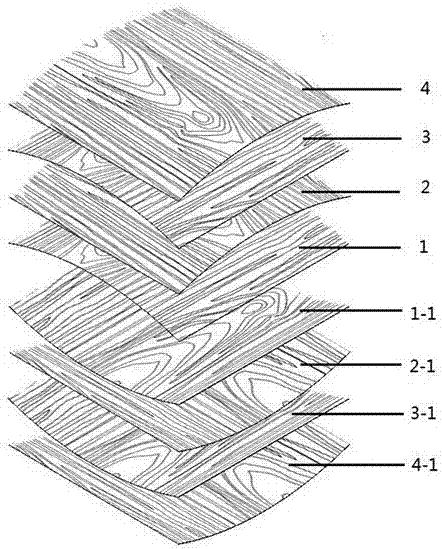
[0016] Embodiment one: if figure 1 As shown, from the center line of the plywood to both sides, layers 1 and 1-1, 2 and 2-1, 3 and 3-1, 4 and 4-1 are respectively arranged, among which 1 and 1-1 are made of the same material and have the same thickness , the wood fibers are in the same direction, and the loose side of the rotary cut veneer is opposite. 2 and 2-1 have the same material, the same thickness, and the wood fibers are in the same direction, and the loose side of the rotary-cut veneer is opposite; the fiber directions of layer 2 and layer 1 are perpendicular to each other.
Embodiment 2
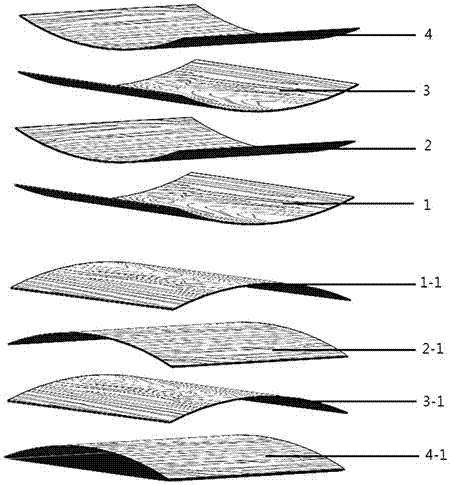
[0017] Embodiment two: if figure 2 As shown, from the center line of the plywood to both sides, layers 1 and 1-1, 2 and 2-1, 3 and 3-1, 4 and 4-1 are respectively arranged, among which 1 and 1-1 are made of the same material and have the same thickness , the wood fibers are in the same direction, and the tight sides of the rotary cut veneer are opposite. 2 and 2-1 have the same material, the same thickness, the wood fibers are in the same direction, and the tight surface of the rotary cut veneer is opposite; the fiber directions of layer 2 and layer 1 are perpendicular to each other.
Embodiment 3
[0018] Embodiment 3: From the center line of the plywood to both sides, layers 1 and 1-1 are made of the same material, have the same thickness, the wood fibers are in the same direction, and the tight surfaces of the rotary-cut veneers are opposite. 2 and 2-1 have the same material, the same thickness, and the wood fibers are in the same direction, and the loose side of the rotary-cut veneer is opposite; the fiber directions of layer 2 and layer 1 are perpendicular to each other.
PUM
 Login to View More
 Abstract
Description
Claims
Application Information
 Login to View More