
Satellite position and speed forecasting method based on GLONASS almanac parameters
A satellite position and parameter technology, applied in the field of satellite position and velocity prediction based on GLONASS almanac parameters, can solve problems such as complex expressions and many calculation steps
- Summary
- Abstract
- Description
- Claims
- Application Information
AI Technical Summary
Problems solved by technology
Method used
Image



Examples
Embodiment Construction
[0044] Examples are given below to describe the present invention in detail.
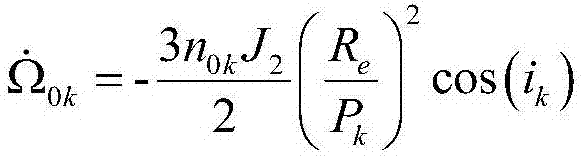
[0045] Based on the special definition of GLONASS almanac parameters, the present invention improves the existing classical GPS user algorithm model in a targeted manner, and provides a satellite position and speed prediction method based on GLONASS almanac parameters, based on the principle of satellite orbit dynamics and satellite position The method of expressing the orbital elements of the velocity, according to the GLONASS almanac parameters (as shown in Table 1), calculate the orbital parameters such as the average angular velocity, the semi-major axis, the deviating anomaly angle, the mean anomaly angle, and the right ascension of the ascending node and their changes at the observation time Rate, and then obtain the latitude angle, latitude angle change rate, radial vector and radial vector change rate at the observation time, from which the position and speed of the satellite in the orbital c...
PUM
 Login to View More
 Abstract
Description
Claims
Application Information
 Login to View More