
Moving Object Stitching Method Based on Single Fixed Camera Image Sequence
A moving target and image sequence technology, applied in the field of occasions, can solve the problems of non-negligible camera translation, inability to match the entire image, and inability to splicing input of image sequences.
Patent Information
- Authority / Receiving Office
- CN · China
- Patent Type
- Patents(China)
- Current Assignee / Owner
- Publication Date
- 2019-10-18
Smart Images
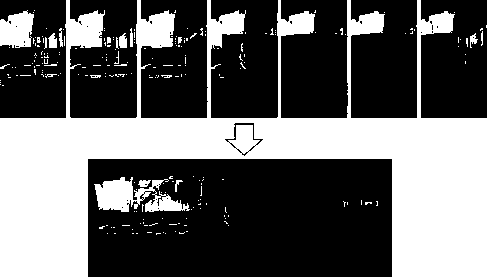
Figure 1 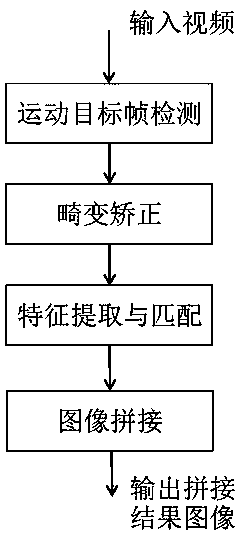
Figure 2 
Figure 3
Abstract
Description
technical field
[0001] The invention relates to a moving target splicing method based on a single fixed camera image sequence, which is suitable for bayonet video monitoring and other occasions. Background technique
[0002] Image mosaic is to combine several partial images with overlapping parts into a large seamless panoramic image. The basic technical route is usually to re-project multiple images onto a common surface after registration, and then fuse the images. To generate a panoramic image, the core technology is image registration and transformation.
[0003] The current relatively mature image stitching technology is to stitch multiple images collected by multiple fixed cameras. The processing process is as follows: (1) extract and match image features, calculate the transformation matrix between adjacent images and Called the homography matrix. (2) Using an iterative algorithm, decompose the internal and external parameter matrices of the cameras corresponding to...
Examples
Embodiment Construction
[0070] The present invention will be further described below in conjunction with the accompanying drawings.
[0071] See attached Figure 1-6 , what the present invention considers is the mosaic of moving object, and mosaic object is the moving object in image sequence (such as figure 1 shown), and therefore the camera translation during the image acquisition process cannot be ignored, and the infinity assumption is not satisfied.
[0072] Due to the above reasons, the key problems to be solved in the present invention are: (1) Distinguish moving frames and still frames in the image sequence, and use moving frames containing moving objects as splicing input. (2) Distinguish the motion area and the still area in the image, and only process the motion area in the image when the image is matched. (3) Considering that the distance between the camera and the target will cause image distortion, the image needs to be corrected for distortion. (4) Select an appropriate image transf...