
Automatic lung medical image segmentation method
An automatic segmentation and medical image technology, applied in image analysis, image enhancement, image data processing, etc., can solve the problems of not giving the outline of the lungs, inaccuracy, etc.
Patent Information
- Authority / Receiving Office
- CN · China
- Current Assignee / Owner
- Publication Date
- 2018-08-28
- Estimated Expiration
- Not applicable · inactive patent
Smart Images
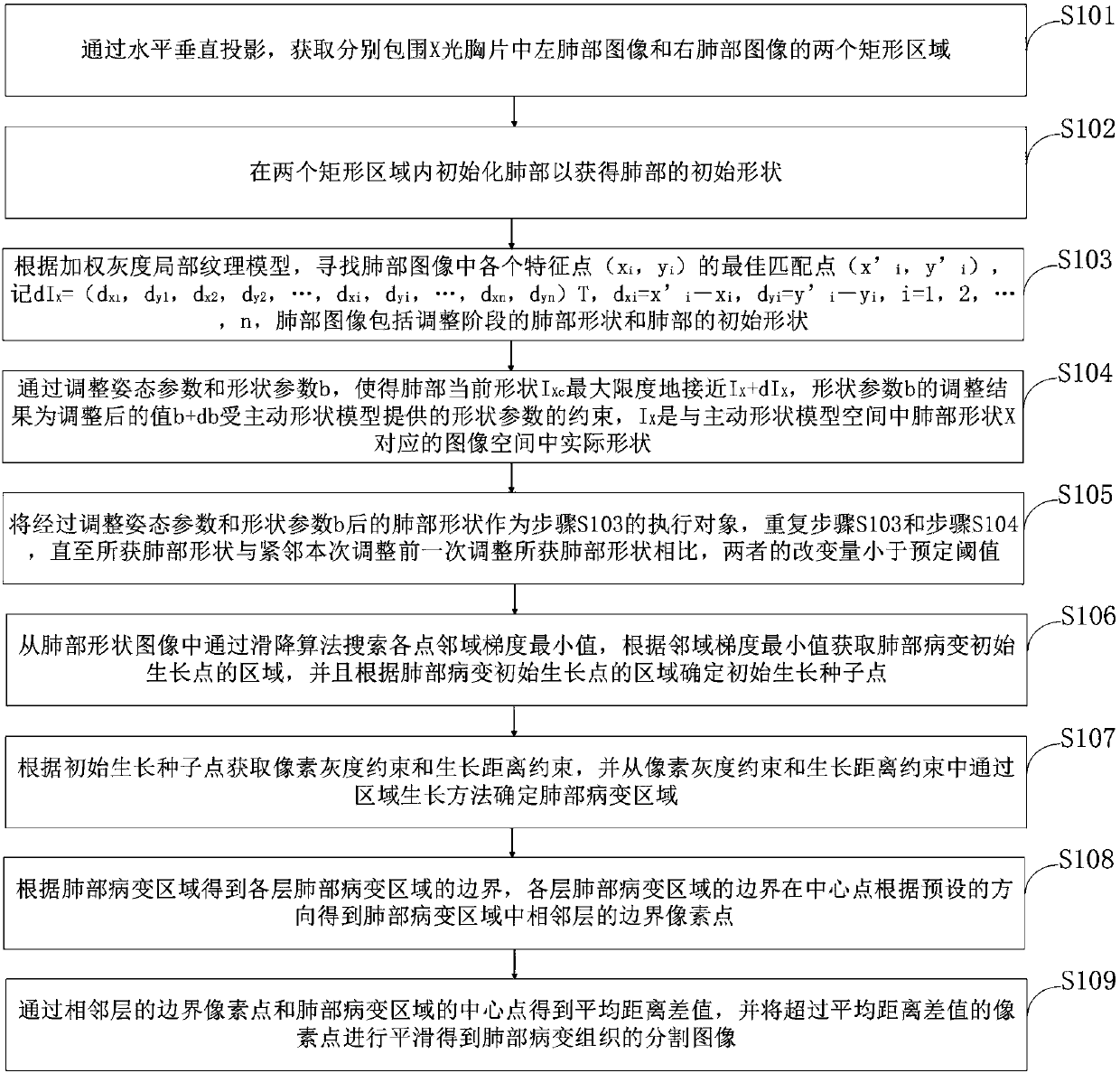
Figure 1 
Figure 2 
Figure 3
Abstract
Description
technical field
[0001] The invention belongs to the technical field of medical image segmentation, in particular to an automatic segmentation method for lung medical images. Background technique
[0002] At present, lung segmentation can be roughly divided into two methods: rule-based reasoning and pixel classification. The methods used by rule-based schemes are (local) thresholding, region growing, edge detection, morphological operations, fitting geometric models and functions, dynamic programming, etc., and most lung region segmentation algorithms fall into this category. Pixel-based classification schemes attempt to classify each pixel in an image into an anatomical type (usually lungs and background, but in some cases more types are used, e.g. also heart, middle diaphragm and diaphragm). The classifiers used are various neural networks or Markov random field models, and various (local) features are used for classification, including grayscale, position, and texture me...
Examples
Embodiment Construction
[0046] In order to make the object, technical solution and advantages of the present invention more clear, the present invention will be further described in detail below in conjunction with the examples. It should be understood that the specific embodiments described here are only used to explain the present invention, not to limit the present invention.
[0047] The application principle of the present invention will be further described below in conjunction with the accompanying drawings.
[0048] like figure 1 As shown, the present invention provides a lung medical image automatic segmentation method comprising the following steps:
[0049] Step S101, through horizontal and vertical projection, obtain two rectangular areas respectively surrounding the left lung image and the right lung image in the X-ray chest film;
[0050] Step S102, initialize the lungs in two rectangular areas to obtain the initial shape of the lungs;
[0051] Step S103, according to the weighted gr...