Check patentability & draft patents in minutes with Patsnap Eureka AI!

A method for recovering palladium from palladium-containing waste catalyst

A waste catalyst and palladium ion technology, applied in the direction of improving process efficiency, can solve the problems of palladium scarce resource waste, complex process flow, environmental pollution, etc., to avoid high energy consumption and environmental pollution, short process flow, and high recovery rate Effect

Active Publication Date: 2020-12-15
CHONGQING UNIVERSITY OF SCIENCE AND TECHNOLOGY
View PDF1 Cites 0 Cited by
  • Summary
  • Abstract
  • Description
  • Claims
  • Application Information

AI Technical Summary

Problems solved by technology

Such a traditional process not only has high energy consumption and complicated process, but more importantly, the recovery rate is low, which causes a serious waste of palladium, a scarce resource, and brings huge losses to the country. At the same time, there is serious environmental pollution.

Method used

the structure of the environmentally friendly knitted fabric provided by the present invention; figure 2 Flow chart of the yarn wrapping machine for environmentally friendly knitted fabrics and storage devices; image 3 Is the parameter map of the yarn covering machine
View more

Image

Smart Image Click on the blue labels to locate them in the text.
Viewing Examples
Smart Image
  • A method for recovering palladium from palladium-containing waste catalyst

Examples

Experimental program
Comparison scheme
Effect test

Embodiment 1

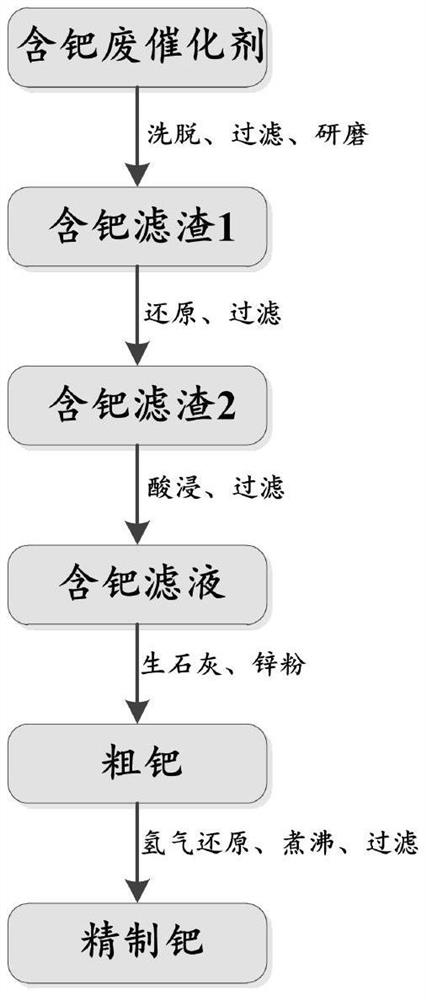
[0023] 100g of palladium-containing waste catalyst was added to a 1000mL flask, and 300mL of a composite solution was added. The composite solution included carbon tetrachloride, ethanol, methanol, petroleum ether, glacial acetic acid, carbon disulfide, chloroform and ether. Each component in the composite solution was added The ratio is the same, washed 3 times for 30 minutes each time; after filtration, the palladium-containing waste catalyst is ground and pulverized into powder with a particle size of 20-200 mesh, and 100 mL of hydrazine hydrate is added to reduce it at 80 ° C for 30 min. Filter, carry out acid leaching of filter residue with 100mL aqua regia for 30min, then add 30g quicklime, 4g zinc powder successively, obtain sponge palladium after passing hydrogen for 10min, finally boil it, filter to obtain refined palladium, and its recovery of palladium The rate reached 99.4%.

Embodiment 2

[0025] 100g of palladium-containing waste catalyst was added to a 1000mL flask, and 300mL of a composite solution was added for washing 3 times for 25 minutes each time. The composite solution included carbon tetrachloride, ethanol, methanol, glacial acetic acid, carbon disulfide, chloroform and ether. The addition ratio of each component in the liquid is the same; after filtration, the palladium-containing waste catalyst is ground and pulverized, and 100 mL of sodium borohydride-methanol solution (mass fraction is 40%) is added to reduce it for 30 min at 80 ° C, and after filtration, The filter residue was subjected to acid leaching with 100 mL of aqua regia for 30 min, then 30 g of quicklime and 5 g of tin powder were added successively, and palladium sponge was obtained after passing in hydrogen for 10 min. Finally, it was boiled and filtered to obtain refined palladium, and its recovery rate to palladium reached 99.2%.

Embodiment 3

[0027] In a 1000mL flask, 100g of palladium-containing waste catalyst was added, and 300mL of a composite solution was added. The composite solution included carbon tetrachloride, ethanol, methanol, carbon disulfide, chloroform and diethyl ether, and each component was added in the same proportion in the composite solution. Washed 3 times for 50 minutes each time; after filtration, the palladium-containing waste catalyst was ground and pulverized, 100 mL of formic acid was added at 80°C, and the mixture was reduced for 30 min. After filtration, the filter residue was acid leached with 100 mL of aqua regia for 30 min. Then 25g of quicklime and 6g of magnesium powder were added successively, the palladium sponge was obtained after passing hydrogen for 20min, and finally it was boiled and filtered to obtain refined palladium, and its recovery rate to palladium reached 99.3%.

the structure of the environmentally friendly knitted fabric provided by the present invention; figure 2 Flow chart of the yarn wrapping machine for environmentally friendly knitted fabrics and storage devices; image 3 Is the parameter map of the yarn covering machine
Login to View More

PUM

PropertyMeasurementUnit
particle size (mesh)aaaaaaaaaa
Login to View More

Abstract

The invention discloses a method for recycling palladium from a palladium-contained waste catalyst. The method comprises following steps that firstly, waste pre-treatment, wherein composite liquid isadopted for eluting the palladium-contained waste catalyst, filtering is carried out, and palladium-contained filter residue is obtained; secondly, palladium formation through palladium oxide reduction, wherein a reducing agent and the palladium-contained filter residue are used for having a reaction, the palladium oxide in the waste residue is reduced into elementary substance palladium; thirdly,acid soluble operation to obtain palladium ions, wherein organic acid haves a reaction with the elementary substance palladium, and an acid solution system existing in a palladium ion state is obtained; fourthly, replacement to obtain palladium, wherein a metal replacement method is adopted to carry out replacement on the palladium ions in the acid solution system, and sponge palladium is obtained; fifthly, palladium refining, wherein hydrogen is further used for reducing the metal palladium, and high-purity metal palladium is obtained. The organic composite liquid is used for eluting the palladium-contained waste catalyst, the problems of high energy consumption and environment pollution in the prior art are solved, the process flow is short, and the problems that in the current palladium recycling technology, energy consumption is high, and the recycling rate is low are solved.

Description

technical field [0001] The invention relates to a method for recovering palladium from a palladium-containing waste catalyst, belonging to the field of precious metal secondary resource recovery and utilization, in particular to a metal palladium recovery method with mild reaction conditions, high recovery rate and low cost. Background technique [0002] As a rare and precious metal, palladium plays the role of catalyst in industrial production, such as plastic electroplating production process, fluorine pyridine, toluene diisocyanate synthesis, terephthalic acid hydrorefining, etc., all use palladium as a catalyst. Since palladium is a precious metal with scarce resources and high price, it is of great significance for how to recover palladium from deactivated catalysts. [0003] At present, the methods for recovering palladium from palladium-containing waste catalysts mainly include incineration method and wet adsorption tower recovery method. Most of these methods have lo...

Claims

the structure of the environmentally friendly knitted fabric provided by the present invention; figure 2 Flow chart of the yarn wrapping machine for environmentally friendly knitted fabrics and storage devices; image 3 Is the parameter map of the yarn covering machine
Login to View More

Application Information

Patent Timeline
no application Login to View More
Patent Type & Authority Patents(China)
IPC IPC(8): C22B11/00C22B7/00
CPCC22B11/048Y02P10/20
Inventor 李敏
Owner CHONGQING UNIVERSITY OF SCIENCE AND TECHNOLOGY
Features
  • R&D
  • Intellectual Property
  • Life Sciences
  • Materials
  • Tech Scout
Why Patsnap Eureka
  • Unparalleled Data Quality
  • Higher Quality Content
  • 60% Fewer Hallucinations
Social media
Patsnap Eureka Blog
Learn More