A photosensitive zr-b-si-c ceramic precursor and its in-situ preparation method
What is AI technical title?
AI technical title is built by Patsnap AI team. It summarizes the technical point description of the patent document.
A ceramic precursor, zr-b-si-c technology, applied in the field of ceramic materials, can solve problems such as high viscosity, complicated process, and instability
Active Publication Date: 2021-09-10
XIAMEN UNIV OF TECH
View PDF4 Cites 0 Cited by
Summary
Abstract
Description
Claims
Application Information
AI Technical Summary
This helps you quickly interpret patents by identifying the three key elements:
Problems solved by technology
Method used
Benefits of technology
Problems solved by technology
The invention solves the problems of high viscosity, low polymerization rate, large thermal stress, complex process and instability caused by the need to add ceramic powder and dispersant in traditional photocurable precursors, and provides a photosensitive photocurable photopolymer suitable for ultra-high temperature ceramic 3D printing. Sensitive Zr-B-Si-C ceramic precursor and its in-situ synthesis method
Method used
the structure of the environmentally friendly knitted fabric provided by the present invention; figure 2 Flow chart of the yarn wrapping machine for environmentally friendly knitted fabrics and storage devices; image 3 Is the parameter map of the yarn covering machine
View more
Image
Smart Image Click on the blue labels to locate them in the text.
Viewing Examples
Smart Image
Click on the blue label to locate the original text in one second.
Reading with bidirectional positioning of images and text.
Smart Image
Examples
Experimental program
Comparison scheme
Effect test
preparation example Construction
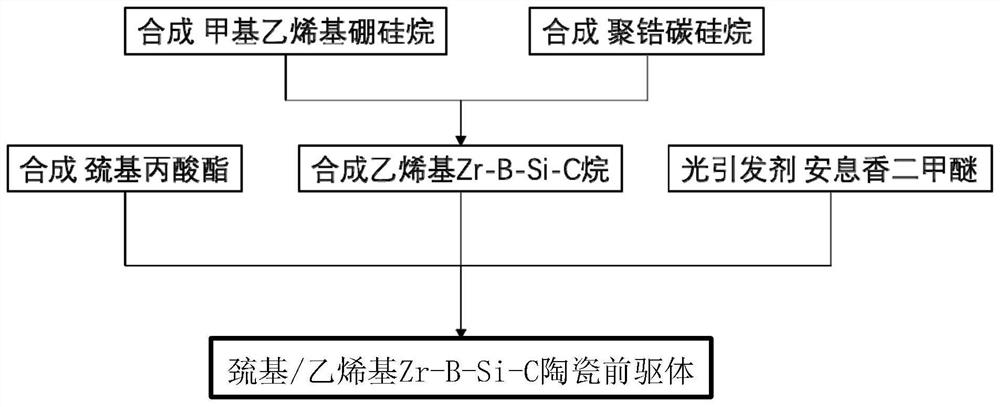
[0026] The present invention provides a kind of preparation method of photosensitive Zr-B-Si-C ceramic precursor in the first aspect, described method comprises the following steps:
[0027] (1) Methyl vinyl dichlorosilane (C 3 h 6 Cl 2 Si) and borane dimethyl sulfide ((CH 3 ) 2 S·BH 3 ) to mix uniformly to obtain the first mixed solution, and then add metal sodium (Na) to the first mixed solution for dechlorination to obtain methylvinyl borosilane; in the present invention, the toluene solution is, for example, toluene standard solution;
[0028] (2) Chloromethyltrichlorosilane (CH 2 Cl 4 Si), Methylchloromethyldichlorosilane (C 2 h 5 Cl 3 Si) and dichlorozirconocene (C 10 h 10 Cl 2 Zr) mix uniformly to obtain a second mixed solution, then add metal magnesium (Mg) to the second mixed solution to carry out the first heat preservation reaction to obtain a reaction solution, then add a reducing agent to the reaction solution to carry out the second heat preservation...
Embodiment 1
[0056] This embodiment provides a preparation method for in-situ synthesis of a photosensitive Zr-B-Si-C ceramic precursor, the preparation method comprising the following steps:
[0057] S1. Melt 13.4g of trimethylolpropane into 100mL of toluene solvent, add 1g of concentrated sulfuric acid as an acidic catalyst; after heating to boiling, add 31.8g of 3-mercaptopropionic acid, fully react, wash with water until neutral, and then distill under reduced pressure to obtain Mercaptopropionate.
[0058] S2, in N 2 Under the protection of an inert gas, dissolve 21.2g of methylvinyldichlorosilane into 100mL of toluene solution, then add 3.8g of borane dimethyl sulfide to obtain the first mixed solution, and then add 6.9 g of metal Na was dechlorinated, and liquid methylvinyl borosilane was obtained after standing at room temperature, extraction, and filtration.
[0059] S3, in N 2 Under inert gas protection, 18.4g (chloromethyl) trichlorosilane (CH 2 Cl 4 Si), 16.4g (chloromethy...
Embodiment 2
[0064] Embodiment 2 is basically the same as Embodiment 1, the difference is:
[0065] In step S5, the amount of benzoin dimethyl ether photoinitiator is 1 mL, that is, the amount of benzoin dimethyl ether is 0.25 wt%.
the structure of the environmentally friendly knitted fabric provided by the present invention; figure 2 Flow chart of the yarn wrapping machine for environmentally friendly knitted fabrics and storage devices; image 3 Is the parameter map of the yarn covering machine
Login to View More
PUM
Login to View More
Abstract
The invention relates to a photosensitive Zr-B-Si-C ceramic precursor and an in-situ preparation method thereof. The method is as follows: mix methyl vinyl dichlorosilane and borane dimethyl sulfide evenly, then add metal sodium for dechlorination to obtain methyl vinyl borosilane; mix chloromethyl trichlorosilane, methyl chloride Methyldichlorosilane and dichlorozirconocene are mixed evenly, then metal magnesium is added for the first heat preservation reaction, and then a reducing agent is added for the second heat preservation reaction to obtain polyzirconium carbosilane; methylvinyl borosilane and polyzirconium Carbosilane is mixed uniformly to obtain vinyl Zr-B-Si-C alkane; vinyl Zr-B-Si-C alkane is mixed with mercaptopropionate evenly, and then a photoinitiator is added to initiate a polymerization reaction to obtain the ceramic Precursor. The invention solves the problems of high viscosity, large thermal stress, and attenuation of mechanical properties of structural parts in traditional light-curing systems, and provides high-quality raw materials for light-curing 3D printing ultra-high temperature ceramic structural parts.
Description
technical field [0001] The invention belongs to the technical field of ceramic materials, and in particular relates to a photosensitive Zr-B-Si-C ceramic precursor and an in-situ preparation method thereof. Background technique [0002] Based on the designability of the chemical composition of the organic polymer precursor, Zr-B-Si-C ceramic materials with specific properties can be customized according to actual application requirements. 2 A new approach to ultra-high temperature ceramic materials. At the same time, with the rapid development of 3D printing technology, this rapid net shape technology can effectively solve the problems of difficult processing of ceramic materials, long preparation cycle, and even the inability to process small and complex structural parts. Based on the particularity of ceramic printing, light curing is the preferred method for ultra-high temperature ceramic 3D printing. It is worth noting that for the precursors suitable for 3D printing of...
Claims
the structure of the environmentally friendly knitted fabric provided by the present invention; figure 2 Flow chart of the yarn wrapping machine for environmentally friendly knitted fabrics and storage devices; image 3 Is the parameter map of the yarn covering machine
Login to View More
Application Information
Patent Timeline
Application Date:The date an application was filed.
Publication Date:The date a patent or application was officially published.
First Publication Date:The earliest publication date of a patent with the same application number.
Issue Date:Publication date of the patent grant document.
PCT Entry Date:The Entry date of PCT National Phase.
Estimated Expiry Date:The statutory expiry date of a patent right according to the Patent Law, and it is the longest term of protection that the patent right can achieve without the termination of the patent right due to other reasons(Term extension factor has been taken into account ).
Invalid Date:Actual expiry date is based on effective date or publication date of legal transaction data of invalid patent.


 Login to View More
  Login to View More