Substrate and liquid crystal display panel

A substrate and overlapping area technology, applied in nonlinear optics, instruments, optics, etc., can solve the problems of high power consumption of display panels and low aperture ratio of display panels, reduce the degree and width of light leakage, and improve transmittance , the effect of reducing the electric field strength

CN110824795AInactive Publication Date: 2020-02-21SHENZHEN CHINA STAR OPTOELECTRONICS SEMICON DISPLAY TECH CO LTD
10 Cites 15 Cited by

Patent Information

Authority / Receiving Office
CN · China
Patent Type
Applications(China)
Current Assignee / Owner
Publication Date
2020-02-21
Estimated Expiration
Not applicable · inactive patent

Smart Images

  • Figure 1
    Figure 1
  • Figure 2
    Figure 2
  • Figure 3
    Figure 3
Patent Text Reader

Abstract

The invention provides a substrate. The substrate comprises a substrate body, a shading metal layer, a signal line layer and a pixel electrode layer. The shading metal layer is located on the substrate and is patterned to form a shielding electrode; the signal line layer is patterned to form a data line; the pixel electrode layer is patterned to form a pixel electrode; and the orthographic projection of the data line on the substrate and the orthographic projection of the shielding electrode on the substrate have an overlapping area. According to the invention, the overlapping area of the shielding electrode and the data line is increased; therefore, the shielding electrode shields the electric field of the data line more, the electric field intensity between the data line and the pixel electrode is reduced, the degree and width of light leakage are both reduced, namely, the width of the light leakage are shielded by a black matrix is reduced, the overlapping area between the black matrix and the pixel electrode is reduced, the aperture ratio f the display panel is improved, the penetration rate of the display panel is increased, and the power consumption of the display panel is reduced.
Need to check novelty before this filing date? Find Prior Art

Description

technical field

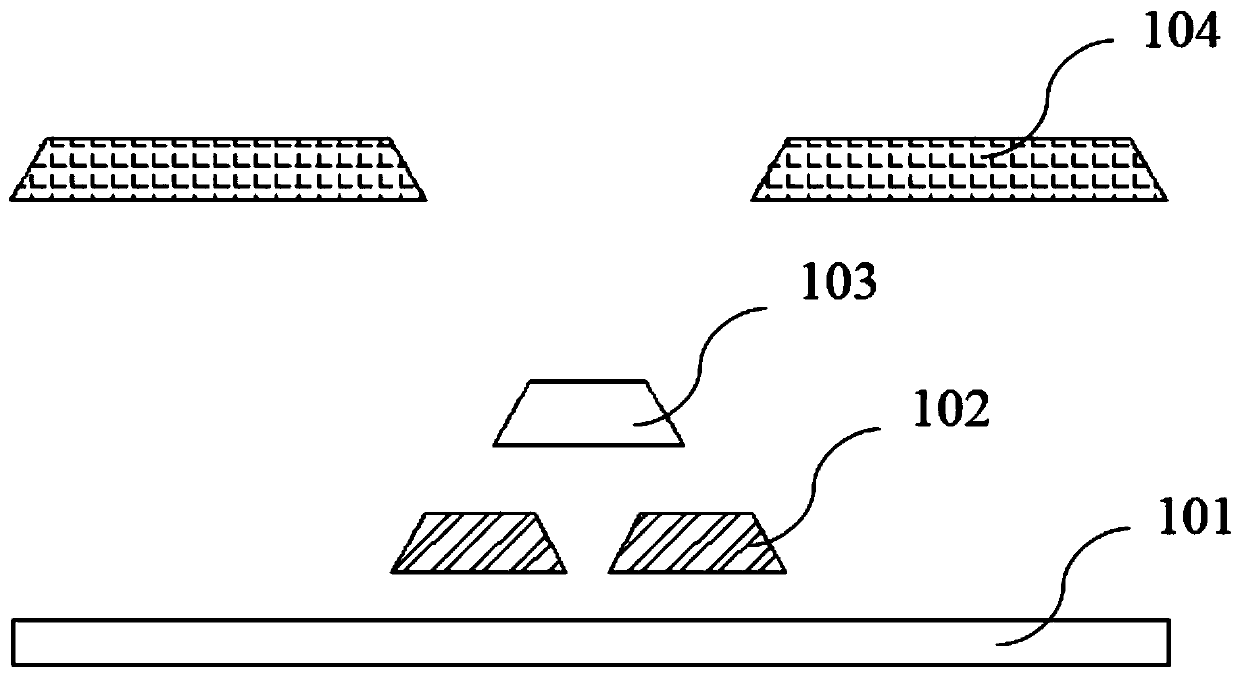
[0001] The invention relates to the field of display technology, in particular to a substrate and a liquid crystal display panel. Background technique

[0002] Thin Film Transistor-Liquid Crystal Display (TFT-LCD) is widely used in mobile phones, tablet computers, TVs and other products. Generally speaking, a liquid crystal display panel is a liquid crystal layer sandwiched between two parallel upper and lower substrates. between them, and apply a voltage to the electrodes of the upper and lower substrates to generate an electric field between the two substrates to control the tilting direction of the liquid crystal molecules in the liquid crystal layer, thereby displaying different pictures. With the increasing acceptance of liquid crystal display devices in the market With the increase, consumers have higher and higher requirements on the quality of liquid crystal display devices, such as viewing angle, contrast ratio, picture response rate, power consumpti...

Examples

Embodiment Construction

[0026] The following will clearly and completely describe the technical solutions in the embodiments of the present invention with reference to the accompanying drawings in the embodiments of the present invention. Obviously, the described embodiments are only some, not all, embodiments of the present invention. Based on the embodiments of the present invention, all other embodiments obtained by those skilled in the art without making creative efforts belong to the protection scope of the present invention.

[0027] Such as figure 1 As shown, the basic structural diagram of the substrate provided by Embodiment 1 of the present invention, from which the various components of the present invention and the relative positional relationship between the various components can be seen intuitively. The substrate includes a substrate 101 , a light-shielding metal layer, a signal line layer, and a pixel electrode layer; the light-shielding metal layer is located on the substrate 101, an...