A method for synthesizing sucrose-6-phosphate by using recombinant high temperature resistant sucrose phosphate synthase
What is AI technical title?
AI technical title is built by Patsnap AI team. It summarizes the technical point description of the patent document.
A phosphate synthase, high-temperature-resistant technology, applied in the field of enzyme engineering, can solve problems such as difficulty in preparation and purification of sucrose-6-phosphate
Active Publication Date: 2021-06-29
NORTHEAST NORMAL UNIVERSITY
View PDF5 Cites 0 Cited by
Summary
Abstract
Description
Claims
Application Information
AI Technical Summary
This helps you quickly interpret patents by identifying the three key elements:
Problems solved by technology
Method used
Benefits of technology
Problems solved by technology
[0003] Currently, sucrose-6-phosphate has not been commercialized worldwide due to the difficulty in its preparation and purification
Method used
the structure of the environmentally friendly knitted fabric provided by the present invention; figure 2 Flow chart of the yarn wrapping machine for environmentally friendly knitted fabrics and storage devices; image 3 Is the parameter map of the yarn covering machine
View more
Image
Smart Image Click on the blue labels to locate them in the text.
Viewing Examples
Smart Image
Click on the blue label to locate the original text in one second.
Reading with bidirectional positioning of images and text.
Smart Image
Examples
Experimental program
Comparison scheme
Effect test
Embodiment 1
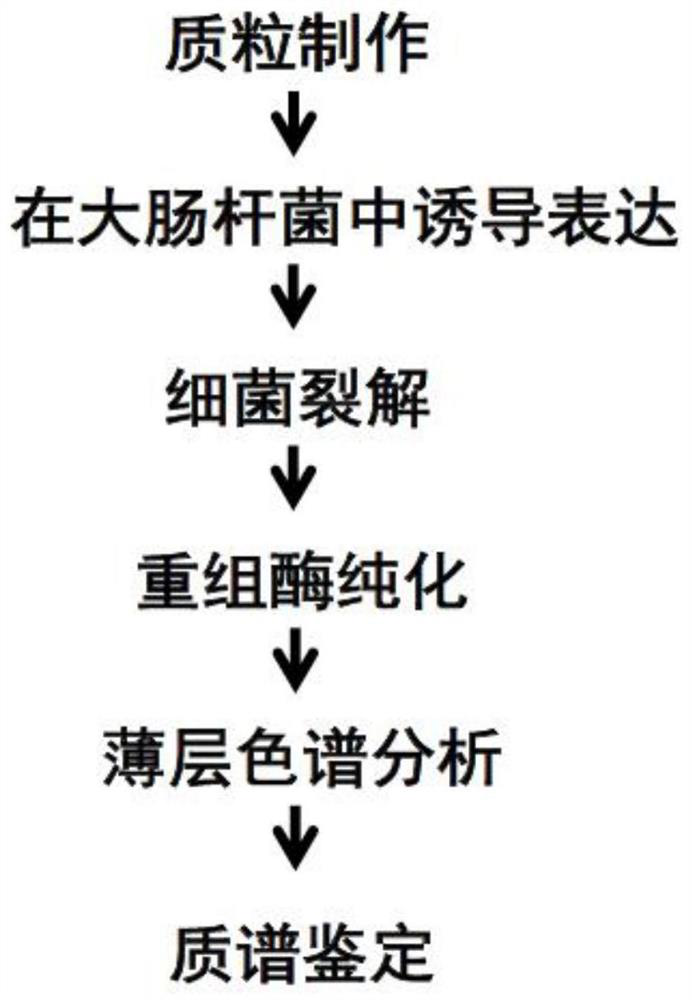
[0059] The preparation of embodiment 1 escherichia coli BL21 (DE3) competent cell
[0060] Shake 4ml of Escherichia coli BL21(DE3) to the exponential growth phase; centrifuge at 10000g for 2min to collect the bacteria; add 1ml of 0.1M calcium chloride to resuspend the cells; centrifuge at 10000g for 2min to collect the bacteria; add 1ml of 0.1M calcium chloride and resuspend Suspend bacteria in ice bath for 45 minutes; heat shock at 42°C for 2 minutes; add LB medium preheated at 37°C and place on a shaker for 1.5 hours; collect bacteria by centrifugation, and spread bacteria on agarose gel containing kanamycin LB board.
Embodiment 2
[0061] Example 2 Cloning of high temperature resistant sucrose phosphate synthase gene, construction of overexpression plasmid, transformation of Escherichia coli BL21 (DE3)
[0062] Insert the gene of high temperature resistant sucrose phosphate synthase (the uniprot database number is tll1590) into the plasmid pET28a, the restriction endonuclease sites are NdeI and XhoI, the end of the cDNA of high temperature resistant sucrose phosphate synthase is added with stop codon TAA, The obtained plasmid was named pET28a_tll1590; 0.1-10 μg of plasmid pET28a_tll1590 was transferred per 0.1 ml of Escherichia coli BL21 (DE3).
Embodiment 3
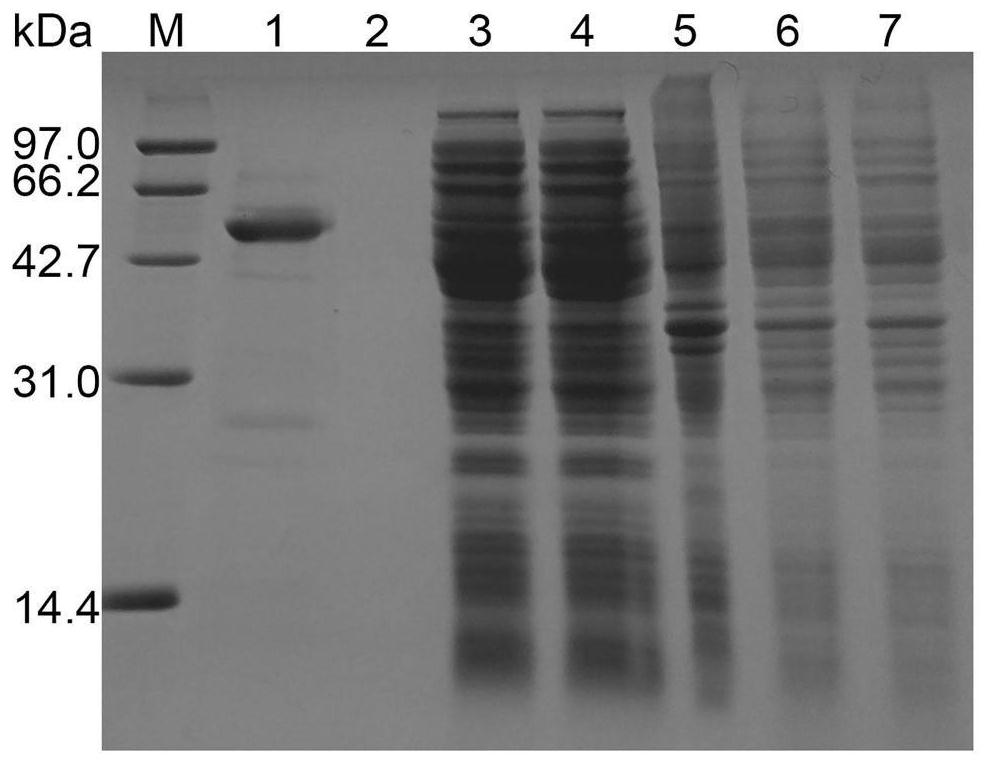
[0063] Example 3 Induced expression and affinity chromatography purification of high temperature resistant sucrose phosphate synthase
[0064] (1) Pick several Escherichia coli colonies, place them in 10ml LB liquid medium, place them in a shaker for culture, the temperature of the shaker is 37°C, and the speed of the shaker is 200rpm, cultivate overnight; expand to 1L LB liquid medium cultured in a shaker, the temperature of the shaker is 37°C, the speed of the shaker is 200rpm, and cultivated to the exponential growth phase; add 0.1-10mM IPTG to induce protein expression, the induction temperature is 37°C, and the induction time is 16h; the next day Bacteria were collected by centrifugation at 5000g;
[0065] (2) Discard the supernatant, add 50ml bacterial lysate (50mM Tris-HCl, pH 8.0, 150mM NaCl and 20mM imidazole), fully suspend the bacteria, ultrasonically lyse the bacteria for 20min, power 30%, turn on for 3 seconds, turn off 3 seconds;
[0066] (3) Centrifuge at 1200...
the structure of the environmentally friendly knitted fabric provided by the present invention; figure 2 Flow chart of the yarn wrapping machine for environmentally friendly knitted fabrics and storage devices; image 3 Is the parameter map of the yarn covering machine
Login to View More
PUM
Login to View More
Abstract
A method for synthesizing sucrose-6-phosphate by using recombinant high-temperature-resistant sucrose-phosphate synthase belongs to the field of enzyme engineering. The invention includes cloning the gene of high-temperature-resistant sucrose-phosphate synthase, constructing an overexpression plasmid, and transforming Escherichia coli BL21 (DE3) Induced expression of high temperature resistant sucrose phosphate synthase, purified by affinity chromatography to obtain recombinant high temperature resistant sucrose phosphate synthase; the recombinant high temperature resistant sucrose phosphate synthase with a concentration of 0.01-10 μg / ml and the fructose-6 with a concentration of 0.1-20 mM -Phosphoric acid and uridine glucose diphosphate at a concentration of 0.1-20mM were reacted at 70°C for 1-24h to obtain sucrose-6-phosphate. The optimum reaction temperature of the recombinant high-temperature-resistant sucrose phosphate synthase is 70°C, and it can withstand a temperature of 100°C. It can maintain enzyme activity at 100°C and catalyze the generation of sucrose-6-phosphate, which is suitable for industrial production of sucrose-6-phosphate phosphoric acid.
Description
technical field [0001] The invention belongs to the technical field of enzyme engineering, and in particular relates to a method for synthesizing sucrose-6-phosphate by using recombinant high-temperature resistant sucrose phosphate synthase. Background technique [0002] Sucrose-phosphate synthase (EC 2.4.1.14) (Sucrose-phosphate synthase, SPS) belongs to GT-B type glycosyltransferase. SPS exists in living organisms such as plants and cyanobacteria. SPS is a key enzyme for the synthesis of sucrose in plants and cyanobacteria, and it is also the rate-limiting enzyme for the synthesis of sucrose. Plants and cyanobacteria can further use sucrose phosphate phosphorylase (SPP) to hydrolyze the phosphate radical on sucrose-6-phosphate to generate sucrose. [0003] At present, due to the difficulty in the preparation and purification of sucrose-6-phosphate, sucrose-6-phosphate has not been commercialized worldwide. Contents of the invention [0004] The purpose of the present ...
Claims
the structure of the environmentally friendly knitted fabric provided by the present invention; figure 2 Flow chart of the yarn wrapping machine for environmentally friendly knitted fabrics and storage devices; image 3 Is the parameter map of the yarn covering machine
Login to View More
Application Information
Patent Timeline
Application Date:The date an application was filed.
Publication Date:The date a patent or application was officially published.
First Publication Date:The earliest publication date of a patent with the same application number.
Issue Date:Publication date of the patent grant document.
PCT Entry Date:The Entry date of PCT National Phase.
Estimated Expiry Date:The statutory expiry date of a patent right according to the Patent Law, and it is the longest term of protection that the patent right can achieve without the termination of the patent right due to other reasons(Term extension factor has been taken into account ).
Invalid Date:Actual expiry date is based on effective date or publication date of legal transaction data of invalid patent.



 Login to View More
  Login to View More