A kind of disperse dye dyeing method of treating cotton fabric by water-based polyurethane
A water-based polyurethane and disperse dye technology, applied in the direction of dyeing, fiber treatment, plant fiber, etc., can solve the problems of low water solubility, difficult to dye with disperse dyes, no affinity for cotton fibers, etc. Performance, Environmentally Friendly Effects
- Summary
- Abstract
- Description
- Claims
- Application Information
AI Technical Summary
Problems solved by technology
Method used
Image

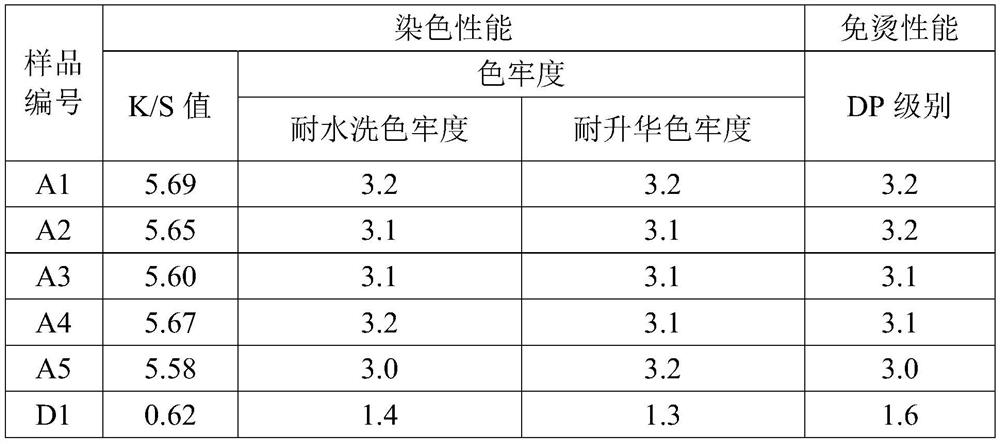
Examples
Embodiment 1
[0046] The cotton fabric was dipped and rolled in the finishing solution twice, so that the liquid carrying rate was 75%, dried at 80°C for 5 minutes, and baked at 160°C for 2 minutes, and then the treated cotton fabric was taken out and washed with water and dried at 80°C. In the finishing solution, the concentration of water-based polyurethane (number average molecular weight is 10000) is 70g / L, the concentration of penetrant NR is 0.6g / L, and the concentration of tetraisobutyl titanate is 25g / L.
[0047] Take 10 parts by weight of the pretreated cotton fabric and add it to the disperse dye formulation, the disperse dye formulation contains 0.2 parts by weight of disperse red dye and 0.02 part by weight of levelling agent, and the bath ratio is 1:20, and the starting time is 1:20. The dyeing temperature is 40°C, and then the temperature is increased at a heating rate of 2°C / min. After the temperature reaches 90°C, the dyeing is incubated for 40 minutes, and then cooled at a c...
Embodiment 2
[0049] The cotton fabric was dipped and rolled in the finishing solution twice, so that the liquid carrying rate was 75%, dried at 80°C for 5 minutes, and baked at 160°C for 2 minutes, and then the treated cotton fabric was taken out and washed with water and dried at 80°C. In the finishing solution, the concentration of water-based polyurethane (number average molecular weight is 8000) is 60g / L, the concentration of penetrant NR is 0.4g / L, and the concentration of zinc naphthenate is 30g / L.
[0050] Get 10 parts by weight of the pretreated cotton fabric and add it to the disperse dye formulation, which contains 0.4 parts by weight of disperse red dye and 0.03 part by weight of leveling agent, and the bath ratio is 1:50. The dyeing temperature is 30°C, and then the temperature is increased at a heating rate of 1°C / min. After the temperature reaches 70°C, the dyeing is maintained for 80 minutes, and then cooled at a cooling rate of 1°C / min. After cooling to 40°C, the cloth is re...
Embodiment 3
[0052] The cotton fabric was dipped and rolled in the finishing solution twice, so that the liquid carrying rate was 75%, dried at 80°C for 5 minutes, and baked at 160°C for 2 minutes, and then the treated cotton fabric was taken out and washed with water and dried at 80°C. In the finishing solution, the concentration of water-based polyurethane (number average molecular weight is 15000) is 80g / L, the concentration of penetrant NR is 0.8g / L, and the concentration of iron octoate is 20g / L.
[0053] Take 10 parts by weight of the pretreated cotton fabric and add it to the disperse dye preparation, which contains 0.5 parts by weight of disperse red dye and 0.015 parts by weight of leveling agent, and the bath ratio is 1:10, and the starting time is 1:10. The dyeing temperature is 60°C, and then the temperature is raised at a heating rate of 1.5°C / min. After the temperature reaches 100°C, the dyeing is maintained for 40 minutes, and then cooled at a cooling rate of 1.5°C / min. After...
PUM
| Property | Measurement | Unit |
|---|---|---|
| concentration | aaaaa | aaaaa |
Abstract
Description
Claims
Application Information
 Login to View More
PatSnap Eureka turns technology decisions into work you can execute. Powered by our Innovation Knowledge Graph, it runs expert workflows across engineering, life sciences, materials and intellectual property. Get your review-ready output in minutes.


