
Application of gene os11g0682000 and its encoded protein in regulating rice bacterial blight resistance
A technology for resistance to bacterial blight and bacterial blight of rice, which can be applied in the fields of application, genetic engineering, plant genetic improvement, etc., and can solve the problems of narrow resistance spectrum, easy mutation of pathogenic varieties, and easy loss of variety resistance.
- Summary
- Abstract
- Description
- Claims
- Application Information
AI Technical Summary
Problems solved by technology
Method used
Image

Examples
Embodiment 1
[0091] Example 1. Method for knocking out rice gene Os11g0682000 based on pYLCRISPR / Cas9 system
[0092] 1. Sequence analysis and target sequence screening of rice gene Os11g0682000
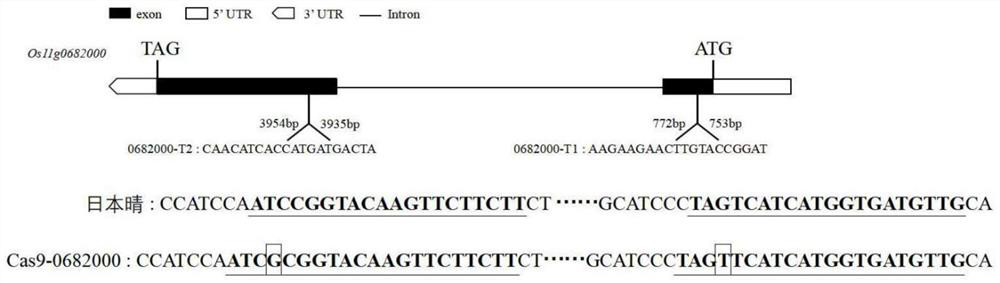
[0093] The nucleotide sequence of the rice gene Os11g0682000 is shown in SEQ ID No.2, and the amino acid sequence of the encoded protein is SEQ ID No.1. Sequence analysis shows that the gene includes 2 exons in total, which are No. 636-1680 (first exon) and No. 4346-6198 (second exon) of SEQ ID No. 2, respectively.
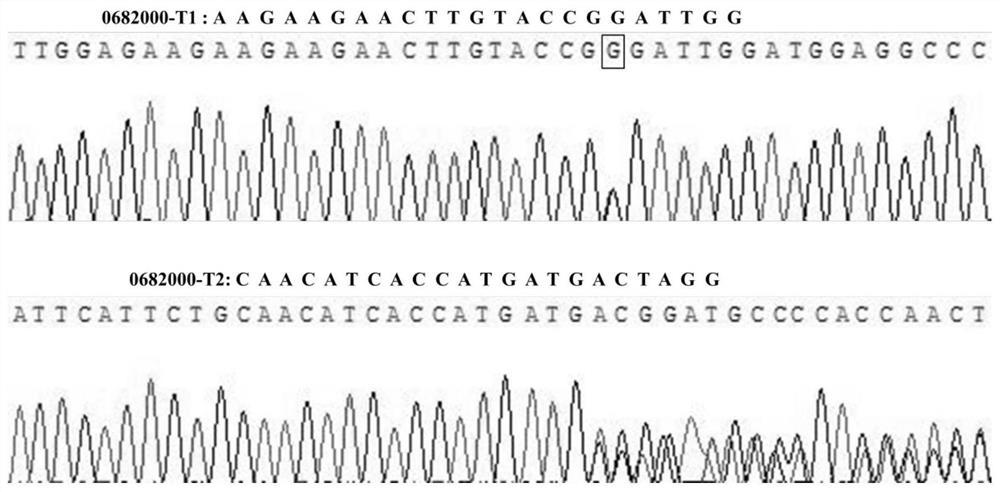
[0094] In the present invention, the sequence on the first exon of the rice gene Os11g0682000 is used as the 0682000-T1 target sequence of the rice gene Os11g0682000 targeted knockout method based on the pYLCRISPR / Cas9 system, and the sequence on the second exon of the rice gene Os11g0682000 is used as the target sequence based on pYLCRISPR The 0682000-T2 target sequence of the rice gene Os11g0682000 site-directed knockout method of the / Cas9 system.
[0095] After a large number o...
Embodiment 2
[0120] Example 2. Application of pYLCRISPR / Cas9 technology-based targeted knockout method in rice varieties
[0121] 1. pYLCRISPR / Cas9 technology targeted knockout of Os11g0682000 gene
[0122] The recombinant Agrobacterium EH105-Cas9-0682000 was used to infect the callus induced by wild-type Nipponbare mature embryos, and the obtained rice transformed plants were respectively named NIP-Cas9-0682000; the specific methods of the experiment are as follows:
[0123] 1. The recombinant Agrobacterium EH105-Cas9-0682000 obtained in Example 1 was inoculated in YEB liquid medium (containing 50 μg / ml kanamycin and 20 μg / ml rifampicin), and cultured with shaking at 28°C and 200rpm until OD600 is 0.6-0.8; centrifuge at 5000rpm, 4°C for 5min, and resuspend the bacterial pellet in AAM liquid medium (acetosyringone concentration is 200μM / L, pH 5.2) until the OD600 is 0.6-0.8.
[0124] 2. Remove the glumes from the mature seeds of wild-type Nipponbare, soak them in 75% ethanol for 1 min, th...
PUM
| Property | Measurement | Unit |
|---|---|---|
| length | aaaaa | aaaaa |
| length | aaaaa | aaaaa |
Abstract
Description
Claims
Application Information
 Login to View More