Visual SLAM method based on semantic optical flow and inverse depth filtering

A deep filtering and semantic technology, which is applied in the direction of character and pattern recognition, 2D image generation, and extraction from basic elements, etc., can solve the problem that the visual positioning system is susceptible to interference, achieve good performance, excellent precision, and improve calculation accuracy Effect

CN111311708AActive Publication Date: 2020-06-19BEIHANG UNIV
7 Cites 5 Cited by

Patent Information

Authority / Receiving Office
CN · China
Patent Type
Applications(China)
Current Assignee / Owner
Publication Date
2020-06-19

Smart Images

  • Figure 1
    Figure 1
  • Figure 2
    Figure 2
  • Figure 3
    Figure 3
Patent Text Reader

Abstract

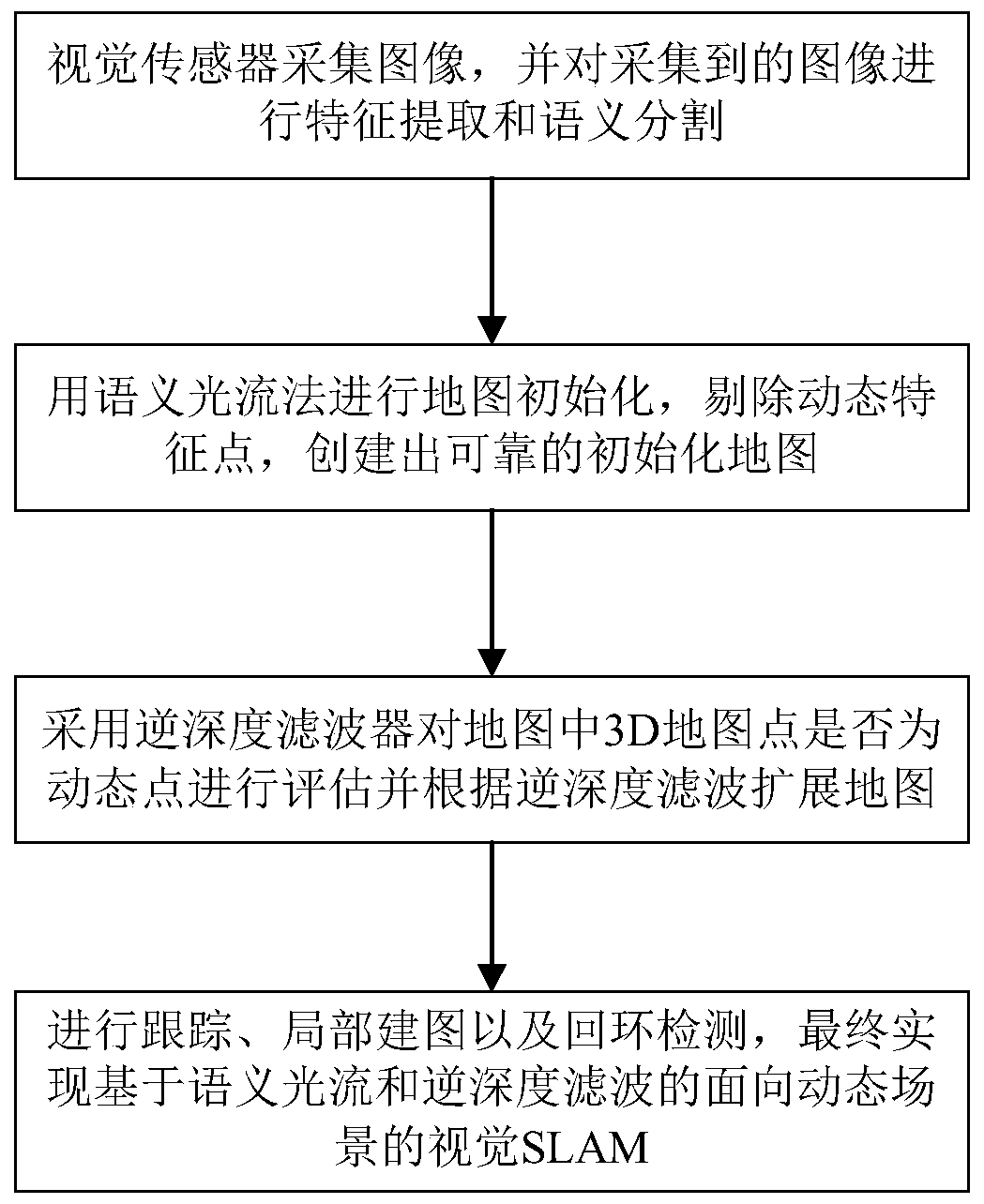
The invention relates to a visual SLAM method based on semantic optical flow and inverse depth filtering, and the method comprises the following steps: (1) a visual sensor collects an image, carries out the feature extraction and semantic segmentation of the collected image, and obtains extracted feature points and a semantic segmentation result; and (2) according to the feature points and a segmentation result, performing map initialization by using a semantic optical flow method, removing dynamic feature points, and creating a reliable initialization map; and (3) evaluating whether 3D map points in the initialized map are dynamic points or not by adopting an inverse depth filter, and expanding the map according to an evaluation result of the inverse depth filter. And (4) continuing to perform tracking, local mapping and loopback detection in sequence for the map expanded by the depth filter, and finally realizing dynamic scene-oriented visual SLAM based on semantic optical flow and inverse depth filtering.
Need to check novelty before this filing date? Find Prior Art

Description

technical field

[0001] The present invention relates to a visual SLAM method based on semantic optical flow and inverse depth filtering, which is a new visual SLAM method that combines semantic optical flow and inverse depth filtering technology, and is suitable for solving the problem of traditional visual SLAM systems in high dynamic scenes Failure and lack of understanding of the scene. Background technique

[0002] Simultaneous Localization and Mapping (SLAM) refers to the estimation of the pose of the robot itself through the acquired sensor data without the prior information of the environment, and at the same time constructing a globally consistent environment map. Among them, the SLAM system based on visual sensors is called visual SLAM. Because of its low hardware cost, high positioning accuracy, and the advantages of completely autonomous positioning and navigation, this technology has attracted wide attention in the fields of artificial intelligence and virtual re...

Examples

Embodiment Construction

[0034] The technical solutions in the embodiments of the present invention will be clearly and completely described below in conjunction with the accompanying drawings in the embodiments of the present invention. Obviously, the described embodiments are only part of the embodiments of the present invention, not all of them. Based on the embodiments of the present invention, all other embodiments obtained by persons of ordinary skill in the art without making creative efforts belong to the protection scope of the present invention.

[0035] like figure 1 Shown, the concrete realization steps of the present invention are as follows:

[0036] Step 1. The image data collected by the sensor will be obtained, image feature points will be extracted, and the RGB image of the current frame will be semantically segmented using the SegNet semantic segmentation network. Feature points are classified into static, latent dynamic and dynamic categories by semantic information. Among them, ...