Supercharge Your Innovation With Domain-Expert AI Agents!

A cell electrochemical sensor based on 3D printing technology and its application

A 3D printing and electrochemical technology, which is applied in the field of cell electrochemical sensors, can solve the problems of poor detection accuracy and uneven distribution of sensors, and achieve the effects of small sample requirements, avoiding cross-contamination, and fast detection speed

Active Publication Date: 2021-06-25
JIANGNAN UNIV
View PDF5 Cites 0 Cited by
  • Summary
  • Abstract
  • Description
  • Claims
  • Application Information

AI Technical Summary

Problems solved by technology

The current patent (CN 107219274B) discloses a method for preparing a cell electrochemical sensor for analyzing the combined toxicity of mycotoxins. Specifically, laminin is fixed on the electrode surface, and then the cells are seeded on the electrode surface, and rat tail collagen is added dropwise to form a 3D sensor. Stereocomplexes fix cells to obtain cell sensors, and the sensors prepared in this way may have problems of uneven distribution and poor detection accuracy

Method used

the structure of the environmentally friendly knitted fabric provided by the present invention; figure 2 Flow chart of the yarn wrapping machine for environmentally friendly knitted fabrics and storage devices; image 3 Is the parameter map of the yarn covering machine
View more

Image

Smart Image Click on the blue labels to locate them in the text.
Viewing Examples
Smart Image
  • A cell electrochemical sensor based on 3D printing technology and its application
  • A cell electrochemical sensor based on 3D printing technology and its application
  • A cell electrochemical sensor based on 3D printing technology and its application

Examples

Experimental program
Comparison scheme
Effect test

Embodiment 1

[0061] Example 1 Preparation of cell electrochemical sensor

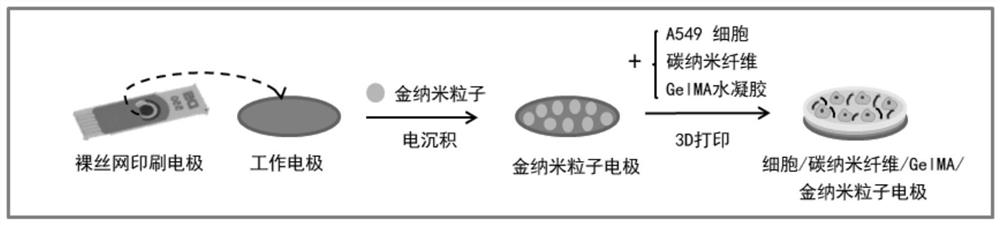
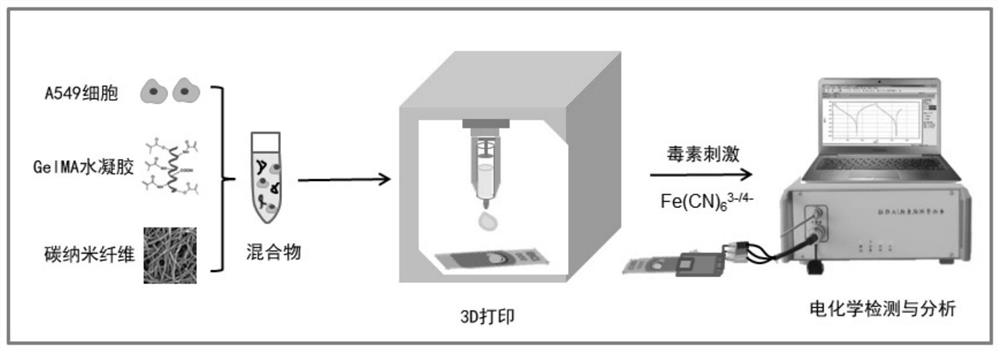
[0062] A method for constructing cell electrochemical sensors based on 3D printing technology (such as figure 2 shown), including the following steps:

[0063] (1) Preparation of photosensitive methacryloyl gelatin (GelMA) solution: Take the LAP initiator and add it to DMEM cell culture medium to make the final concentration 0.5%, and then dissolve it in a water bath at 60°C for 30 minutes in the dark to obtain the dissolved solution. Standard initiator solution; add the GelMA material in the dissolved standard initiator solution, and dissolve it in the dark for 30 minutes in a water bath at 60° C., and shake it 3 times during the period to obtain the GelMA solution (mass concentration is 7.5%); then the obtained GelMA solution Use a 0.22μm sterile filter membrane to filter into a clean container for use.

[0064] (2) Preparation of cell / carbon nanofiber / GelMA composite hydrogel: add a certain amount of carbon na...

Embodiment 2

[0070] Example 2 Application of cell electrochemical sensor based on 3D printing technology

[0071] The electrochemical sensor after incubation obtained in Example 1 was evaluated for the cytotoxicity of deoxynivalenolium family toxins, specifically as follows:

[0072] (1) Drug stimulation: Remove the original culture medium on the working electrode, dilute the toxin standard substance with DMEM cell culture medium into a gradient concentration solution, and then take 150 μL DON and 15-ADON at 0.1, 0.2, 0.5, 1, 2 , 5ug / mL concentration range and DON+15-ADON toxin solution in the concentration range of 0.1+0.1, 0.2+0.2, 0.5+0.5, 1+1, 2+2, 5+5ug / mL are dropped on the printing work with cells On the electrode, place it in an incubator for 24 hours to measure the corresponding impedance value.

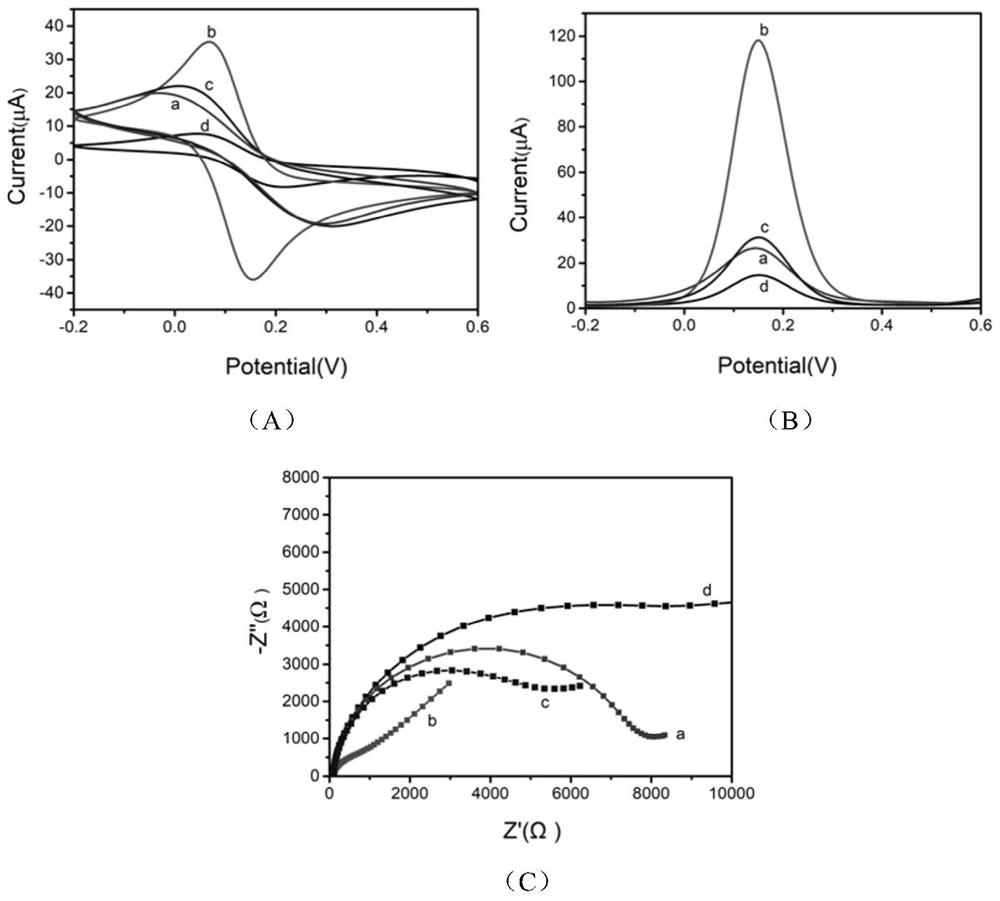
[0073] (2) Electrochemical signal value detection: use 150μL 2.5mM The PBS solution was used as the electrode reaction system, and the frequency range of the electrochemical impedance...

Embodiment 3

[0086] Embodiment 3 verification experiment

[0087] The CCK8 method was used to detect the cytotoxicity of DON, 15-ADON and DON+15-ADON alone and in combination: the density was 5×10 4 / mL lung cancer cells A549 were adherently inoculated into a 96-well plate, and after 24 hours of culture, the culture medium was removed, and 100 μL of the toxin solution at the same dose as in Example 2 was added. After 24 hours of toxin stimulation, aspirate the supernatant and add 100 μL of culture solution containing 10% CCK8 to each well, incubate at 37°C for 2 hours, then measure the absorbance value at 450 nm with a microplate reader, and calculate the inhibition rate of cell activity. The calculation method is as follows:

[0088]

[0089] Among them, OD 加药 : Absorbance value after toxin stimulation for 24h, OD 0加药 : Absorbance value after 24h stimulation without toxin, OD 空白 : Absorbance value of pure cell culture solution.

[0090] Depend on Figure 5 It can be seen that the ...

the structure of the environmentally friendly knitted fabric provided by the present invention; figure 2 Flow chart of the yarn wrapping machine for environmentally friendly knitted fabrics and storage devices; image 3 Is the parameter map of the yarn covering machine
Login to View More

PUM

No PUM Login to View More

Abstract

The invention discloses a cell electrochemical sensor based on 3D printing technology and an application thereof, belonging to the technical field of electrochemical sensors and toxin detection. The cell electrochemical sensor of the present invention is constructed based on 3D printing technology, and the construction method includes the following steps: accurately depositing the cell / carbon nanofiber / GelMA composite hydrogel on the working electrode of the screen printing electrode through 3D printing, After curing, the cell electrochemical sensor is obtained. The invention constructs a three-dimensional cell growth environment and a fast and sensitive cell electrochemical sensor. The cell electrochemical sensor constructed in the present invention can quickly and effectively judge the type and degree of combined action of deoxynivalenolium family toxins by combining the electrochemical impedance method and the combined index method.

Description

technical field [0001] The invention relates to a cell electrochemical sensor based on 3D printing technology and its application, belonging to the technical field of electrochemical sensors and toxin detection. Background technique [0002] 3D printing technology is a computer-aided technology that produces engineered tissues in a mechanized, organized and optimized manner. It can assemble tissues by precisely positioning biological materials and living cells layer by layer, and has the ability to control space. 3D printing can be used not only to make basic arrays, but also to develop more complex arrays by setting different dwell times or repeating specific G-codes without making special molds or masks, which enables a series of specific drug screening requirements On-demand bioprinting of 3D tumor array chips for rapid drug screening becomes possible. [0003] For a long time, the pollution of mycotoxins in food and feed has been serious. The annual loss of food and fee...

Claims

the structure of the environmentally friendly knitted fabric provided by the present invention; figure 2 Flow chart of the yarn wrapping machine for environmentally friendly knitted fabrics and storage devices; image 3 Is the parameter map of the yarn covering machine
Login to View More

Application Information

Patent Timeline
no application Login to View More
Patent Type & Authority Patents(China)
IPC IPC(8): G01N27/327G01N27/30G01N27/416G01N27/48B29C64/135B29C64/209B29C64/314B29C64/321B29C64/393B33Y10/00B33Y30/00B33Y40/00B33Y40/10B33Y50/02B33Y70/10
CPCG01N27/3278G01N27/308G01N27/48G01N27/416B29C64/135B29C64/209B29C64/314B29C64/321B29C64/393B33Y10/00B33Y30/00B33Y40/10B33Y40/00B33Y50/02B33Y70/10B33Y80/00B29C64/106B29K2089/00B29K2105/124B29K2307/04G01N33/5014
Inventor 孙秀兰韦凯敏孙嘉笛纪剑张银志
Owner JIANGNAN UNIV
Features
  • R&D
  • Intellectual Property
  • Life Sciences
  • Materials
  • Tech Scout
Why Patsnap Eureka
  • Unparalleled Data Quality
  • Higher Quality Content
  • 60% Fewer Hallucinations
Social media
Patsnap Eureka Blog
Learn More