
Lactic acid bacteria strains capable of inhibiting multiple drug-resistant food-borne pathogenic bacteria in broad-spectrum manner and application of lactic acid bacteria strains
A technology of food-borne pathogenic bacteria and multi-drug resistant bacteria, applied in the field of microbiology, can solve the problems of less research on lactic acid bacteria, achieve good antibacterial effect, rich resource pool, and broad application prospects
- Summary
- Abstract
- Description
- Claims
- Application Information
AI Technical Summary
Problems solved by technology
Method used
Image

Examples
Embodiment 1
[0022] Isolation and screening of embodiment 1 lactic acid bacteria
[0023] 1. Preliminary screening of lactic acid bacteria
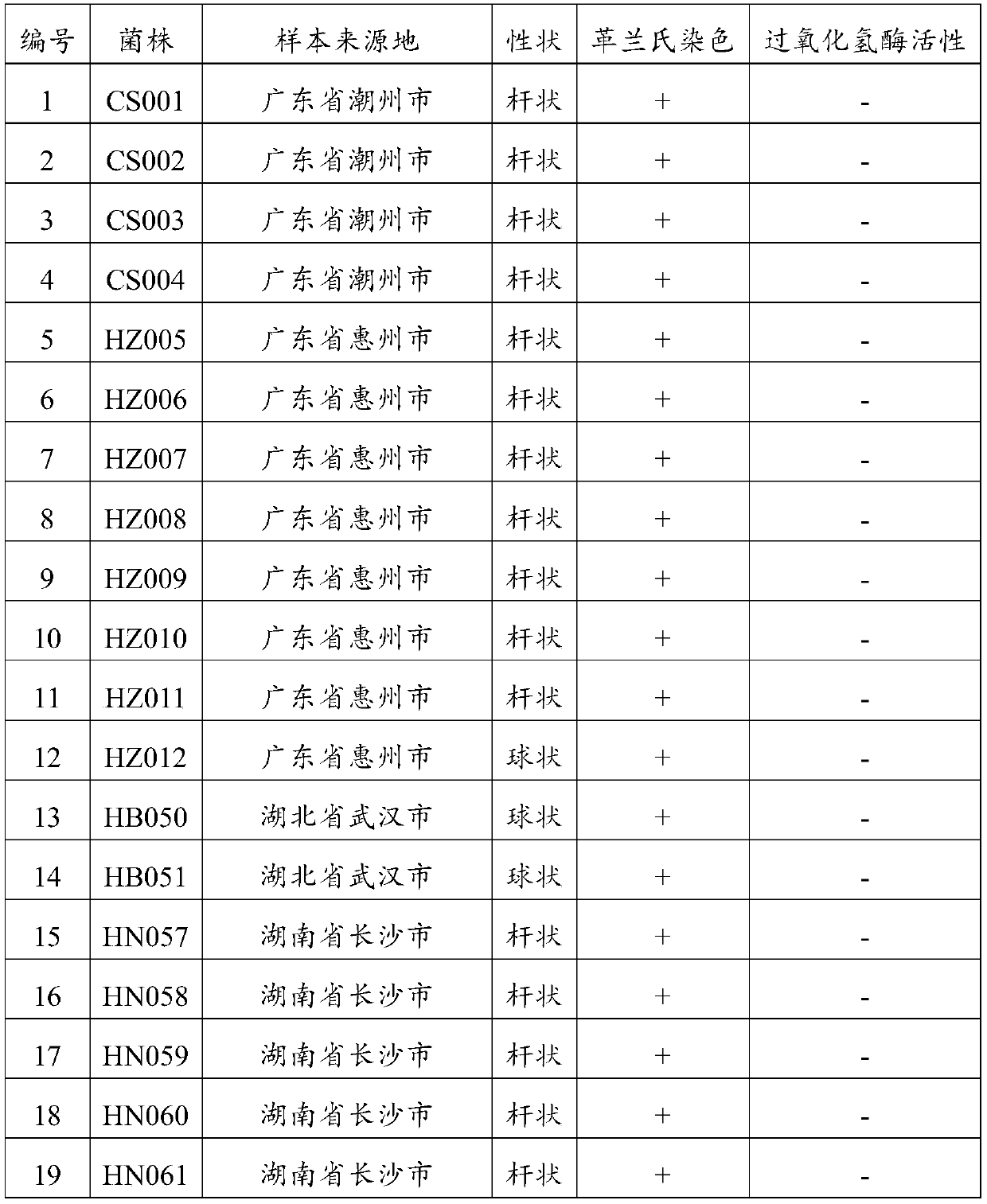
[0024] Collect homemade kimchi as samples, immerse each sample in 100mL MRS broth medium, enrich and culture at 37°C for 24 hours, and inoculate them in MRS solid medium after 10-fold serial dilution, and culture them anaerobically at 37°C for 48 hours , pick the typical colonies on the plate, separate them by streaking to obtain pure colonies, and carry out microscopic examination, Gram staining and catalase activity test. The purified strains were stored in a -80°C refrigerator.
[0025] A total of 63 suspected strains were screened, among which the results of Gram staining were positive and the results of catalase activity test were negative. The results are shown in Table 1 ("+" is positive, "-" is negative).
[0026] Table 1 Screening results of lactic acid bacteria
[0027]
[0028]
[0029]
[0030] 2. Screening of acid-resistant a...
Embodiment 2
[0061] Identification of embodiment 2 lactic acid bacteria
[0062] (1) API identification
[0063] The strains GS083, GS086, GS090 and GF110 were identified using API50CHL series identification reagent strips, and the identification results are shown in Table 6 ("+" indicates positive, "-" indicates negative, "?" indicates suspicious).
[0064] The identification results of API50CHL series of strains in Table 6
[0065]
[0066]
[0067]
[0068] It can be seen from Table 6 that the bacterial strains GS083, GS086 and GS090 of the present invention are all Lactobacillus plantarum, and the identification rate is 99.9%; the bacterial strain GF110 is Lactobacillus fermentum, and the identification rate is 99.9%
[0069] (2) Identification of the strain by 16S rDNA sequencing
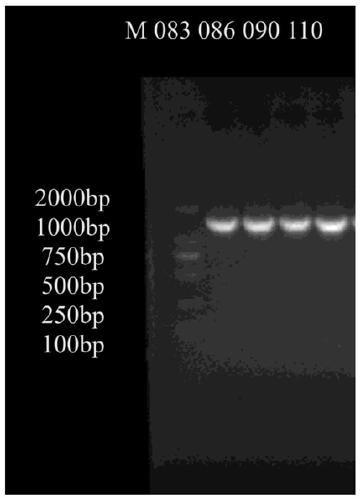
[0070] The DNA of bacterial strains GS083, GS086, GS090 and GS090 was obtained using a genomic DNA extraction kit as a template for PCR amplification, using universal primers (forward primer is 5...
Embodiment 3
[0073] The probiotic property of embodiment 3 lactic acid bacteria
[0074] (1) Simulated gastric juice and pancreatic juice viability test
[0075] Simulated gastric juice: prepared by dissolving 0.35% (w / v) pepsin in phosphate buffered solution (PBS), acidified with 1M HCl to pH=2.0; simulated pancreatic juice: containing 1.1% (w / v) NaHCO 3 , 0.1% (w / v) trypsin solution in PBS, adjusted to pH 8.0 with 1M NaOH.
[0076] After centrifuging the overnight cultured bacteria solution, collect the bacteria, wash twice with PBS, resuspend in the same amount of artificial gastric juice, culture at 37°C, measure the number of viable bacteria by plate counting method at 0h and 3h respectively, and calculate their survival Rate(%). The collected bacteria treated with artificial gastric juice were suspended in the same volume of simulated pancreatic juice, incubated at 37°C for 24h, and the number of viable bacteria was measured by plate counting method at 0h and 24h respectively, and ...
PUM
| Property | Measurement | Unit |
|---|---|---|
| diameter | aaaaa | aaaaa |
Abstract
Description
Claims
Application Information
 Login to View More