Ship pose estimation method based on three-dimensional point cloud features

A pose estimation and 3D point cloud technology, applied in the field of signal processing, can solve the problems of inability to provide pose estimation, long running time, difficult operation, etc., and achieve the effects of shortening running time, improving computing speed, and saving storage space

CN111915677APending Publication Date: 2020-11-10HARBIN ENG UNIV
0 Cites 7 Cited by

Patent Information

Authority / Receiving Office
CN · China
Current Assignee / Owner
Publication Date
2020-11-10

Smart Images

  • Figure 1
    Figure 1
  • Figure 2
    Figure 2
  • Figure 3
    Figure 3
Patent Text Reader

Abstract

The invention provides a ship pose estimation method based on three-dimensional point cloud features, and the method comprises the steps: firstly obtaining the three-dimensional point cloud data of atarget ship from six directions, and obtaining a complete point cloud library of the target ship in a splicing mode; constructing a point cloud template library of the target ship; and calculating ISS3D feature points and feature histograms of the to-be-registered target ship point clouds to obtain an initial coordinate transformation matrix in which the feature points in the template point cloudlibrary coincide with corresponding feature points in the to-be-registered point cloud library, thereby achieving rapid coarse registration of the point clouds in a global range. adopting an ICP pointcloud registration algorithm to carry out accurate registration of the point cloud on the basis of rough registration in the last step, and obtaining a coordinate transformation matrix for achievingaccurate registration of the point cloud; and finally, performing six-degree-of-freedom pose estimation on the target ship by utilizing the precise coordinate transformation matrix and the initial pose information of the ship in the point cloud template library. The invention provides a ship pose estimation algorithm experiment based on point cloud features, and the effectiveness of the method isverified through experimental data comparison.
Need to check novelty before this filing date? Find Prior Art

Description

technical field

[0001] The invention relates to a ship pose estimation method based on three-dimensional point cloud features, which belongs to the signal processing technology method. Background technique

[0002] 3D lidar is a very important sensor for obtaining surrounding information. It has the advantages of high measurement accuracy, high point cloud density, fast speed, and low cost. important role. Especially for ship-borne lidar, the three-dimensional point cloud information of the target ship is obtained in open seas, narrow waterways, and in and out of the port, and on this basis, the position and attitude of the target ship can be accurately estimated using the point cloud information. If the pose estimation error of the point cloud of the target ship is large, it will not only lead to a large error in subsequent processing, but may even cause a ship collision accident. Therefore, it is necessary to accurately estimate the position and attitude of the target shi...

Examples

Embodiment Construction

[0057] The present invention will be further described in detail below in conjunction with the accompanying drawings and specific embodiments.

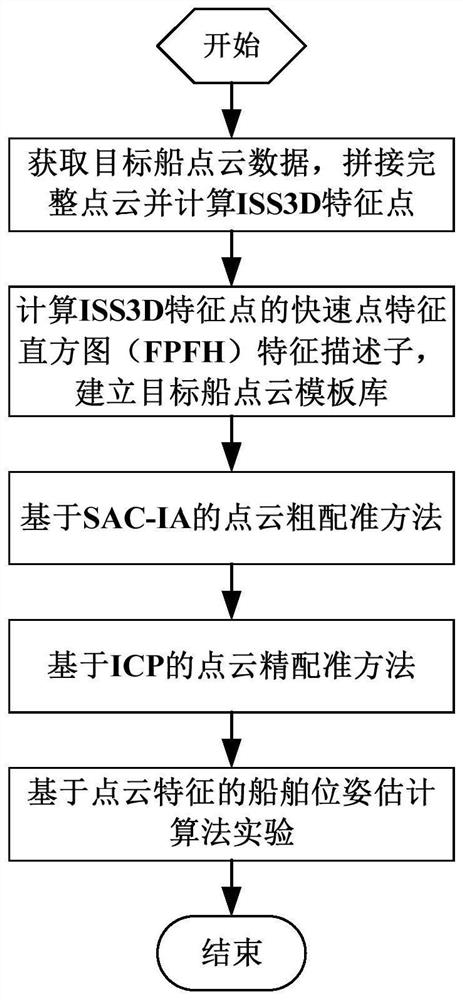
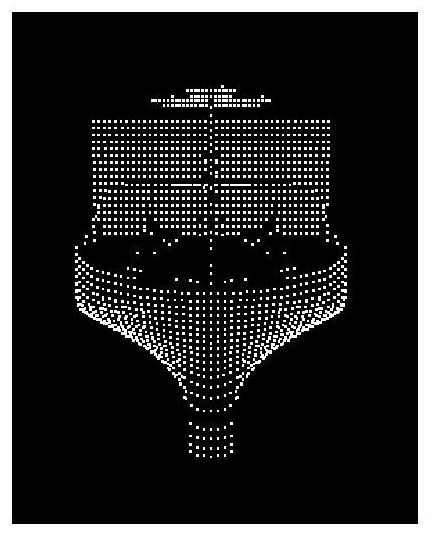
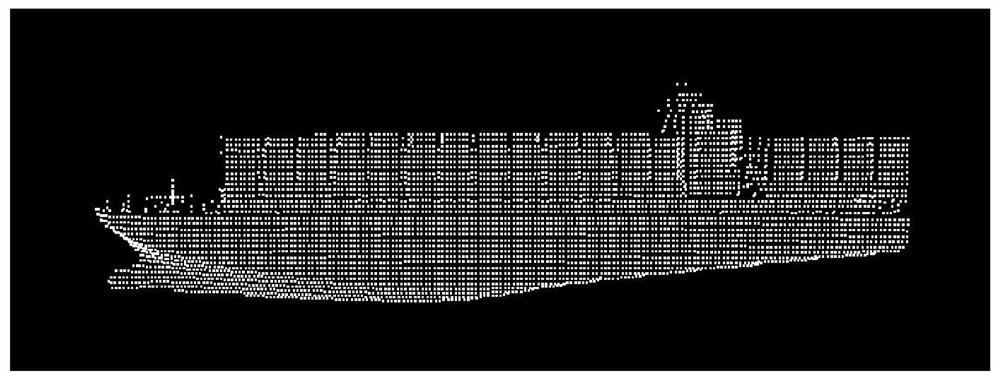
[0058] to combine Figure 1 to Figure 6 , the process flow of a pose estimation method for a three-dimensional point cloud of a ship proposed by the present invention is shown in the figure below. This patent first obtains the 3D point cloud data of the target ship from 6 directions, and adopts the splicing method to obtain the complete point cloud library of the target ship. Use the complete point cloud calculation obtained in the previous step to obtain the ISS3D feature points and their feature histograms, and build the point cloud template library of the target ship. Calculate the ISS3D feature points and their feature histograms of the point cloud of the target ship to be registered, use the SAC-IA point cloud registration algorithm, and use the feature histogram to match the point cloud template library with the feature points ...