Wireless charging method and system for outdoor robot

A wireless charging and robotics technology, applied in the field of intelligent robots, can solve the problems that the accuracy cannot meet the requirements of automatic charging, lidar or depth cameras are expensive, and achieve the effect of improving charging efficiency, improving signal receiving ability and reducing costs.

CN111917192AInactive Publication Date: 2020-11-10JINAN INSPUR HIGH TECH TECH DEV CO LTD
13 Cites 2 Cited by

Patent Information

Authority / Receiving Office
CN · China
Patent Type
Applications(China)
Current Assignee / Owner
Publication Date
2020-11-10
Estimated Expiration
Not applicable · inactive patent

Smart Images

  • Figure 1
    Figure 1
  • Figure 2
    Figure 2
  • Figure 3
    Figure 3
Patent Text Reader

Abstract

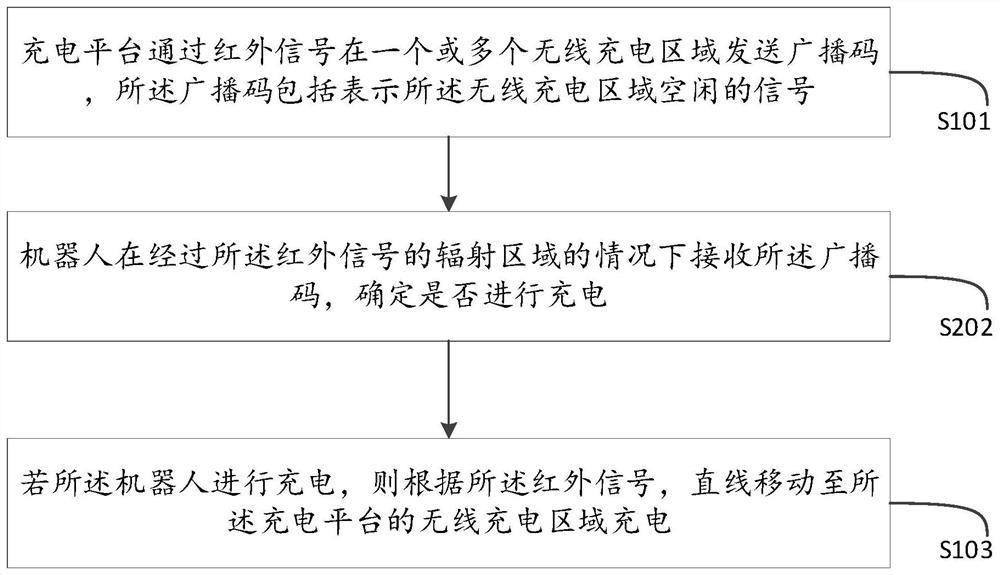
The invention relates to a wireless charging method and system for an outdoor robot, and the method comprises the steps that a charging platform transmits a broadcast code in one or more wireless charging regions through an infrared signal, wherein the broadcast code comprises a signal representing that the wireless charging region is idle; the robot receives the broadcast code under the conditionthat the robot passes through an infrared signal radiation area corresponding to the wireless charging area, and determines whether to charge or not; if the robot is charged, the robot linearly movesto a wireless charging area of the charging platform for charging according to the infrared signal. According to the embodiment of the invention, information interaction is carried out through the infrared signals, the positioning accuracy can be ensured based on the linearity of infrared light transmission, the cost of the infrared emitter and the infrared receiver is low, and the cost of charging equipment can be reduced; meanwhile, the communication distance of the infrared signals is wide, the coverage range of the infrared signals can be enlarged, and the applicability and expansibilityof the product are improved.
Need to check novelty before this filing date? Find Prior Art

Description

technical field

[0001] The invention relates to the technical field of intelligent robots, in particular to a wireless charging method and system for outdoor robots. Background technique

[0002] With the development of fifth-generation communication technology and artificial intelligence technology, more and more intelligent robots have entered the public's field of vision, such as banks, restaurants, hospitals, etc., can see them, and even some service robots have entered our homes . Because most of the service robots are powered by batteries, in daily use, when the robot is exhausted or will be exhausted, we need to move it back to the charging place and charge it. Repeatedly charging the robot every day greatly reduces our experience of using the service robot, so the automatic charging function of the robot is very necessary. Automatic return to home charging can greatly improve the robot's intelligence and user experience.

[0003] Robots on the market mostly use ex...

Examples

Embodiment Construction

[0048] In order to explain the overall concept of the present application more clearly, the following detailed description will be given by way of examples in combination with the accompanying drawings.

[0049] According to an aspect of an embodiment of the present invention, an embodiment of the present invention provides a wireless charging system for an outdoor robot, and the system includes: a charging platform and a robot.

[0050] figure 1 A schematic structural diagram of a charging platform provided by an embodiment of the present invention. like figure 1 As shown, the part of the charging platform is mainly composed of a charging coil, a charging and control circuit, an infrared receiver, and an infrared transmitter; specifically, the charging platform is provided with a plurality of wireless charging areas, and each of the wireless charging areas Infrared sensors are respectively provided for interacting with the robot by sending and receiving infrared signals thr...