Marker for detecting or assisting in detecting retinal cone cells and application of marker
What is AI technical title?
AI technical title is built by Patsnap AI team. It summarizes the technical point description of the patent document.
A technology of cone cells and retina, applied in the field of biomedicine, can solve problems such as the inability to use animal models or cell model identification.
Active Publication Date: 2020-12-11
INST OF ZOOLOGY CHINESE ACAD OF SCI
View PDF3 Cites 0 Cited by
Summary
Abstract
Description
Claims
Application Information
AI Technical Summary
This helps you quickly interpret patents by identifying the three key elements:
Problems solved by technology
Method used
Benefits of technology
Problems solved by technology
Existing ARR3 (NM_004312.3, NP_004303.2) etc. are used as markers of retinal cone cells, but this marker cannot be applied to the identification of ARR3 knockout animal models or cell models
Method used
the structure of the environmentally friendly knitted fabric provided by the present invention; figure 2 Flow chart of the yarn wrapping machine for environmentally friendly knitted fabrics and storage devices; image 3 Is the parameter map of the yarn covering machine
View more
Image
Smart Image Click on the blue labels to locate them in the text.
Viewing Examples
Smart Image
Click on the blue label to locate the original text in one second.
Reading with bidirectional positioning of images and text.
Smart Image
Examples
Experimental program
Comparison scheme
Effect test
Embodiment 1
[0083] Example 1. Discovery and application of retinal cone cell markers
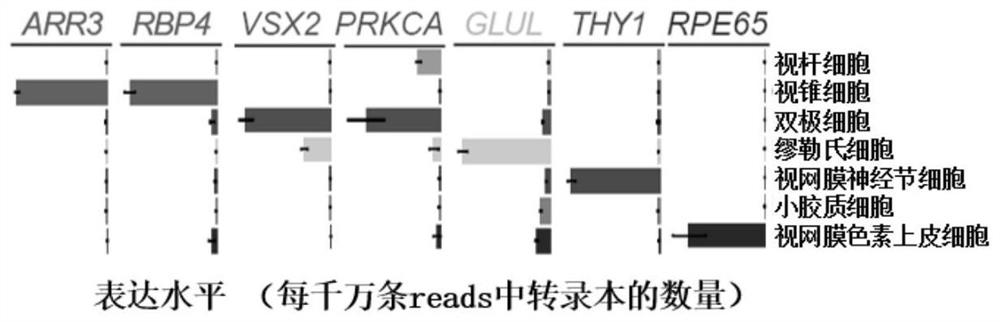
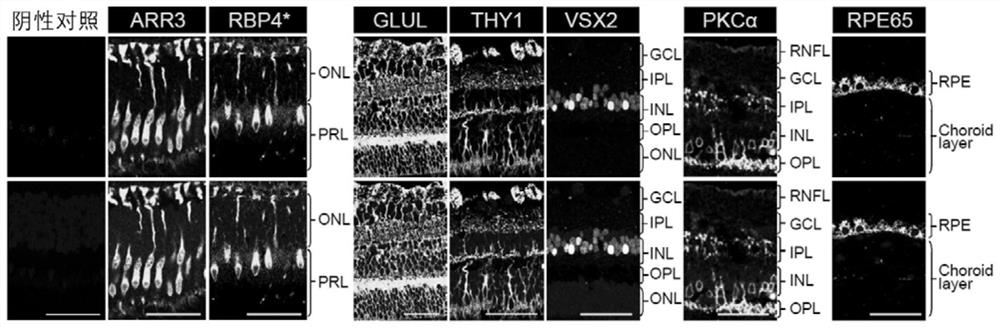
[0087] According to the average life expectancy of cynomolgus monkeys and its corresponding relationship with human age, the young group consists of 8 cynomolgus monkeys aged 4-6 (half male and female), and 8 cynomolgus monkeys (half male and female) aged 18-21 The monkeys made up the old group. All cynomolgus monkeys underwent physical examination, including the measurement of basic parameters (such as body mass index (BMI)), the detection of biochemical indicators (such as blood routine, urine routine), and the examination of important internal organs such as brain MRI and heart. U...
Embodiment 2
[0133] Example 2, the application of protein RBP4 in detecting whether the sample to be tested contains retinal cone cells
[0136] If the sample to be tested is the retina, it is prepared according to the method of (2)-2 of Example 1.
[0137] If the sample to be tested is retinal cells, it is prepared according to the conventional method of cell sheet preparation.
[0138] The samples to be tested were retinal tissues from 3 young cynomolgus monkey individuals and 3 old cynomolgus monkey individuals.
[0139] 2. Frozen sections (approximately 8 μm) were placed on positively charged glass slides and stored at -80°C.
[0140] 3. Take the slices, first wash them with PBS buffer, then place them in pH 6.0, 10 mM sodiumcitrate buffer, and heat the slices at 98°C for 3 times (5 min each time) in microwave, for the purpose of antigen retrieval.
[0141] 4. After completing step 3, after...
the structure of the environmentally friendly knitted fabric provided by the present invention; figure 2 Flow chart of the yarn wrapping machine for environmentally friendly knitted fabrics and storage devices; image 3 Is the parameter map of the yarn covering machine
Login to View More
PUM
Login to View More
Abstract
The invention discloses a marker for detecting or assisting in detecting retinal cone cells and application of the marker. The invention provides an application of a substance for detecting whether RBP4 protein is expressed in a sample to be detected in at least one of the following aspects of a1) identifying or assisting in identifying retinal cone cells; a2) screening or auxiliary screening of retinal cone cells; a3) evaluating or assisting in evaluating the retinal cone cells; a4) identifying or assisting in identifying whether a to-be-detected sample contains retinal cone cells or not; a5)screening or assisting in screening whether the to-be-detected sample contains retinal cone cells; and a6) evaluating or assisting in evaluating whether the to-be-detected sample contains retinal cone cells or not. Through construction and analysis of a macaca fascicularis retinal cone cell sequencing library and immunofluorescence detection, it is found that RBP4 can be used as a marker for identification or assisted identification of retinal cone cells. The marker can be used for evaluating retinal aging related diseases such as retinal macular degeneration, retinal pigmentation and the like. The marker and the application have important application value.
Description
technical field [0001] The invention belongs to the field of biomedicine, and in particular relates to a marker for detecting or assisting in detecting retinal cone cells and an application thereof. Background technique [0002] As a soft and transparent membrane attached to the inner surface of the choroid, the retina can sense light stimulation and convert it into nerve impulses, which are transmitted to the visual center of the cerebral cortex to form vision. The main retinal photoreceptors, including rods and cones. Degeneration of the retina may lead to visual damage and loss of vision. Therefore, in-depth analysis of retinal cell types and cell-specific molecular markers, and the search for retinal cell markers and retinal cell aging markers will provide important molecular indicators for the research and intervention of retinal development and retinal aging-related diseases. [0003] The degeneration of retinal photoreceptor cells such as cone cells is closely relat...
Claims
the structure of the environmentally friendly knitted fabric provided by the present invention; figure 2 Flow chart of the yarn wrapping machine for environmentally friendly knitted fabrics and storage devices; image 3 Is the parameter map of the yarn covering machine
Login to View More
Application Information
Patent Timeline
Application Date:The date an application was filed.
Publication Date:The date a patent or application was officially published.
First Publication Date:The earliest publication date of a patent with the same application number.
Issue Date:Publication date of the patent grant document.
PCT Entry Date:The Entry date of PCT National Phase.
Estimated Expiry Date:The statutory expiry date of a patent right according to the Patent Law, and it is the longest term of protection that the patent right can achieve without the termination of the patent right due to other reasons(Term extension factor has been taken into account ).
Invalid Date:Actual expiry date is based on effective date or publication date of legal transaction data of invalid patent.




 Login to View More
  Login to View More