AI technical title is built by Patsnap AI team. It summarizes the technical point description of the patent document.
A foreign object detection and train axle technology, applied in the field of fault image recognition, can solve problems such as fault detection accuracy and low efficiency
Active Publication Date: 2021-04-06
HARBIN KEJIA GENERAL MECHANICAL & ELECTRICAL CO LTD
View PDF7 Cites 0 Cited by
Summary
Abstract
Description
Claims
Application Information
AI Technical Summary
This helps you quickly interpret patents by identifying the three key elements:
Problems solved by technology
Method used
Benefits of technology
Problems solved by technology
[0003] The purpose of the present invention is to solve the problems of low accuracy and low efficiency of fault detection in existing manual fault detection methods, and to propose a foreign object detection method for railway train axlebox rotating arms
Method used
the structure of the environmentally friendly knitted fabric provided by the present invention; figure 2 Flow chart of the yarn wrapping machine for environmentally friendly knitted fabrics and storage devices; image 3 Is the parameter map of the yarn covering machine
View more
Image
Smart Image Click on the blue labels to locate them in the text.
Viewing Examples
Smart Image
Click on the blue label to locate the original text in one second.
Reading with bidirectional positioning of images and text.
Smart Image
Examples
Experimental program
Comparison scheme
Effect test
specific Embodiment approach 1
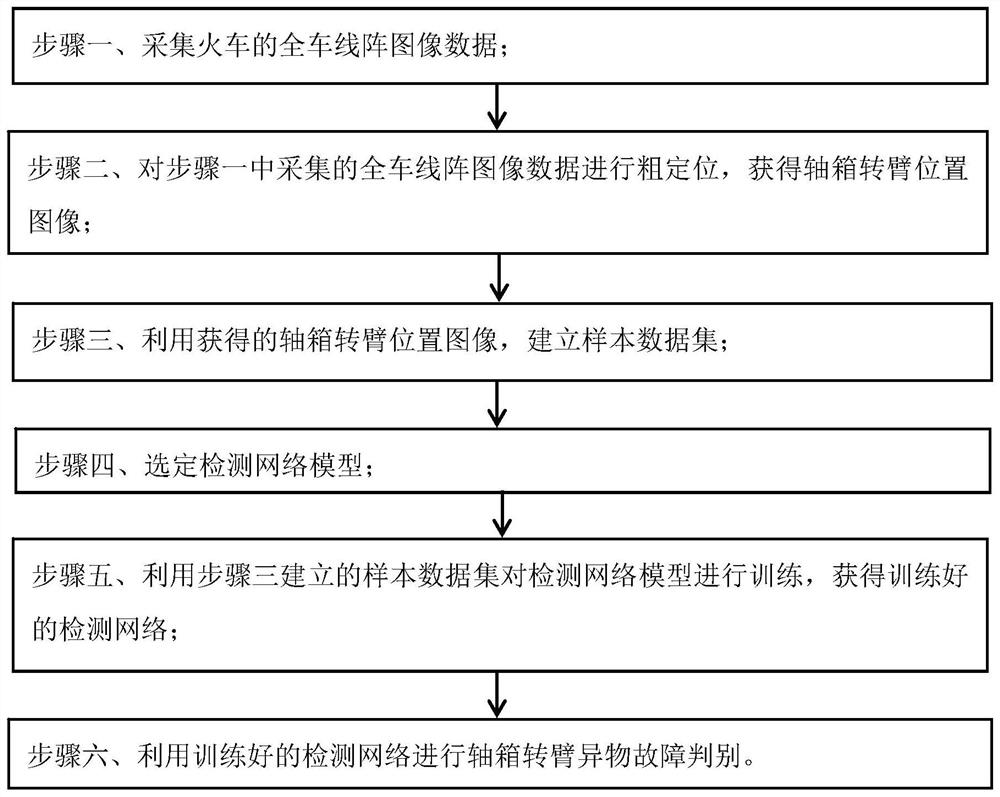
[0074] Specific implementation mode one: combine figure 1 To illustrate this embodiment, the method for detecting foreign objects on the axle box arm of a railway train in this embodiment includes the following steps:
[0075] Step 1, collecting the whole line array image data of the train;
[0076] Step 2: Carry out rough positioning on the line array image data of the whole vehicle collected in step 1, and obtain the position image of the axle box rotating arm;
[0077] Step 3. Using the obtained position image of the axlebox arm, establish a sample data set;
[0079] Step 5. Use the sample data set established in step 3 to train the detection network model to obtain a trained detection network;
[0080] Step 6: Utilize the trained detection network to discriminate the foreign matter fault of the axlebox arm.
specific Embodiment approach 2
[0081] Specific embodiment two: the difference between this embodiment and specific embodiment one is that in the step one, the whole vehicle linear array image data of the train is collected; the specific process is:
[0082] Cameras or video cameras are mounted on fixed equipment around the train track to take pictures of passenger trains running under different conditions. After the passenger train passes the camera or video camera, high-definition grayscale full-vehicle images are obtained.
[0083] Other steps and parameters are the same as those in Embodiment 1.
specific Embodiment approach 3
[0084] Embodiment 3: The difference between this embodiment and Embodiment 1 or 2 is that in Step 2, the line array image data of the entire vehicle collected in Step 1 is roughly positioned to obtain the position image of the axle box arm; the specific process is:
[0085] According to the wheelbase information of the axlebox arm and the prior knowledge of the position of the axlebox arm, the position image of the axlebox arm is intercepted from the line array image data of the whole vehicle.
[0086] In this way, the amount of calculation can be reduced and the speed of recognition can be improved.
[0087] Other steps and parameters are the same as those in Embodiment 1 or Embodiment 2.
the structure of the environmentally friendly knitted fabric provided by the present invention; figure 2 Flow chart of the yarn wrapping machine for environmentally friendly knitted fabrics and storage devices; image 3 Is the parameter map of the yarn covering machine
Login to View More
PUM
Login to View More
Abstract
The invention relates to a railway train axle box tumbler foreign matter detection method, in particular to an axle box tumbler foreign matter detection method. The objective of the invention is to solve the problems of low accuracy and low efficiency of fault detection in an existing manual fault detection method. The method comprises the steps of 1, collecting whole trainlinear array image data of a train; 2, performing coarse positioning on the whole vehicle linear array image data acquired in the step 1 to obtain an axle box tumbler position image; 3, establishing a sample data set by utilizing the obtained axle box tumbler position image; 4, selecting a detection network model; 5, training a detection network model by using the sample data set established in the step 3 to obtain a trained detection network; and 6, performing axle box tumbler foreign matter fault judgment by utilizing the trained detection network. The invention belongs to the field of fault image recognition.
Description
technical field [0001] The invention belongs to the field of fault image recognition, and in particular relates to a method for detecting foreign matter in a railway passenger car axle box rotary arm based on deep learning. Background technique [0002] For a long time, vehicle inspectors have used manual inspection (that is, by viewing the images of passing vehicles) to judge whether there are foreign objects in the axlebox arm area. The inspection work is very important, but a large number of image screening makes the vehicle inspectors work hard. Fatigue is very easy to occur during the process, and it is also prone to missed and wrong detections, making it difficult to guarantee the accuracy and high efficiency of detection. Therefore, it is necessary to use automatic recognition in the fault detection of passenger trains, especially in today's deep learning technology, which is constantly mature and perfect, which can greatly improve the robustness caused by the single ...
Claims
the structure of the environmentally friendly knitted fabric provided by the present invention; figure 2 Flow chart of the yarn wrapping machine for environmentally friendly knitted fabrics and storage devices; image 3 Is the parameter map of the yarn covering machine
Login to View More
Application Information
Patent Timeline
Application Date:The date an application was filed.
Publication Date:The date a patent or application was officially published.
First Publication Date:The earliest publication date of a patent with the same application number.
Issue Date:Publication date of the patent grant document.
PCT Entry Date:The Entry date of PCT National Phase.
Estimated Expiry Date:The statutory expiry date of a patent right according to the Patent Law, and it is the longest term of protection that the patent right can achieve without the termination of the patent right due to other reasons(Term extension factor has been taken into account ).
Invalid Date:Actual expiry date is based on effective date or publication date of legal transaction data of invalid patent.


 Login to View More
  Login to View More