
Wireless Network Traffic Prediction Method Based on Multi-Graph Convolution
A traffic forecasting and wireless network technology, applied in wireless communication, neural learning methods, biological neural network models, etc., can solve problems such as poor accuracy and efficiency, and achieve reasonable modeling, high prediction accuracy, and good prediction results Effect
- Summary
- Abstract
- Description
- Claims
- Application Information
AI Technical Summary
Problems solved by technology
Method used
Image

Examples
Embodiment Construction
[0078] 1) The historical flow data used in this embodiment is Milan every ten minutes from 2013.01.11 to 2014.01.01
[0080]
[0082]
[0084]
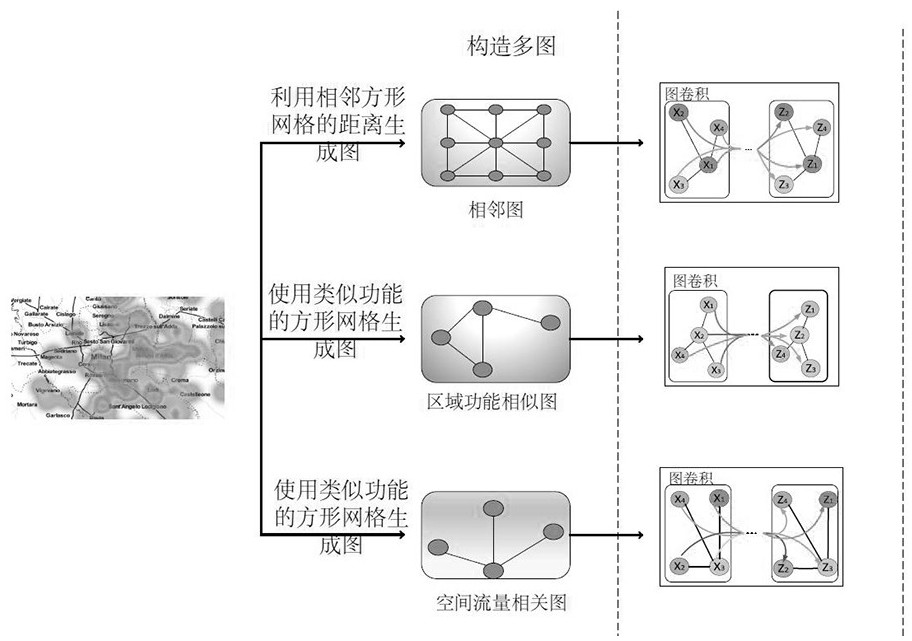
[0087] Adjacent graph G
[0088]
[0089] Among them, || · || represents the second norm, ||v
[0091]
[0092] represents the inner product, ||·|| represents the two-norm, the interest point matrix P of each grid area, the moment of social activity quantity
[0094]
[0097]
[0099]
[0102]
[0103] T
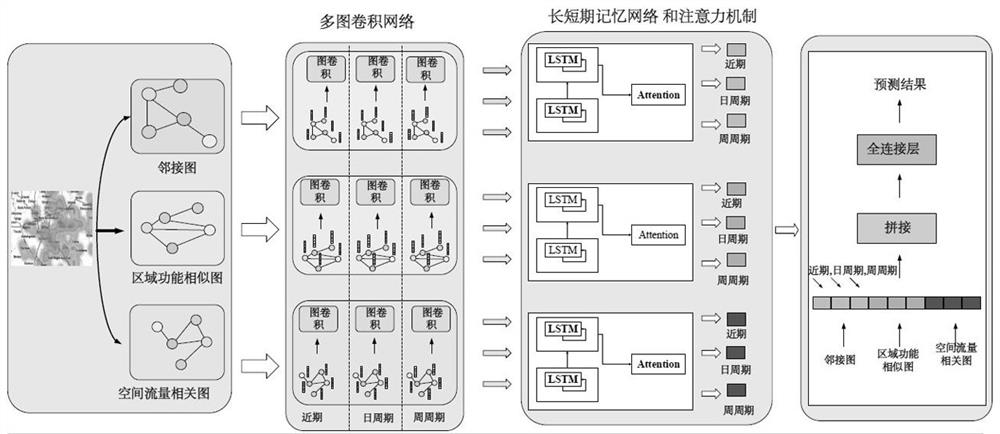
[0105] 1) Graph Convolutional Network: As shown in FIG. 2, this embodiment uses a graph convolutional network to discover the spatial correlation of traffic. root
[0106] g
[0107]*
[0108]
[0110] Because the Chebyshev polynomial is: T
[0111]
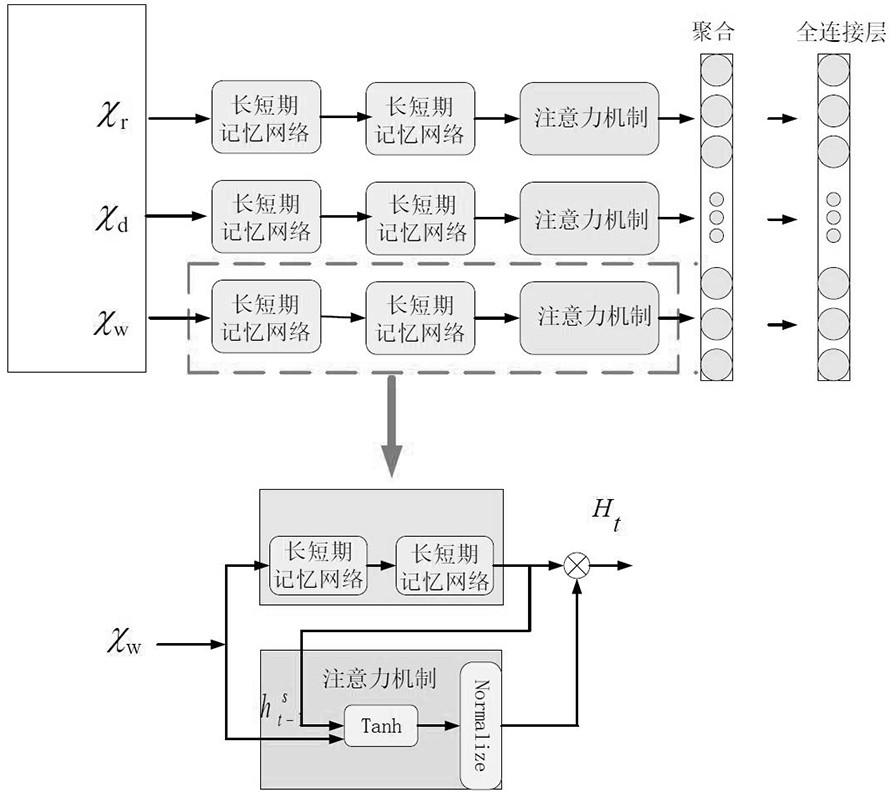
[0113] 2) Long short-term memory network, as shown in Figure 2. This embodiment uses a two-layer long short-term memory network, X
[0114]
[0115] The input gate updates the cell state, first passing the information of the hidden state of the previous layer and the information of the cu...
PUM
 Login to View More
 Abstract
Description
Claims
Application Information
 Login to View More