Check patentability & draft patents in minutes with Patsnap Eureka AI!

Rock mass homogeneous region division method based on improved concatenated table method

A contingency table and rock mass technology, applied in image analysis, image data processing, 3D modeling, etc., can solve the problems of not considering the coupling relationship of different attributes, reducing the accuracy of homogeneous area division, etc., achieving easy application, high The effect of precision

Active Publication Date: 2021-08-20
DALIAN MARITIME UNIVERSITY
View PDF4 Cites 0 Cited by
  • Summary
  • Abstract
  • Description
  • Claims
  • Application Information

AI Technical Summary

Problems solved by technology

However, the existing multi-factor discrimination method only considers multiple attributes of joints independently, but does not consider the coupling relationship between different attributes. Independent consideration of each attribute will reduce the accuracy of homogeneous area division

Method used

the structure of the environmentally friendly knitted fabric provided by the present invention; figure 2 Flow chart of the yarn wrapping machine for environmentally friendly knitted fabrics and storage devices; image 3 Is the parameter map of the yarn covering machine
View more

Image

Smart Image Click on the blue labels to locate them in the text.
Viewing Examples
Smart Image
  • Rock mass homogeneous region division method based on improved concatenated table method
  • Rock mass homogeneous region division method based on improved concatenated table method
  • Rock mass homogeneous region division method based on improved concatenated table method

Examples

Experimental program
Comparison scheme
Effect test

Embodiment Construction

[0033] It should be noted that, in the case of no conflict, the embodiments of the present invention and the features in the embodiments can be combined with each other. The present invention will be described in detail below with reference to the accompanying drawings and examples.

[0034] In order to make the purpose, technical solutions and advantages of the embodiments of the present invention clearer, the technical solutions in the embodiments of the present invention will be clearly and completely described below in conjunction with the drawings in the embodiments of the present invention. Obviously, the described embodiments It is only some embodiments of the present invention, but not all embodiments. The following description of at least one exemplary embodiment is merely illustrative in nature and in no way taken as limiting the invention, its application or uses. Based on the embodiments of the present invention, all other embodiments obtained by persons of ordina...

the structure of the environmentally friendly knitted fabric provided by the present invention; figure 2 Flow chart of the yarn wrapping machine for environmentally friendly knitted fabrics and storage devices; image 3 Is the parameter map of the yarn covering machine
Login to View More

PUM

No PUM Login to View More

Abstract

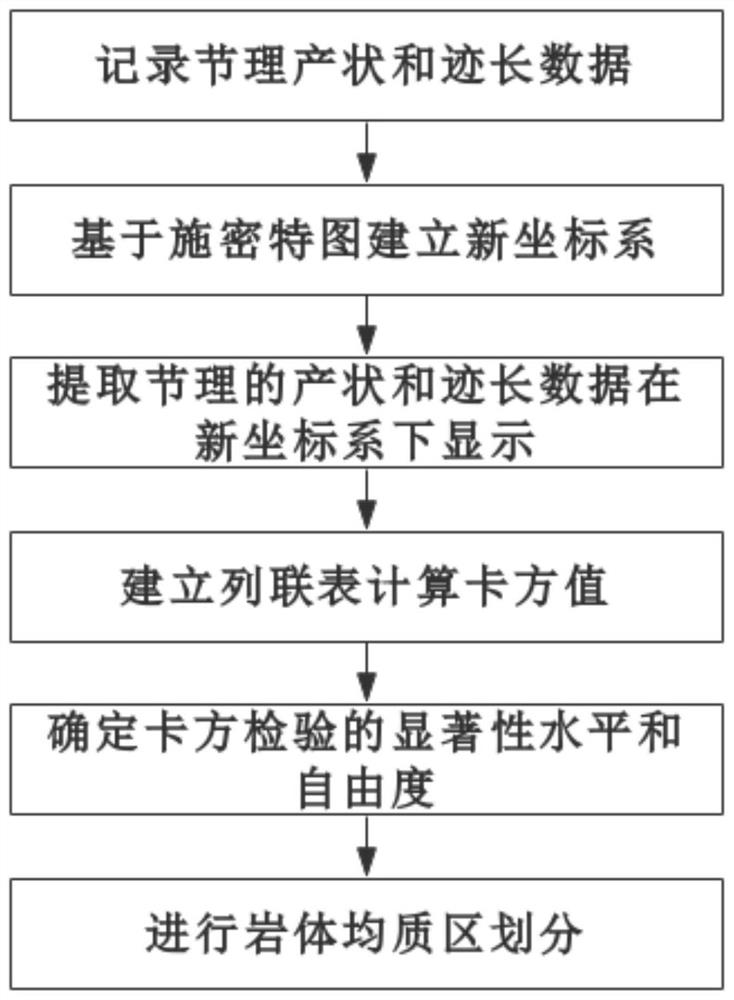
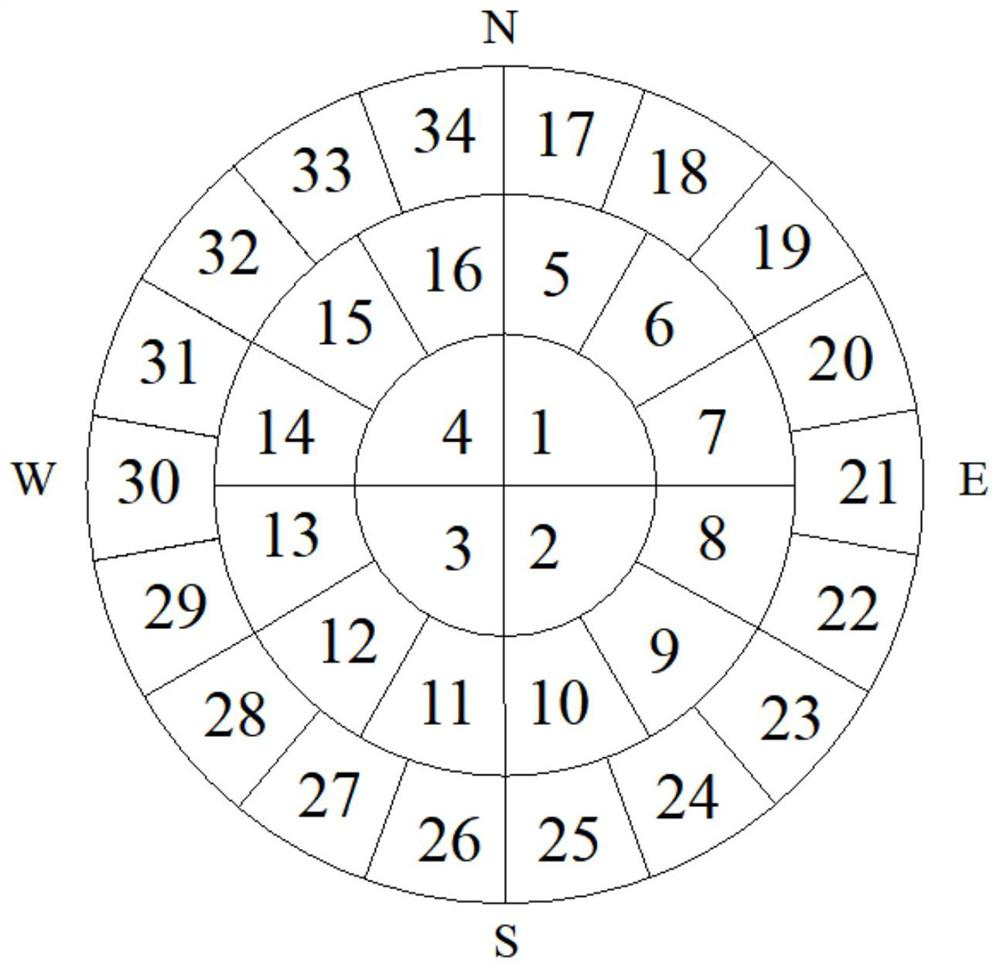
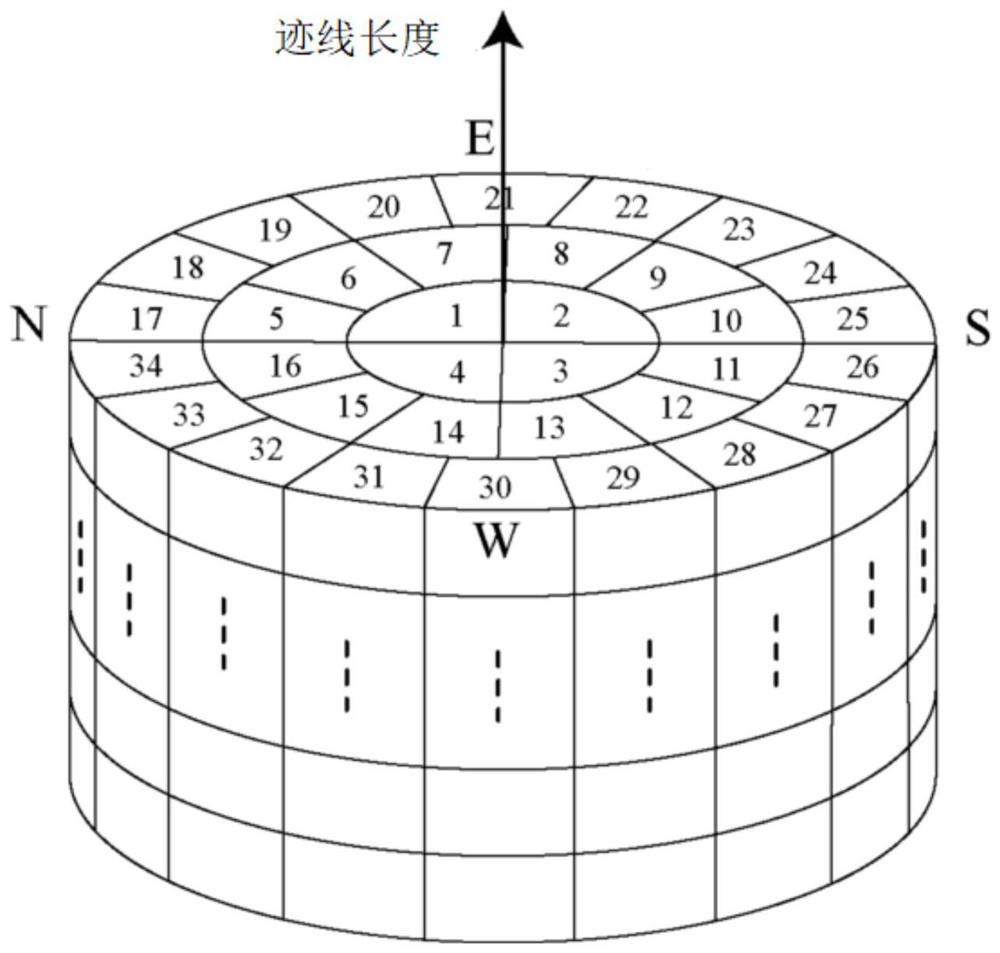
The invention provides a rock mass homogeneous region division method based on an improved train connection table method. The method comprises the steps of recording occurrence and trace length of joints of two regions; adding a trace length coordinate axis on the Schmidt diagram, wherein the Schmidt diagram and the trace length coordinate axis form a cell element; respectively extracting occurrence and trace length data of joints of the two areas, projecting the data in the new coordinate system, establishing a column connection table on the basis of the two projection drawings, and obtaining a chi-square value of chi-square test; determining the significance level and the degree of freedom of chi-square test; and performing homogeneous region division on the joints of the two regions according to chi-square test. A column linked table method is improved, and a coordinate axis for displaying joint trace length information is added, so that occurrence and trace length changes can be detected at the same time in the homogeneous region division process. The invention provides a method for determining the significance level instead of selecting a specific significance level to compare the two regions, so that the division result of the homogeneous region is more persuasive.

Description

technical field [0001] The invention relates to the technical field of homogeneous area division of rock mass, in particular to a method for dividing homogeneous area of ​​rock mass by improving the contingency table method. Background technique [0002] Joints are usually formed by multiple stages of geological tectonic movements, and each stage of geological movement has its unique geological characteristics, resulting in very complex geometric parameters of joints (such as occurrence and trace length, etc.). Joints have a strong impact on the mechanical and hydraulic properties of rock mass. Even in the same area, the properties of rock mass in different engineering parts may still be different. Different rock masses can be divided into the same homogeneous zone in the case of similar geometric properties. Rock masses in the same homogeneous zone can be analyzed or reinforced by using the same discrete joint network model or the same design scheme, thus saving a lot of m...

Claims

the structure of the environmentally friendly knitted fabric provided by the present invention; figure 2 Flow chart of the yarn wrapping machine for environmentally friendly knitted fabrics and storage devices; image 3 Is the parameter map of the yarn covering machine
Login to View More

Application Information

Patent Timeline
no application Login to View More
IPC IPC(8): G06T17/00G06T7/187
CPCG06T17/00G06T7/187G06T2219/016G06T2207/10012
Inventor 刘铁新李嘉琪姜谙男梁正召张正虎詹必雄韩鞠唐卫平侯拉平张霄汉周立飞刘林涛
Owner DALIAN MARITIME UNIVERSITY
Features
  • R&D
  • Intellectual Property
  • Life Sciences
  • Materials
  • Tech Scout
Why Patsnap Eureka
  • Unparalleled Data Quality
  • Higher Quality Content
  • 60% Fewer Hallucinations
Social media
Patsnap Eureka Blog
Learn More