Check patentability & draft patents in minutes with Patsnap Eureka AI!

A relaxation nuclear magnetic resonance method for detecting glucose content in liquid biological samples

A biological sample, nuclear magnetic resonance technology, applied in the field of biochemical analysis and detection, can solve problems such as interference with the specificity of detection methods, and achieve the effect of improving detection ability and low detection limit

Active Publication Date: 2021-01-15
SOUTHEAST UNIV
View PDF6 Cites 0 Cited by
  • Summary
  • Abstract
  • Description
  • Claims
  • Application Information

AI Technical Summary

Problems solved by technology

However, other substances in biological samples besides glucose also have various types of redox reactions, which can also cause Fe 3+ and Fe 2+ The relaxation transformation between , greatly interferes with the specificity of this detection method
[0004] The reaction between glucose oxidase and glucose is highly specific, and potassium permanganate is a commonly used indicator for the reaction product hydrogen peroxide, and there is no related report on its use in the detection of glucose content.

Method used

the structure of the environmentally friendly knitted fabric provided by the present invention; figure 2 Flow chart of the yarn wrapping machine for environmentally friendly knitted fabrics and storage devices; image 3 Is the parameter map of the yarn covering machine
View more

Image

Smart Image Click on the blue labels to locate them in the text.
Viewing Examples
Smart Image
  • A relaxation nuclear magnetic resonance method for detecting glucose content in liquid biological samples
  • A relaxation nuclear magnetic resonance method for detecting glucose content in liquid biological samples
  • A relaxation nuclear magnetic resonance method for detecting glucose content in liquid biological samples

Examples

Experimental program
Comparison scheme
Effect test

Embodiment 1

[0037] A sample of the BSA solution was tested, the glucose content of which was unknown.

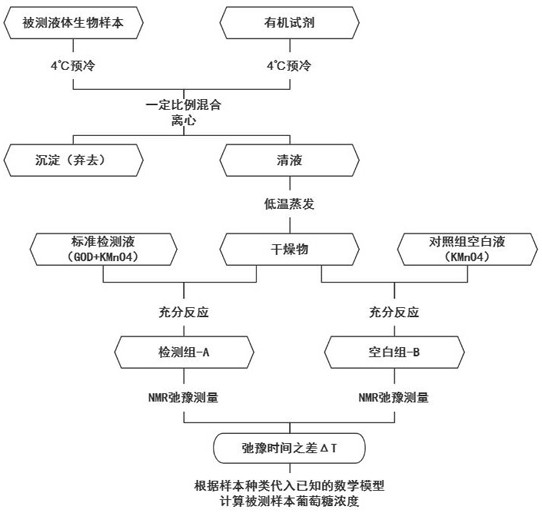
[0038] 1. Measure 500uL of the sample, place it at 4°C for pre-cooling, add 1000uL of absolute ethanol that is also pre-cooled at 4°C, invert and mix well, place it at 4°C for precipitation for 20 minutes, and centrifuge at room temperature (3500 rpm, 10 minutes) ;

[0039] 2. Centrifuge the supernatant obtained in step 1, divide it into groups A and B, take 150uL each, and place it in a drying oven at 85°C to evaporate completely;

[0040] 3. Add 1mL each of the standard detection solution and standard blank solution in the same ratio as the data model corresponding to the BSA solution sample to the dry matter A and B groups obtained in step 2, oscillate to dissolve and mix well, and let it stand for 1 hour to make it fully reaction;

[0041] 4. Take 200uL of the samples obtained in step 3 after the completion of the reaction and put them into a 7.5mm nuclear magnetic resonance test ...

Embodiment 2

[0044] The production of the standard detection solution and the standard blank solution is taken as an example to detect samples with a glucose concentration range of 1-20mM.

[0045] 1. Calculate the required minimum concentration of potassium permanganate according to the reaction equation and scale it up appropriately. Weigh 0.15g of potassium permanganate and dissolve it in 4mL of pH 5 acetic acid buffer at room temperature;

[0046] 2. Weigh 5 mg of glucose oxidase and dissolve it in 4 ml of acetic acid buffer at pH 5 at room temperature;

[0047] 3. Measure 2mL of the glucose oxidase solution in step 2, add 40uL of the potassium permanganate solution in step 1, turn over and mix well, take 1mL of it and dilute it to 20mL with pH 5 acetic acid buffer to obtain a standard detection solution;

[0048] 4. Measure 20uL of the potassium permanganate solution in step 1, dilute it to 20mL with pH 5 acetic acid buffer, turn over and mix well to obtain a standard blank solution....

Embodiment 3

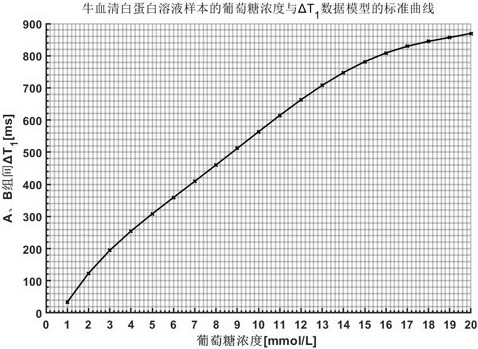
[0050] The establishment of data models under specific categories, taking BSA solution samples as an example.

[0051] 1. Weigh 2g bovine serum albumin and dissolve it in 40mL pH 5 acetic acid buffer solution at room temperature to obtain a 50g / LBSA solution;

[0052] 2. Weigh 0.18g of anhydrous glucose and dissolve it in 10mL of the BSA solution in step 1 at room temperature to obtain a BSA solution with a glucose concentration of 100mM;

[0053] 3. Measure 40, 80, 120, 160, 200, 240, 280, 320, 360, 400, 440, 480, 520, 560, 600, 640, 680, 720, 760, 800uL. The glucose concentration in step 2 is 100mM BSA solution, use the BSA solution in step 1 to dilute to 4mL to obtain glucose concentrations of 1, 2, 3, 4, 5, 6, 7, 8, 9, 10, 11, 12, 13, 14, 15 , 16, 17, 18, 19, 20mM BSA solution, pre-cooled at 4°C;

[0054] 4. Measure 500uL of the BSA solution of each concentration obtained in step 3, add 1000uL of absolute ethanol that was also pre-cooled at 4°C, turn over and mix well, p...

the structure of the environmentally friendly knitted fabric provided by the present invention; figure 2 Flow chart of the yarn wrapping machine for environmentally friendly knitted fabrics and storage devices; image 3 Is the parameter map of the yarn covering machine
Login to View More

PUM

No PUM Login to View More

Abstract

The invention discloses a relaxation nuclear magnetic resonance method for detecting the glucose content of a liquid biological sample. The method uses glucose oxidase and acidified potassium permanganate as reaction substrates, through 1 H‑NMR detects changes in relaxation time to calculate the glucose content in the tested sample. It specifically includes step a): adding absolute ethanol or other equivalent organic reagents to the sample to be tested in a certain proportion and mixing it evenly, and then allowing the interfering protein in the sample to denature and precipitate; step b): taking the supernatant and evaporating the residual organic reagent; Step c): divide into groups A and B and add detection solution and control solution respectively for reaction; step d): use nuclear magnetic resonance instrument to detect relaxation difference between groups A and B; step e): according to the measured relaxation time difference and The known model under this sample category calculates the glucose content of the tested sample. Through the method of the invention, the glucose content in various liquid biological samples can be effectively detected, which is helpful for further research on the application of nuclear magnetic resonance technology in the direction of biological sugar detection.

Description

technical field [0001] The invention belongs to the technical field of analysis and detection of biochemical methods, and in particular relates to a relaxation nuclear magnetic resonance method for detecting the glucose content of a liquid biological sample. Background technique [0002] In recent years, relaxation nuclear magnetic resonance technology has been widely used in food science, biological detection and other fields, but limited by the low resolution of relaxation nuclear magnetic resonance, it is not sensitive to weak changes in the content of small molecules in samples. Specifically, it is applied to liquid When detecting the glucose content in biological samples, because the glucose level in biological samples such as blood, saliva, and urine is generally low, only 0-30mM, it is difficult to accurately determine its content by direct relaxation NMR detection, so it is necessary to design a method Expand the detectable amount caused by the different glucose cont...

Claims

the structure of the environmentally friendly knitted fabric provided by the present invention; figure 2 Flow chart of the yarn wrapping machine for environmentally friendly knitted fabrics and storage devices; image 3 Is the parameter map of the yarn covering machine
Login to View More

Application Information

Patent Timeline
no application Login to View More
Patent Type & Authority Patents(China)
IPC IPC(8): G01N24/08
CPCG01N24/082
Inventor 易红陆荣生陈逸倪中华
Owner SOUTHEAST UNIV
Features
  • R&D
  • Intellectual Property
  • Life Sciences
  • Materials
  • Tech Scout
Why Patsnap Eureka
  • Unparalleled Data Quality
  • Higher Quality Content
  • 60% Fewer Hallucinations
Social media
Patsnap Eureka Blog
Learn More