Temp. compensation of ferroelectric liquid crystal displays
A ferroelectric liquid crystal and temperature compensation technology, applied in the field of temperature compensation, can solve problems such as device parameter changes and limited device temperature range
- Summary
- Abstract
- Description
- Claims
- Application Information
AI Technical Summary
Problems solved by technology
Method used
Image



Examples
Embodiment Construction
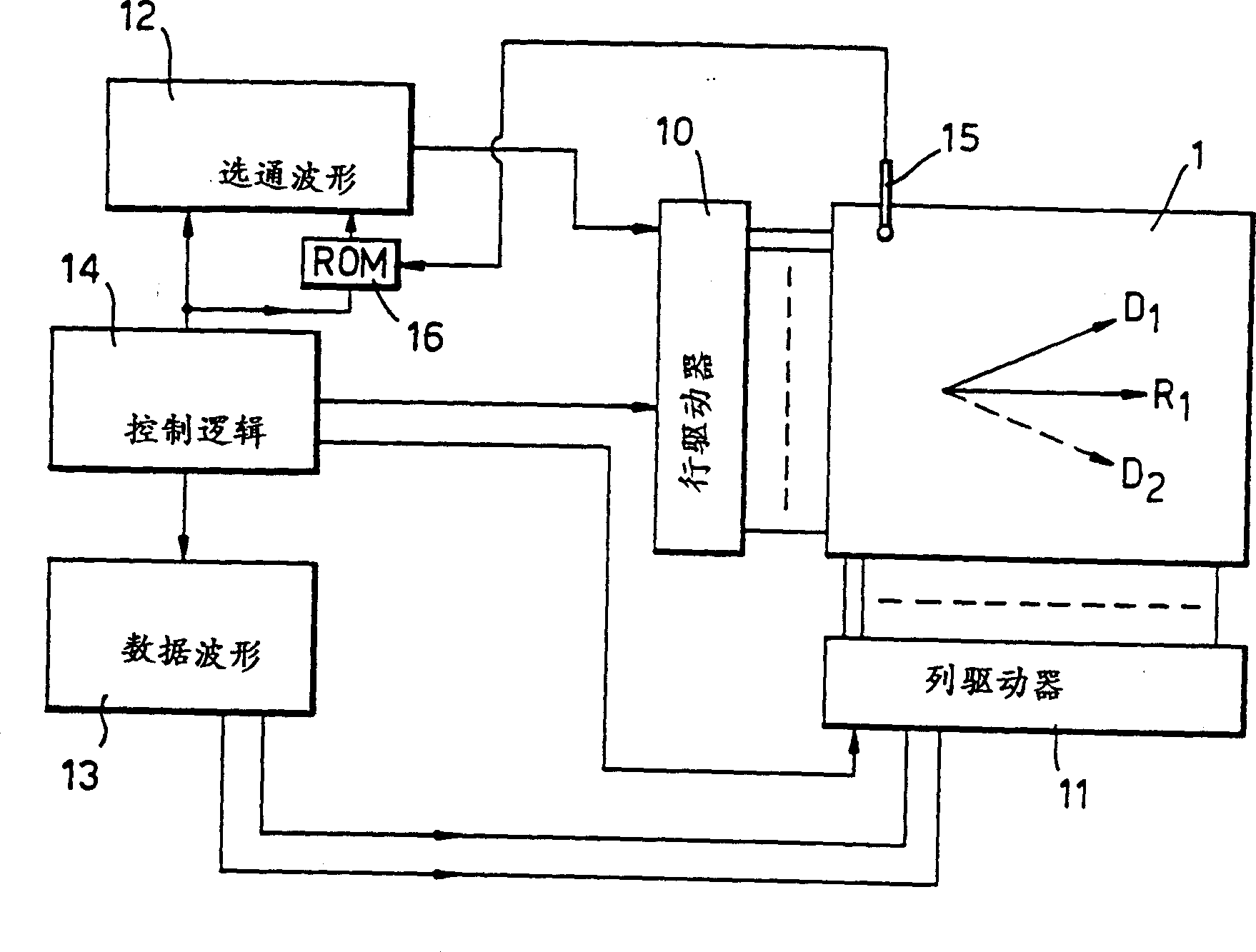
[0058] figure 1 , The display 1 shown in 2 includes two glass walls 2, 3 separated by a spacer ring 4 and / or distribution spacers 1-6um. Electrode structures 5 , 6 made of transparent tin oxide or indium tin oxide (ITO) are formed on the inner surfaces of the two walls. The electrodes are shown as rows and columns forming an X,Y matrix, but other forms are possible. For example, for r, θ displays the shape of a radial surface, or a sector corresponding to a digital seven-segment display. A layer 7 of liquid crystal material is contained between the walls 2 , 3 and the spacer ring 4 .
[0059] Polarizers 8, 9 are provided at the front and rear of the cell 1, respectively. Row driver 10 and column driver 11 apply voltage signals to the cells. Two sets of waveforms are generated and provided to the row driver 10 and the column driver 11 . The gate waveform generator 12 provides row waveforms, and the data waveform generator 13 supplies ON (connection) and OFF (disconnection)...
PUM
 Login to View More
 Abstract
Description
Claims
Application Information
 Login to View More
PatSnap Eureka turns technology decisions into work you can execute. Powered by our Innovation Knowledge Graph, it runs expert workflows across engineering, life sciences, materials and intellectual property. Get your review-ready output in minutes.


