

Dividing amplitude off-axis x-ray holograph device
An X-ray, off-axis technology, used in measurement devices, analysis materials, material analysis using radiation, etc., can solve problems such as insufficient resolution, and achieve high academic value and application prospects.
- Summary
- Abstract
- Description
- Claims
- Application Information
AI Technical Summary
Problems solved by technology
Method used
Image


Examples
Embodiment Construction
[0040] Below in conjunction with embodiment, the present invention will be further described, but should not limit the protection scope of the present invention with this.
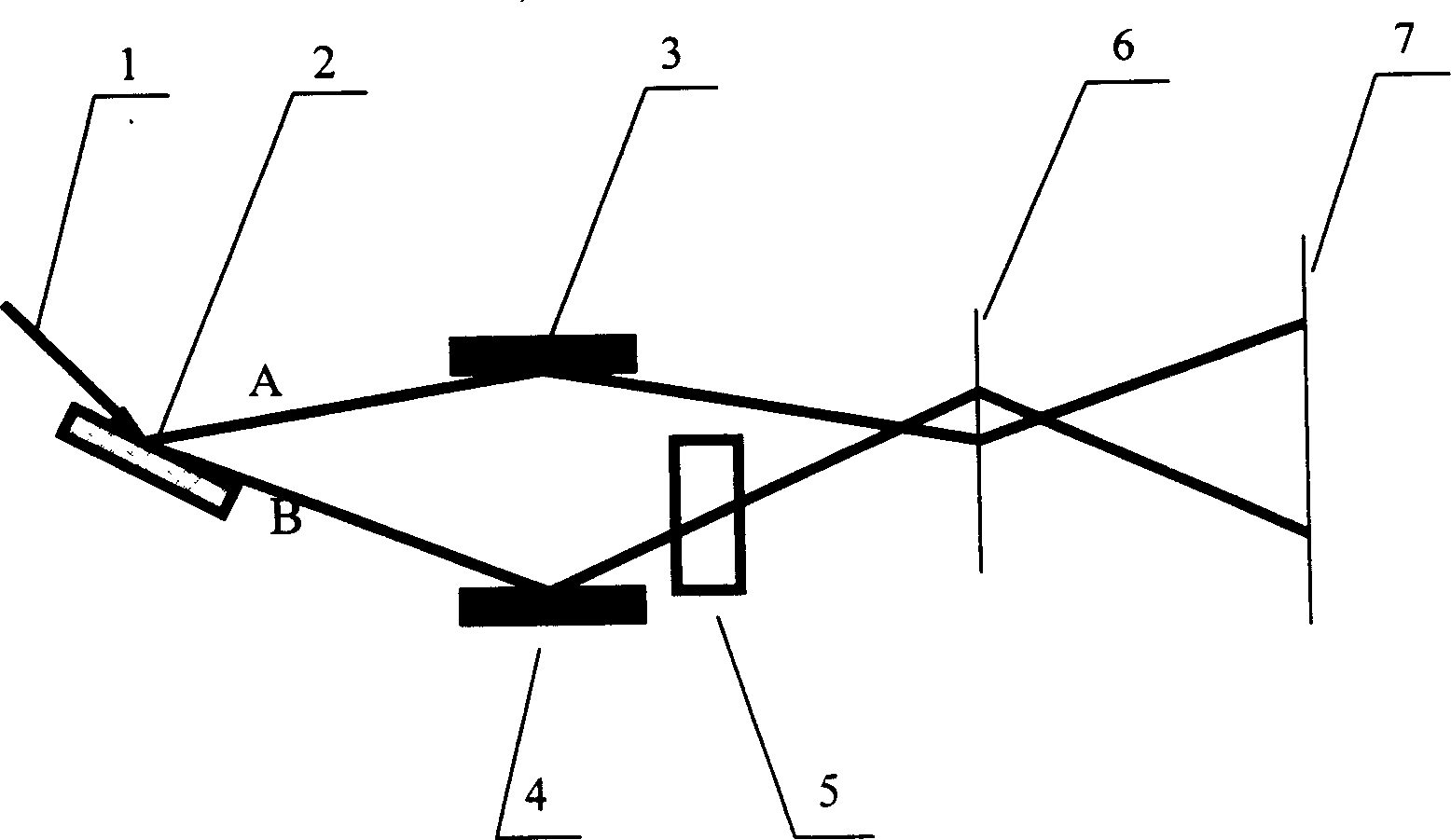
[0041] The sub-amplitude off-axis X-ray holographic device of the present invention is as figure 2 As shown, it consists of seven parts, which include a quasi-monochromatic X-ray source 1, a grating 2, a first reflector 3 and a second reflector 4, an object to be measured 5, an X-ray zone plate 6 and a recording medium 7.
[0042] The so-called quasi-monochromatic X-ray source is a synchrotron radiation source that passes through a monochromator to become a quasi-monochromatic X-ray source, with an adjustable wavelength from 1 Å to 50 Å.
[0043] Said grating is an X-ray reflective grating with 3000 lines / mm, which is available in the market.
[0044] The two reflecting mirrors are reflecting mirrors working in the X-ray band.
[0045] Said X-ray zone plate is an imaging X-ray zone plate with a diameter...
PUM
| Property | Measurement | Unit |
|---|---|---|
| diameter | aaaaa | aaaaa |
| diameter | aaaaa | aaaaa |
Abstract
Description
Claims
Application Information
 Login to View More