Near-eye display with frame rendering based on reflected wavefront analysis for eye characterization

a near-eye display and frame rendering technology, applied in the field of near-eye displays, can solve the problems of affecting the user's experience, blurry or distorted display imagery, cognitive fatigue for users,

US10629105B2Active Publication Date: 2020-04-21GOOGLE LLC
27 Cites 1 Cited by

Patent Information

Authority / Receiving Office
US · United States
Patent Type
Patents(United States)
Current Assignee / Owner
Publication Date
2020-04-21

Smart Images

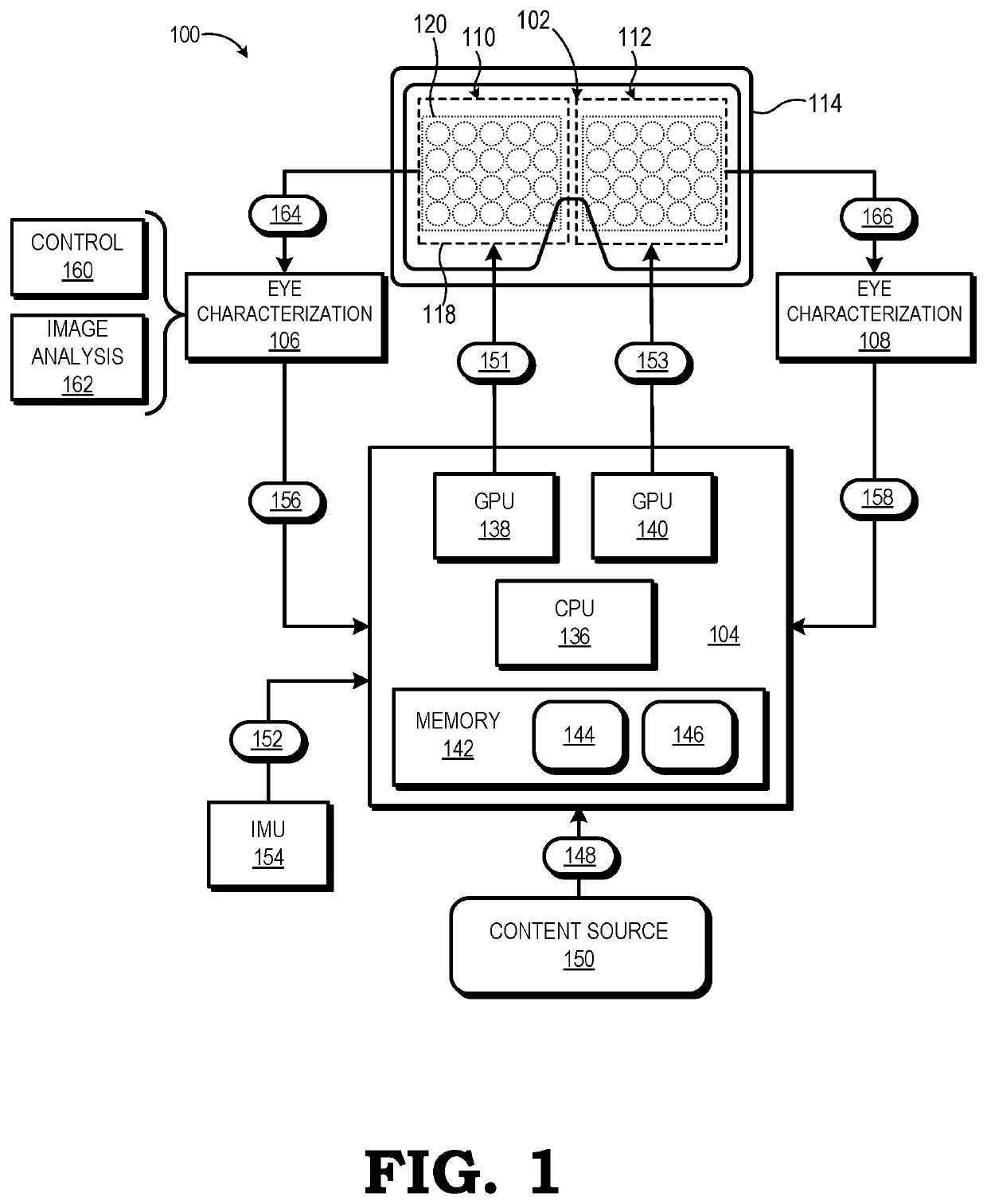
  • Figure 1
    Figure 1
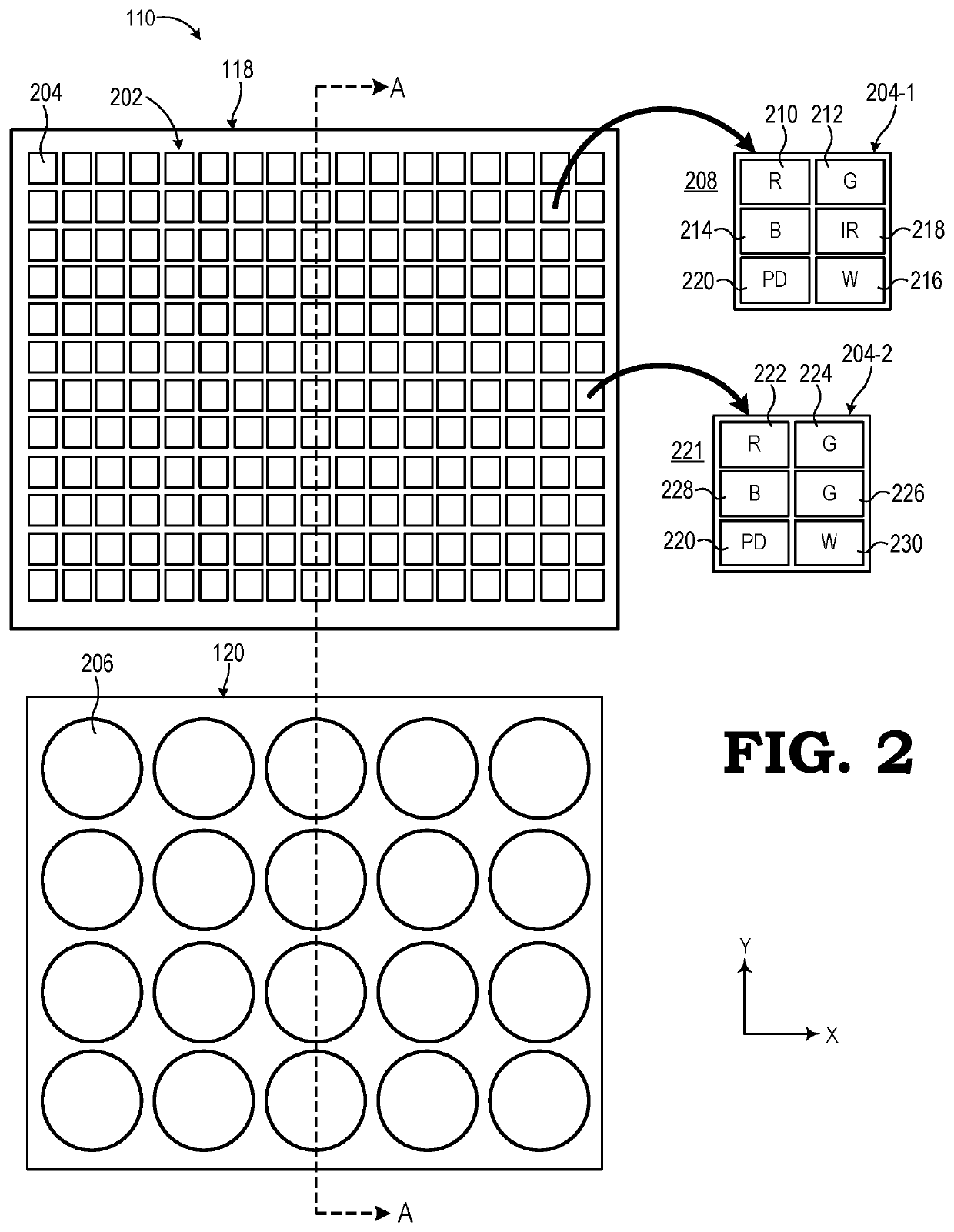
  • Figure 2
    Figure 2
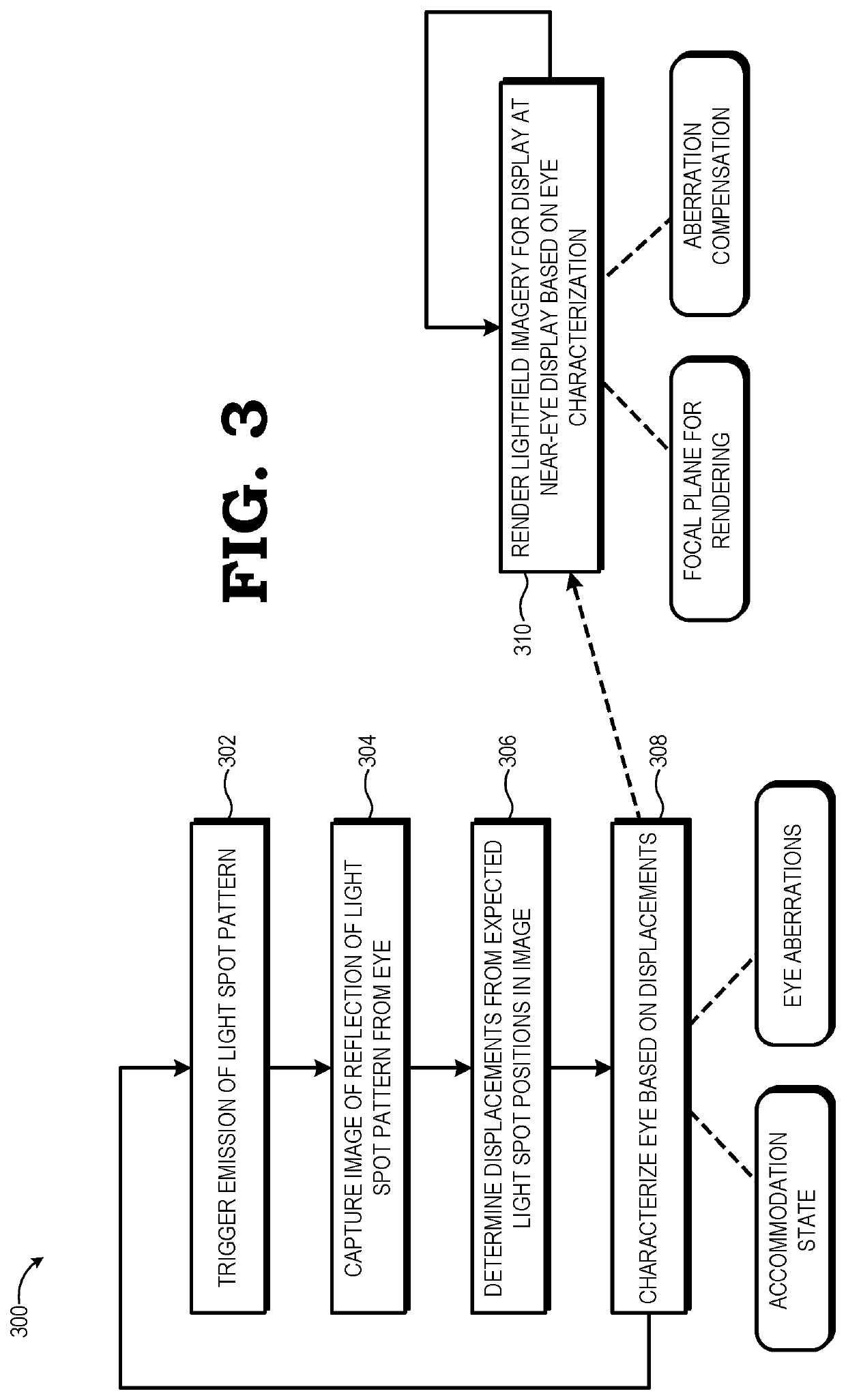
  • Figure 3
    Figure 3
Patent Text Reader

Abstract

A near-eye display system includes an array of lenslets overlying a display panel. The display panel includes an array of light projecting elements, each light projecting element being coaxial with an axis of a corresponding lenslet. The display panel further includes an array of light detecting elements and an array of sub-pixel elements. The system further includes a control component configured to activate the array of light projecting elements to project a pattern of light spots toward an eye of the user and to control the array of light detecting elements to capture an image representing a reflection of the projected pattern of light spots from the eye. The system also includes an analysis component to determine displacements between expected positions and actual positions of at least a subset of light spots in the captured image, and to characterize the eye based on the displacements.
Need to check novelty before this filing date? Find Prior Art

Description

CROSS-REFERENCE TO RELATED APPLICATIONS

[0001] The present disclosure claims priority to U.S. Provisional Patent Application Ser. No. 62 / 520,295, entitled “Near-Eye Display with Frame Rendering Based on Reflected Wavefront Analysis for Eye Characterization” and filed on Jun. 15, 2017, the entirety of which is incorporated by reference herein.BACKGROUNDField of the Disclosure

[0002] The present disclosure relates generally to near-eye displays and, more particularly, to frame rendering for computational near-eye displays.Description of the Related Art

[0003] Head-mounted displays (HMDs) and other near-eye display systems can utilize a near-eye lightfield display or other computational display to provide effective display of three-dimensional (3D) graphics. Generally, the near-eye lightfield display employs one or more display panels and an array of lenslets, pinholes, or other optic features that overlie the one or more display panels. A rendering system renders an array of elemental image...

Examples

Embodiment Construction

[0011]FIGS. 1-5 illustrate example systems and techniques for improved image rendering in a near-eye display system based on characterization of a user's eye using wavefront distortion estimation. In at least one embodiment, the near-eye display system employs a computational display composed of one or more display panels to display near-eye lightfield frames of imagery to a user so as to provide the user with an immersive virtual reality (VR) or augmented reality (AR) experience. Each near-eye lightfield frame is composed of an array of elemental images, with each elemental image representing a view of an object or scene from a different corresponding viewpoint. An array of lenslets overlies each display panel and operates to present the array of elemental images to the user as a single autostereoscopic image.

[0012]In addition to displaying AR or VR video imagery to the user, the display panel also facilitates characterization of one or both of the user's eyes via a wavefront disto...