Check patentability & draft patents in minutes with Patsnap Eureka AI!

Method and apparatus for encoding and decoding of floating-point number

a technology of floating-point numbers and methods, applied in the field of methods and apparatus for encoding and decoding of floating-point numbers, can solve the problems of wasting the storage space of floating-point numbers, and achieve the effect of reducing the data volume of floating-point numbers

Active Publication Date: 2022-07-12
NEUCHIPS CORP
View PDF16 Cites 0 Cited by
  • Summary
  • Abstract
  • Description
  • Claims
  • Application Information

AI Technical Summary

Benefits of technology

The patent provides a method and apparatus for encoding and decoding floating-point numbers using a dynamic adjustment of number of exponent bits and bias based on the original float value. This results in a more efficient compression of the data, reducing the storage space needed. Both the encoding and decoding processes involve converting the original floating-point number to a standard floating-point number. The technical effect is a more efficient and flexible way of managing and reducing the data volume of floating-point numbers.

Problems solved by technology

Obviously, the group of real numbers only uses a very small part of the exponent range −126-127 that may be represented by the floating-point numbers, resulting in a waste of the storage space of the floating-point numbers.

Method used

the structure of the environmentally friendly knitted fabric provided by the present invention; figure 2 Flow chart of the yarn wrapping machine for environmentally friendly knitted fabrics and storage devices; image 3 Is the parameter map of the yarn covering machine
View more

Image

Smart Image Click on the blue labels to locate them in the text.
Viewing Examples
Smart Image
  • Method and apparatus for encoding and decoding of floating-point number
  • Method and apparatus for encoding and decoding of floating-point number

Examples

Experimental program
Comparison scheme
Effect test

Embodiment Construction

[0016]Reference will now be made in detail to the exemplary embodiments of the disclosure, examples of which are illustrated in the accompanying drawings. Wherever possible, the same reference numbers are used in the drawings and the description to refer to the same or like parts.

[0017]The term “coupling (or connection)” used in the full text of the specification of the disclosure (including the claims) may refer to any direct or indirect means of connection. For example, if the text describes that a first apparatus is coupled (or connected) to a second apparatus, it should be interpreted as that the first apparatus may be directly connected to the second apparatus, or the first apparatus may be indirectly connected to the second apparatus through other apparatuses or some kind of connection means. The terms “first” and “second” mentioned in the entire specification of the disclosure (including claims) are used to name the elements, or to distinguish between different embodiments or...

the structure of the environmentally friendly knitted fabric provided by the present invention; figure 2 Flow chart of the yarn wrapping machine for environmentally friendly knitted fabrics and storage devices; image 3 Is the parameter map of the yarn covering machine
Login to View More

PUM

No PUM Login to View More

Abstract

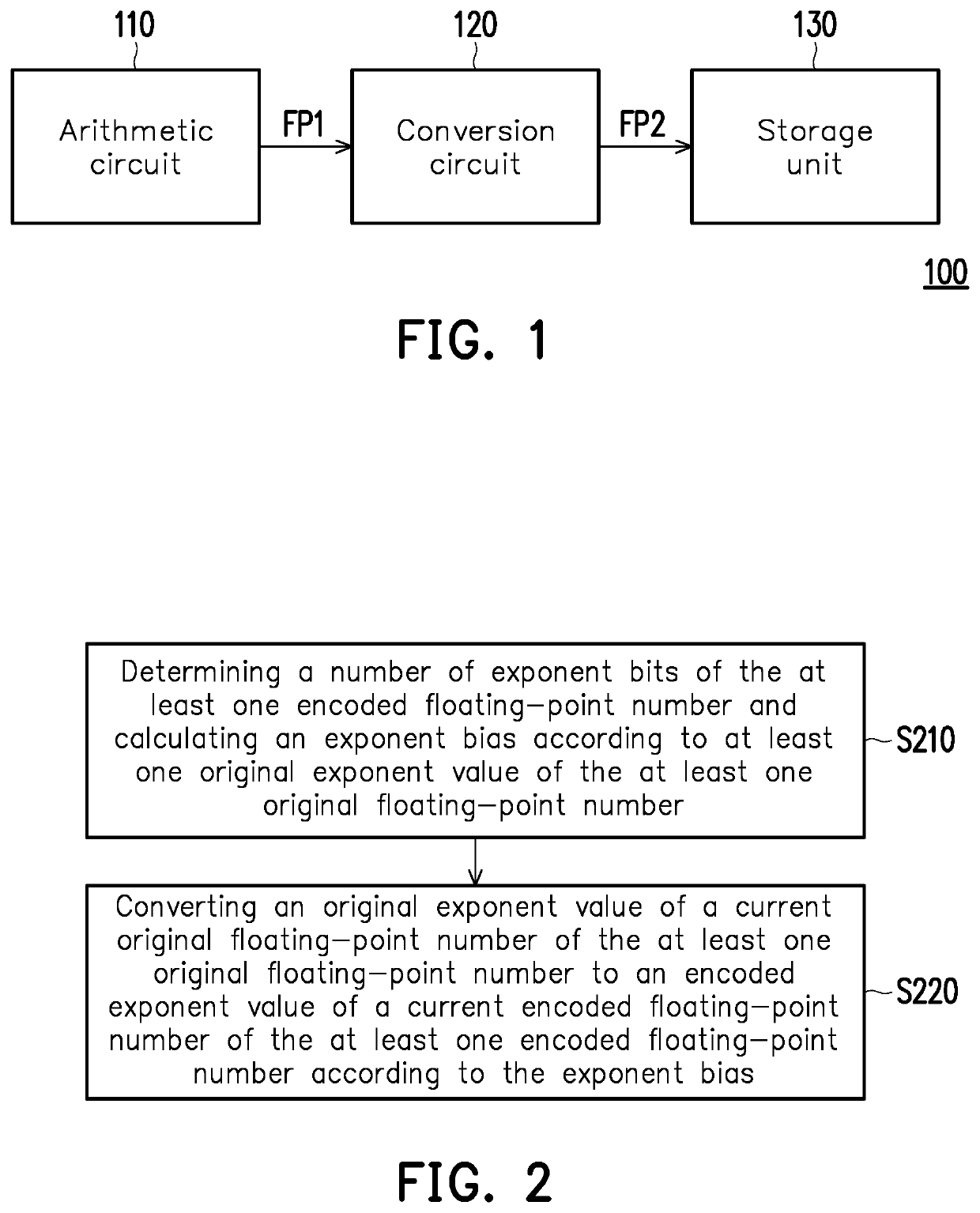
A method and apparatus for encoding and decoding of floating-point number is provided. The method for encoding is used to convert at least one original floating-point number to at least one encoded floating-point number. The method for encoding includes: determining a number of exponent bits of the at least one encoded floating-point number and calculating an exponent bias according to at least one original exponent value of the at least one original floating-point number; and converting an original exponent value of a current original floating-point number of the at least one original floating-point number to an encoded exponent value of a current encoded floating-point number of the at least one encoded floating-point number according to the exponent bias.

Description

CROSS-REFERENCE TO RELATED APPLICATION[0001]This application claims the priority benefit of Taiwan application serial no. 110110407, filed on Mar. 23, 2021. The entirety of the above-mentioned patent application is hereby incorporated by reference herein and made a part of this specification.BACKGROUND1. Technical Field[0002]The disclosure relates to a method and an apparatus for encoding and decoding of floating-point number.2. Description of Related Art[0003]Floating-point (FP) number is an approximate value representation of real numbers. In the IEEE standard for binary floating-point arithmetic (such as IEEE 754), floating-point numbers are specified to include three fields: “sign”, “exponent” and “fraction”. “Sign” represents positive / negative sign of a floating-point number, “exponent” represents the power of a floating-point number (based on two), and “fraction” represents the decimal of a floating-point number (the integer part of a floating-point number in the normalized fo...

Claims

the structure of the environmentally friendly knitted fabric provided by the present invention; figure 2 Flow chart of the yarn wrapping machine for environmentally friendly knitted fabrics and storage devices; image 3 Is the parameter map of the yarn covering machine
Login to View More

Application Information

Patent Timeline
no application Login to View More
IPC IPC(8): H03M7/00H03M7/24G06F7/485H03M7/30
CPCH03M7/24G06F7/485H03M7/6005H03M7/6011G06F9/30025G06F7/483H03M7/30
Inventor HUANG, JUINN DARHUANG, CHENG WEICHEN, TIM WEILIN, CHIUNG-LIANG
Owner NEUCHIPS CORP
Features
  • R&D
  • Intellectual Property
  • Life Sciences
  • Materials
  • Tech Scout
Why Patsnap Eureka
  • Unparalleled Data Quality
  • Higher Quality Content
  • 60% Fewer Hallucinations
Social media
Patsnap Eureka Blog
Learn More