Check patentability & draft patents in minutes with Patsnap Eureka AI!

Efficient lossy instruction scheduling

a lossy instruction and scheduling technology, applied in the field of information processing systems, can solve the problems of power consumption, inefficiency of 110, and difficulty in implementing these larger windows at high frequency

Inactive Publication Date: 2004-07-01
INTEL CORP
View PDF1 Cites 2 Cited by
  • Summary
  • Abstract
  • Description
  • Claims
  • Application Information

AI Technical Summary

Problems solved by technology

Although large scheduling windows may be effective at extracting ILP, the implementation of these larger windows at high frequency is challenging.
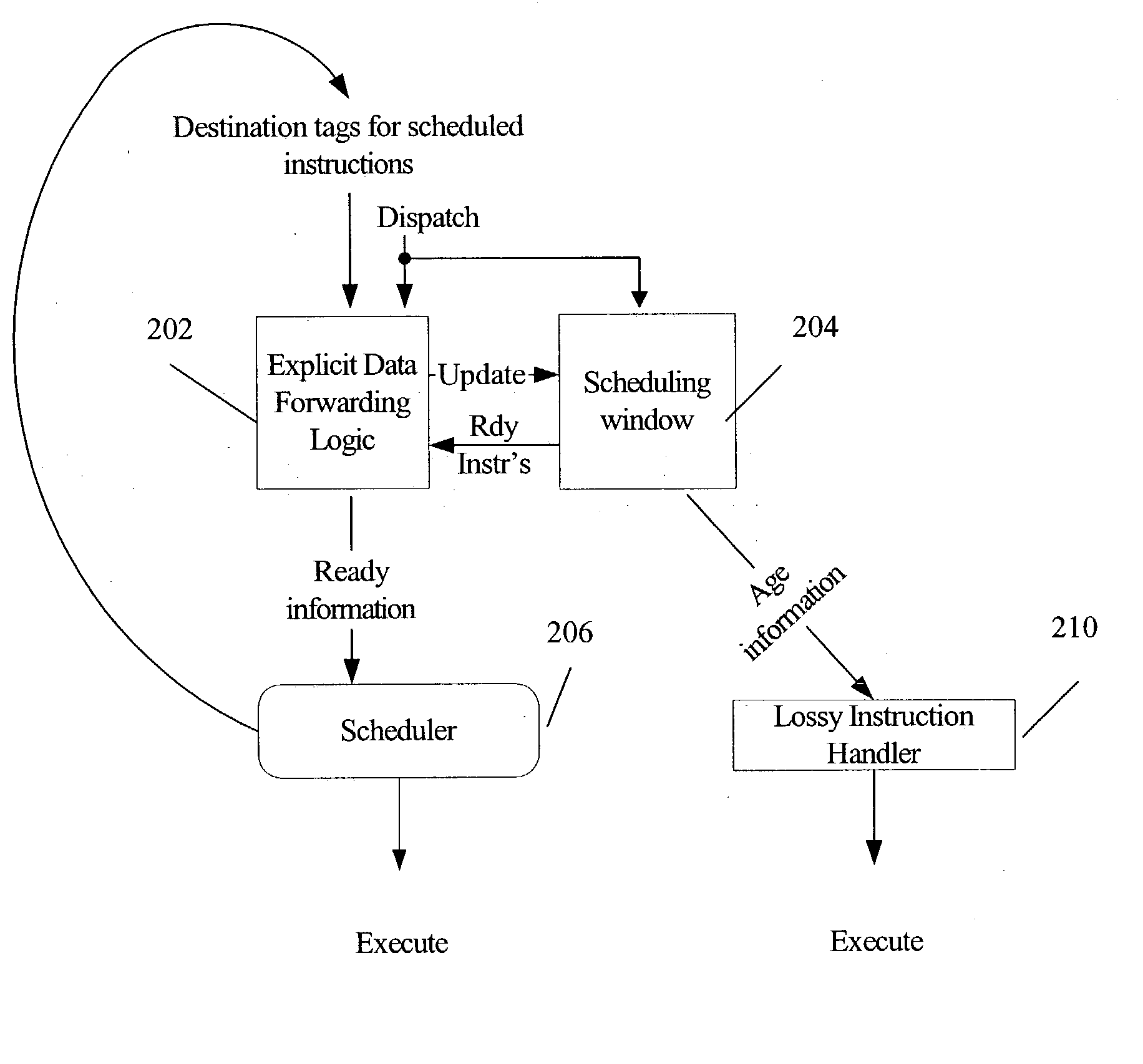
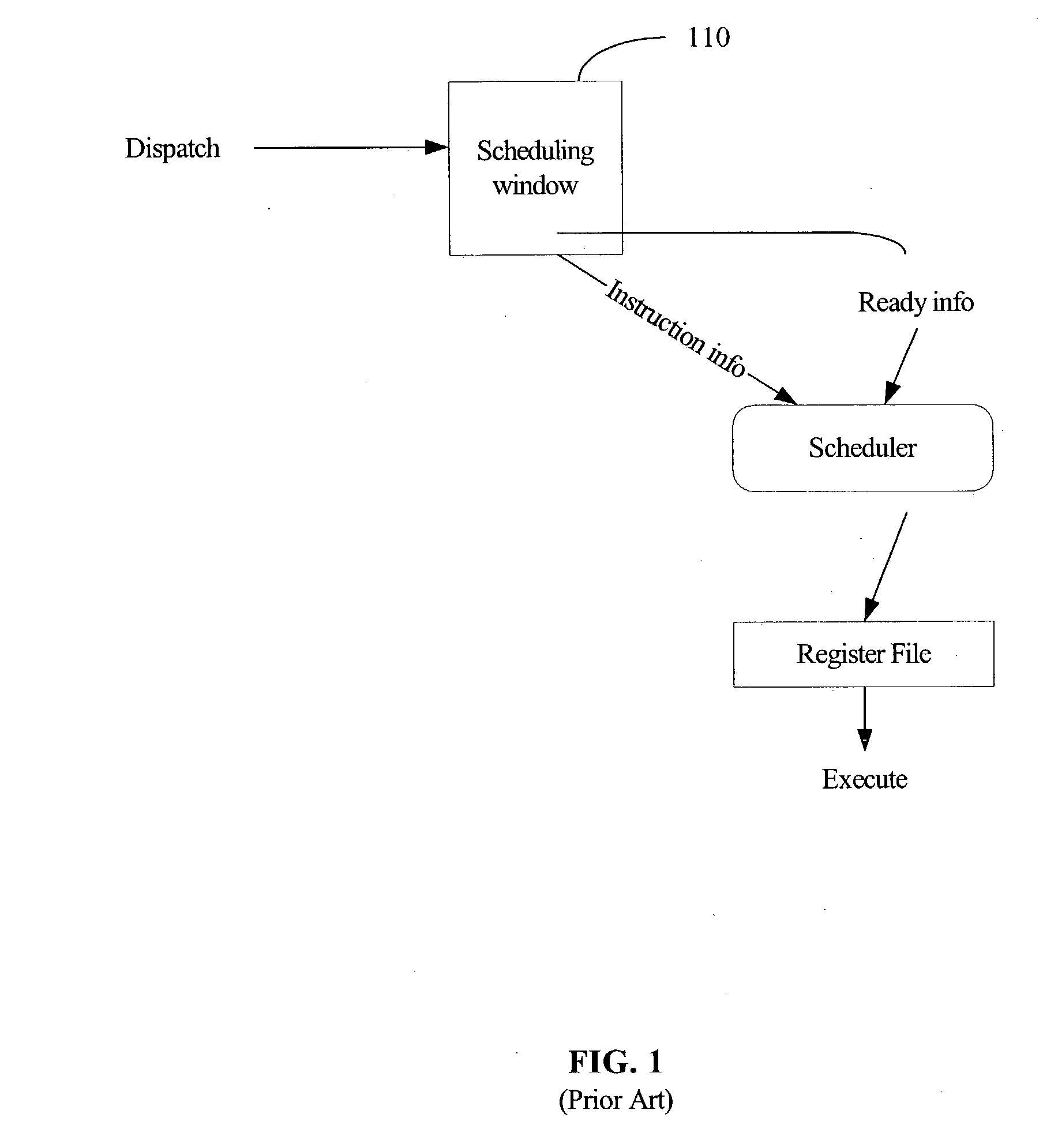
Tracking incoming tag information and recording ready state information for all entries in a large scheduling window 110 can be inefficient in that, typically, only a small subset of all scheduling window entries require such processing at a given time.
Another issue with typical large window 110 schemes is power consumption.

Method used

the structure of the environmentally friendly knitted fabric provided by the present invention; figure 2 Flow chart of the yarn wrapping machine for environmentally friendly knitted fabrics and storage devices; image 3 Is the parameter map of the yarn covering machine
View more

Image

Smart Image Click on the blue labels to locate them in the text.
Viewing Examples
Smart Image
  • Efficient lossy instruction scheduling
  • Efficient lossy instruction scheduling
  • Efficient lossy instruction scheduling

Examples

Experimental program
Comparison scheme
Effect test

Embodiment Construction

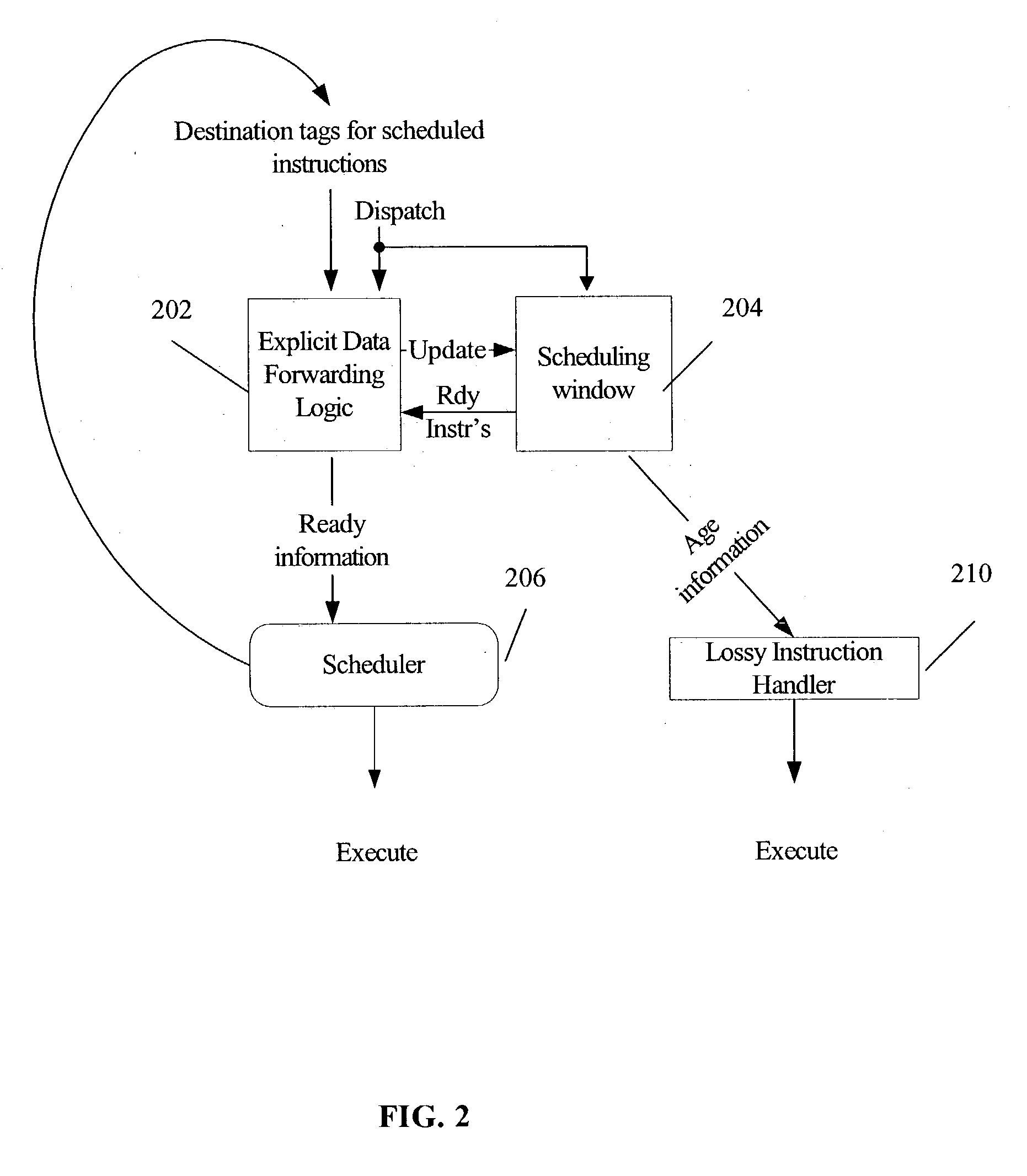
[0015] FIG. 2 is a block diagram illustrating a lossy instruction scheduling scheme that makes ready information available to a scheduler 206 without requiring the time-consuming and power-consuming process of looking through every entry in the scheduling window 204 to determine which instructions are "ready" for scheduling. As used herein, an instruction is "ready" for scheduling when all instructions providing source values upon which the instruction is dependent have been scheduled for execution. Accordingly, the dependent instruction is "ready" for scheduling when the current values of its source operands have been, or are currently scheduled to be, resolved. In other words, a dependent instruction is an instruction having one or more source operands that match the destination values of one or more other instructions, the other instructions occurring prior to the dependent instruction in the instruction stream.

[0016] FIG. 2 illustrates that at least one embodiment of an efficien...

the structure of the environmentally friendly knitted fabric provided by the present invention; figure 2 Flow chart of the yarn wrapping machine for environmentally friendly knitted fabrics and storage devices; image 3 Is the parameter map of the yarn covering machine
Login to View More

PUM

No PUM Login to View More

Abstract

A method and apparatus are provided for providing ready information to a scheduler. Dependence information is maintained in a relatively small map table, with potential loss of information when dependence information exceeds available space in the map table. Ready instructions are maintained, as space allows, in a select queue. Tags for scheduled instructions are maintained in a lookup queue, and dependency information for the scheduled instruction is maintained in an update queue, as space allows. Ready information for instructions in a scheduling window is updated based upon the information in the update queue. Loss of instruction information may occur, due to space limitations, at the map table, lookup queue, update queue, and / or select queue. Scheduling of lost instructions is handled by a lossy instruction handler.

Description

[0001] 1. Technical Field[0002] The present invention relates generally to information processing systems and, more specifically, to the maintaining and forwarding of ready state information to instruction scheduler logic.[0003] 2. Background Art[0004] The performance of many microprocessors is a function of, among other things, core clock frequency and the amount of instruction level parallelism (ILP) that can be derived from application software executed by the processor. ILP is the number of instructions that may be executed in parallel within a processor microarchitecture. In order to achieve a high degree of ILP, microprocessors may use large scheduling windows, high scheduling bandwidth, and numerous execution units. Larger scheduling windows allow a processor to more easily reach around blocked instructions to find ILP in the code sequence. High instruction scheduling bandwidth can sustain the instruction issue rates required to support a large scheduling window, and more exe...

Claims

the structure of the environmentally friendly knitted fabric provided by the present invention; figure 2 Flow chart of the yarn wrapping machine for environmentally friendly knitted fabrics and storage devices; image 3 Is the parameter map of the yarn covering machine
Login to View More

Application Information

Patent Timeline
no application Login to View More
Patent Type & Authority Applications(United States)
IPC IPC(8): G06F9/30G06F9/38
CPCG06F9/3836G06F9/384G06F9/3855G06F9/3838G06F9/3856
Inventor BREKELBAUM, EDWARD A.BLACK, BRYAN P.RUPLEY, JEFFREY P. II
Owner INTEL CORP
Features
  • R&D
  • Intellectual Property
  • Life Sciences
  • Materials
  • Tech Scout
Why Patsnap Eureka
  • Unparalleled Data Quality
  • Higher Quality Content
  • 60% Fewer Hallucinations
Social media
Patsnap Eureka Blog
Learn More