
IP address storage technique for longest prefix match
a technology of ip address and storage technique, which is applied in the direction of transmission, electric digital data processing, instruments, etc., can solve the problems of consuming about six times more power than sram, limiting the memory size of such designs, and severely restricting the number of ip addresses
- Summary
- Abstract
- Description
- Claims
- Application Information
AI Technical Summary
Problems solved by technology
Method used
Image

Examples
Embodiment Construction
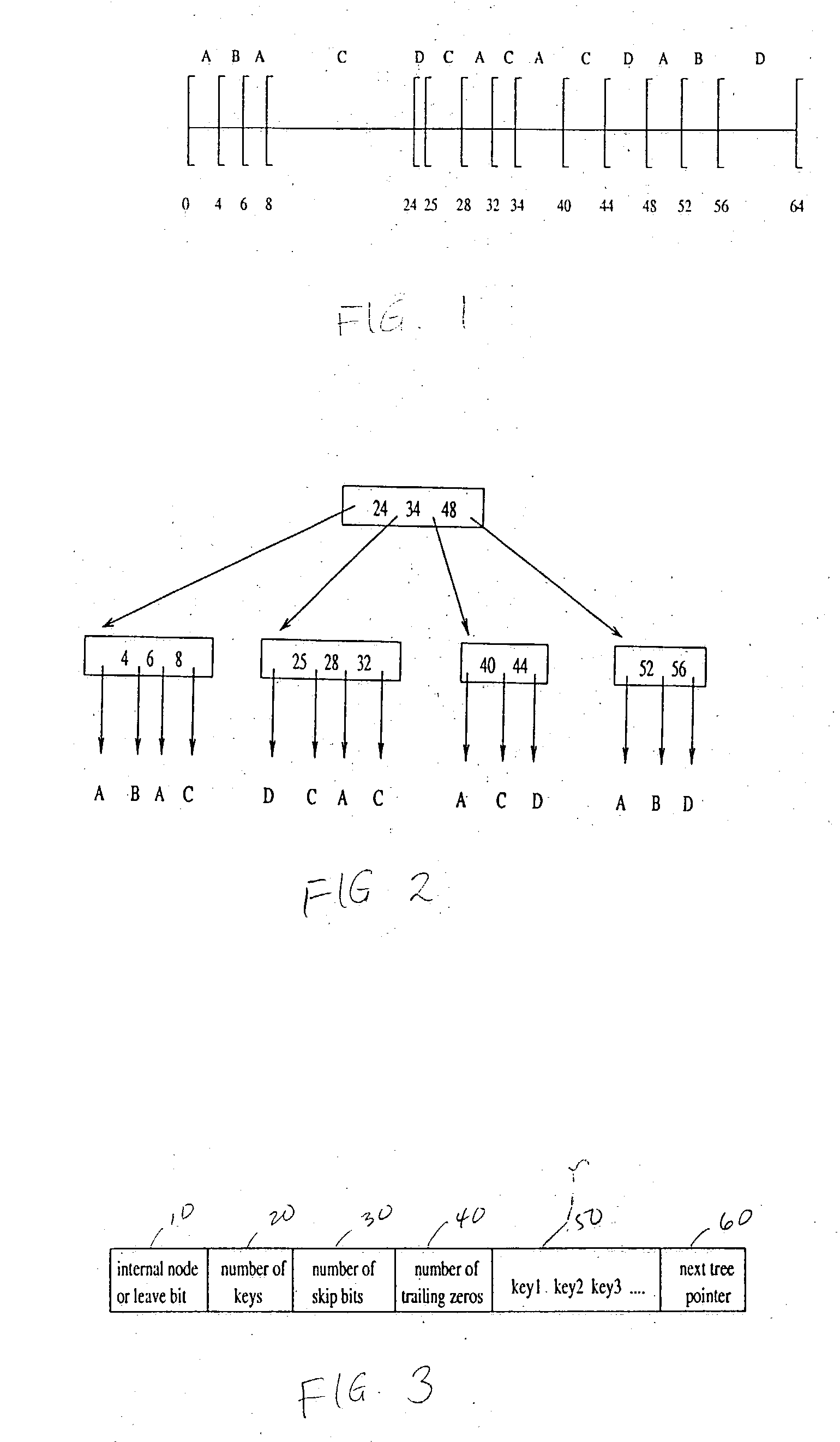
[0029] As noted above, the challenge of matching one IP (Internet Protocol) address to a prefix is daunting. This problem, known as the longest prefix match problem (i.e. finding the largest number of matching bits between one IP address and a database of IP prefixes) may be simplified by converting the problem into a range search conundrum. Simply put, the IP prefixes in the database to be searched may be sorted by order of magnitude (i.e. largest first or largest last). Any IP addresses which seeks a match with the database will only need to determine where in the sorted addresses it needs to be slotted. The longest prefix match would be the smaller of the addresses on either side of the address being searched. As an example, if the address on either side of 110111 are 110110 (smaller in value) and 111001, then the longest prefix match is 110110.
[0030] To implement the above idea, a prefix P is defined as representing addresses in a range. When an address is expressed as an integ...
PUM
 Login to View More
 Abstract
Description
Claims
Application Information
 Login to View More