

Biaryl sulfonamides and methods for using same
a technology of biaryl sulfonamide and sulfonamide, which is applied in the field of biaryl sulfonamide, can solve the problems of severe reduction of quality of life and deficiencies in the biomechanical characteristics of cartilage, and achieve the effect of inhibiting metalloproteinases
Patent Information
- Authority / Receiving Office
- US · United States
- Patent Type
- Applications(United States)
- Current Assignee / Owner
- Publication Date
- 2005-06-16
- Estimated Expiration
- Not applicable · inactive patent
Smart Images
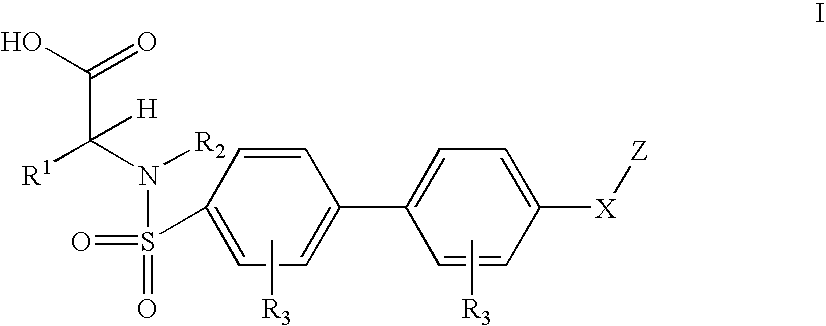
Figure 1 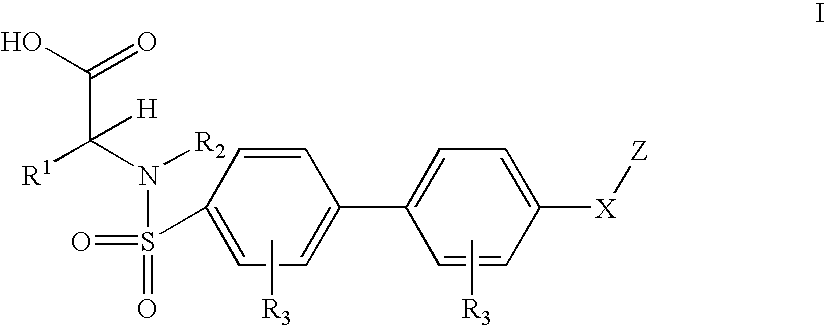
Figure 2 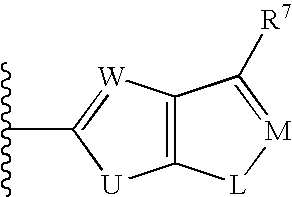
Figure 3
Abstract
Description
CROSS REFERENCE TO RELATED APPLICATIONS
[0001] This application claims benefit to U.S. Provisional Application No. 60 / 526,883, filed Dec. 4, 2003, the entirety of which is incorporated by reference herein.FIELD OF THE INVENTION
[0002] The present invention relates to biaryl sulfonamides and their use as, for example, novel metalloproteinase inhibitors. BACKGROUND OF THE INVENTION
[0003] Metalloproteinases, including matrix metalloproteinases and aggrecanases, are known to have a role in the breakdown of connective tissue. Matrix metalloproteinases (“MMPs”) constitute a superfamily of proteolytic enzymes that are genetically related and capable of degrading almost all the constituents of extracellular matrix and basement membrane that restrict cell movement. Aggrecanases are members of the ADAMTS (A disintegrin and metalloproteinase with thrombospondin motifs) family of proteins. Aggrecanase-1 and aggrecanase-2 have been designated ADAMTS-4 and ADAMTS-5, respectively (Tang B L, Int J...
Examples
example 1a
[0141]
3-Methyl-2-[4′-(3-methyl-quinolin-2-yloxymethyl)-biphenyl-4-sulfonylantinol-butyric acid
[0142] Step 1A [Intermediate 1] To a dry round-bottom flask was added 4-Bromo-benzenesulfonyl chloride (12.2 g, 47.7 mmol, 1 equiv.), anhydrous methylene chloride (170 mL), and H-D-Val-OMe (8.0 g, 47.7 mmol, 1 equiv.). The mixture was cooled to 0° C. in an ice bath followed by the addition of Hunig base (19.11 mL, 109.7 mmol, 2.3 equiv.). The reaction mixture was allowed to warm to room temperature and was stirred overnight. Reaction was complete as determined by TLC. The reaction mixture was then diluted with dichloromethane (100 mL) and washed with brine. The organic layer was dried over anhydrous MgSO4, solvent evaporated to yield 2-(4-Bromo-benzenesulfonylamino)-3-methyl-butyric acid methyl ester in 96% yield (16.0 g). 1H NMR (400 MHz, CHLOROFORM-D) δ ppm 0.87 (d, J=6.82 Hz, 3 H) 0.96 (d, J=6.82 Hz, 3 H) 2.04 (m, 1 H) 3.49 (s, 3 H) 3.74 (d, J=14.40 Hz, 1 H) 5.10 (d, J=9.85 Hz, 1 H) 7.6...
example 1b
[0149]
3-Methyl-2-[4′-(5-trifluoromethyl-pyridin-2-yloxymethyl)-biphenyl-4-sulfonylamino]-butyric acid
[0150] The title compound, 3-Methyl-2-[4′-(5-trifluoromethyl-pyridin-2-yloxymethyl)-biphenyl-4-sulfonylamino]-butyric acid, was prepared according to the procedures similar to that described for Example 1A.
[0151] Step 1C: 2-(4′-Hydroxymethyl-biphenyl-4-sulfonylamino)-3-methyl-butyric acid methyl ester (350 mg, 0.93 mmol, 1 equiv), 2-chloro-5-trifluoromethylpyridine (841 mg, 4.64 mmol, 5 equiv.) were dissolved in DMF (7 mL) followed by the addition of NaH (111 mg, 2.78 mmol, 3 equiv.) under N2 atmosphere. The mixture was heat to 100° C. for 2 hrs and cool to room temperature. Reaction mixture poured onto cold water and the resulting solid collected by filtration. Further purification by column chromatography (Silica gel, 20% EtOAc / Hexane) to afford 259 mg of G9058-182-2 in 54% yield.
[0152] 1H NMR (400 MHz, CHLOROFORM-D) δ ppm 0.82 (d, J=6.82 Hz, 3 H) 0.90 (d, J=6.82 Hz, 3 H) 1.98 (...
example 1c
[0156]
2-[4′-(2,8-Bis-trifluoromethyl-quinolin-4-yloxymethyl)-biphenyl-4-suffonylamino]-3-methyl-butyric acid
[0157] Step 2A [Intermediate 4, G9591-157-1]: To a solution of 2,8-Bis-trifluoromethyl-quinolin-4-ol (3.85 g, 13.7 mmol, 1.1 equiv.) in DMF (40 mL) was added 2-(4-Bromomethyl-phenyl)-4,4,5,5-tetramethyl-[1,3,2]dioxaborolane (3.7 g, 12.5 mmol, 1.0 equiv.) and K2CO3 (3.45 g, 24.92 mmol, 2.2 equiv.) under N2 atmosphere. The reaction mixture was stirred at room temperature overnight. The reaction was complete as determined by TLC. The reaction mixture was poured into cold water, the white precipitate formed was collected by filtration, washed with water, dried under vacuum to yield 4-[4-(4,4,5,5-Tetramethyl-[1,3,2]dioxaborolan-2-yl)-benzyloxy]-2,8-bis-trifluoromethyl-quinoline in 73% yield (4.95 g).
[0158] 1H NMR (400 MHz, CHLOROFORM-D) δ ppm 1.36 (s, 12 H) 5.38 (s, 2 H) 7.21 (s, 1 H) 7.51 (d, J=8.34 Hz, 2 H) 7.65 (t, J=7.83 Hz, 1 H) 7.90 (d, J=8.08 Hz, 2 H) 8.14 (d, J=7.33 Hz, 1...