Check patentability & draft patents in minutes with Patsnap Eureka AI!

Food enclosing container with rebondable rim and liquid absorption and barrier layers

a food container and rim technology, applied in the field of thermoformed paperboard food containers, can solve the problems of container soiled appearance, food product unpleasantly greasy, and container soiled appearan

Inactive Publication Date: 2005-08-25
TYGAR INVESTMENTS
View PDF16 Cites 14 Cited by
  • Summary
  • Abstract
  • Description
  • Claims
  • Application Information

AI Technical Summary

Benefits of technology

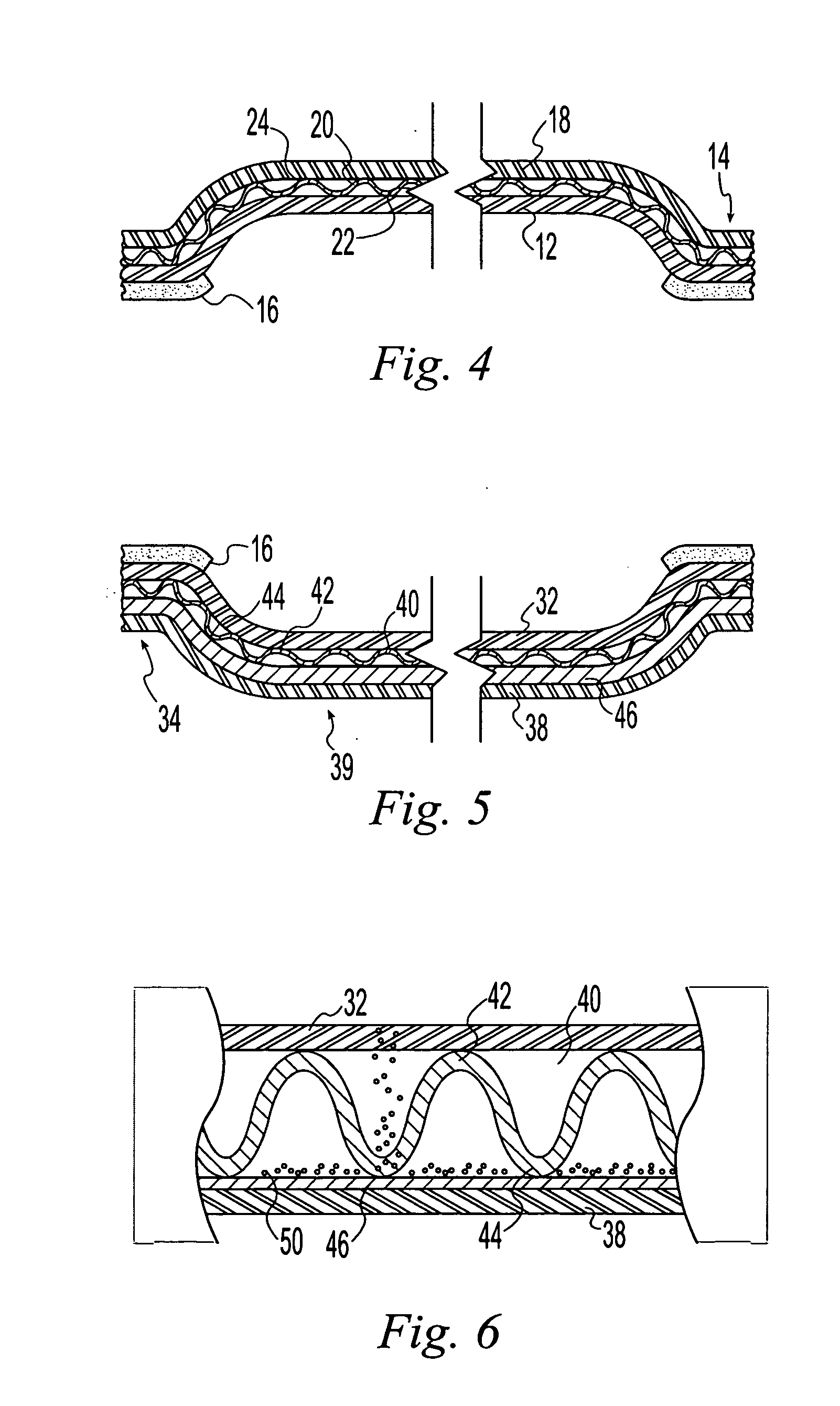
[0024]FIG. 4 is a cross-sectional view illustrating in more detail construction of the top member of the embodiment in FIG. 1.
[00

Problems solved by technology

Although these prior art container products have provided a substantial improvement over prior technology and have given good service to consumers, they continue to exhibit some deficiencies or undesirable characteristics.
As a consequence, the food product becomes unpleasantly greasy and is seen by the consumer to be resting on an undesirably greasy surface.
If, instead, no liquid impervious layer is applied to the bottom surface, exuded grease, juices and moisture soak through the container bottom where they cause the container to exhibit a soiled appearance and can even stain an underlying tablecloth or other supporting surface.
However, this adds further supply cost, consumes additional material and requires additional assembly time and labor.
Additionally, in the absence of a moisture impervious layer, the bottom can become soaked with liquids from the food product and become weakened and flimsy.
The loss of sufficient rigidity makes the container, when held by the consumer, more likely to separate and tear or deform and allow the food product to spill out of the container.
This causes the top of the food product to become undesirably soggy in appearance and texture.
Conventional pizza boxes also require labor to assemble which adds to the cost and time for production of the final, deliverable product.
Once assembled, they require considerable space for storage while awaiting the insertion of a pizza because they do not efficiently nest or stack in a vertical column.
The conventional pizza box also relies on the friction fit of the lid or top against the sidewalls of the bottom and does not always close properly or remain tightly closed to keep the pizza fresh.
Another problem is that the traditional square pizza box is bulky and often difficult to fit into a refrigerator.
Because of their size and bulk, they can be difficult to dispose of.
However, this requires the use of two corrugated layers and the step of gluing them together.
Consequently, the Hall proposal involves significant additional material and manufacturing time and effort.
However, the products were not commercialized because of their serious deficiencies and inadequacies.
The plates were made from paper rather than corrugated paperboard and therefore they lacked sufficient rigidity and thermal insulation characteristics.
As a result, the container formed in this manner was too flimsy to hold the contained product and the rim was so flimsy that it warped and consequently did not permit the adhesive to be properly and evenly applied.
Because of the inadequate insulation provided by paper, this container did not maintain the temperature of the enclosed food product for a sufficiently long time and also allowed its exterior surface to become hot to the touch, possibly resulting in a burning sensation or injury to the consumer.
The paper material was unscored prior to forming the paper plates, which caused bunching of the paper material and formed wrinkles in the product.
The wrinkles in the rim surfaces did not allow for the smooth application of the bonding material used to bond the plates together.
This stringing of the bonding material made the plates incapable of being resealed and the long strings of bonding agent could then fall onto the contained food product.
In addition, the film barrier, placed on the inside of the lower plate, did not allow for the absorption of grease or water vapor and therefore, the grease or condensed liquid would “pool” on the surface and be reabsorbed by the contained food.

Method used

the structure of the environmentally friendly knitted fabric provided by the present invention; figure 2 Flow chart of the yarn wrapping machine for environmentally friendly knitted fabrics and storage devices; image 3 Is the parameter map of the yarn covering machine
View more

Image

Smart Image Click on the blue labels to locate them in the text.
Viewing Examples
Smart Image
  • Food enclosing container with rebondable rim and liquid absorption and barrier layers
  • Food enclosing container with rebondable rim and liquid absorption and barrier layers
  • Food enclosing container with rebondable rim and liquid absorption and barrier layers

Examples

Experimental program
Comparison scheme
Effect test

Embodiment Construction

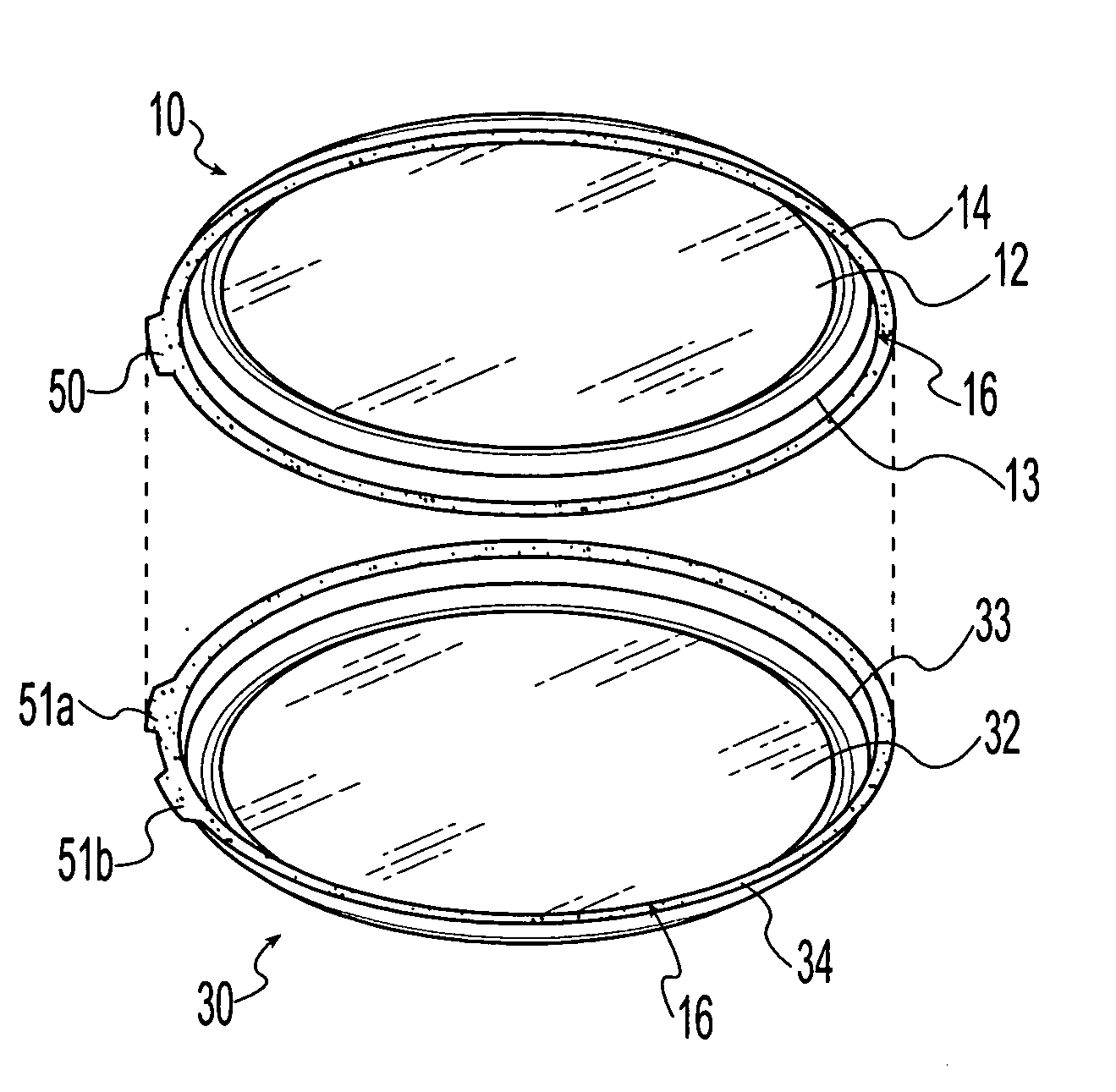
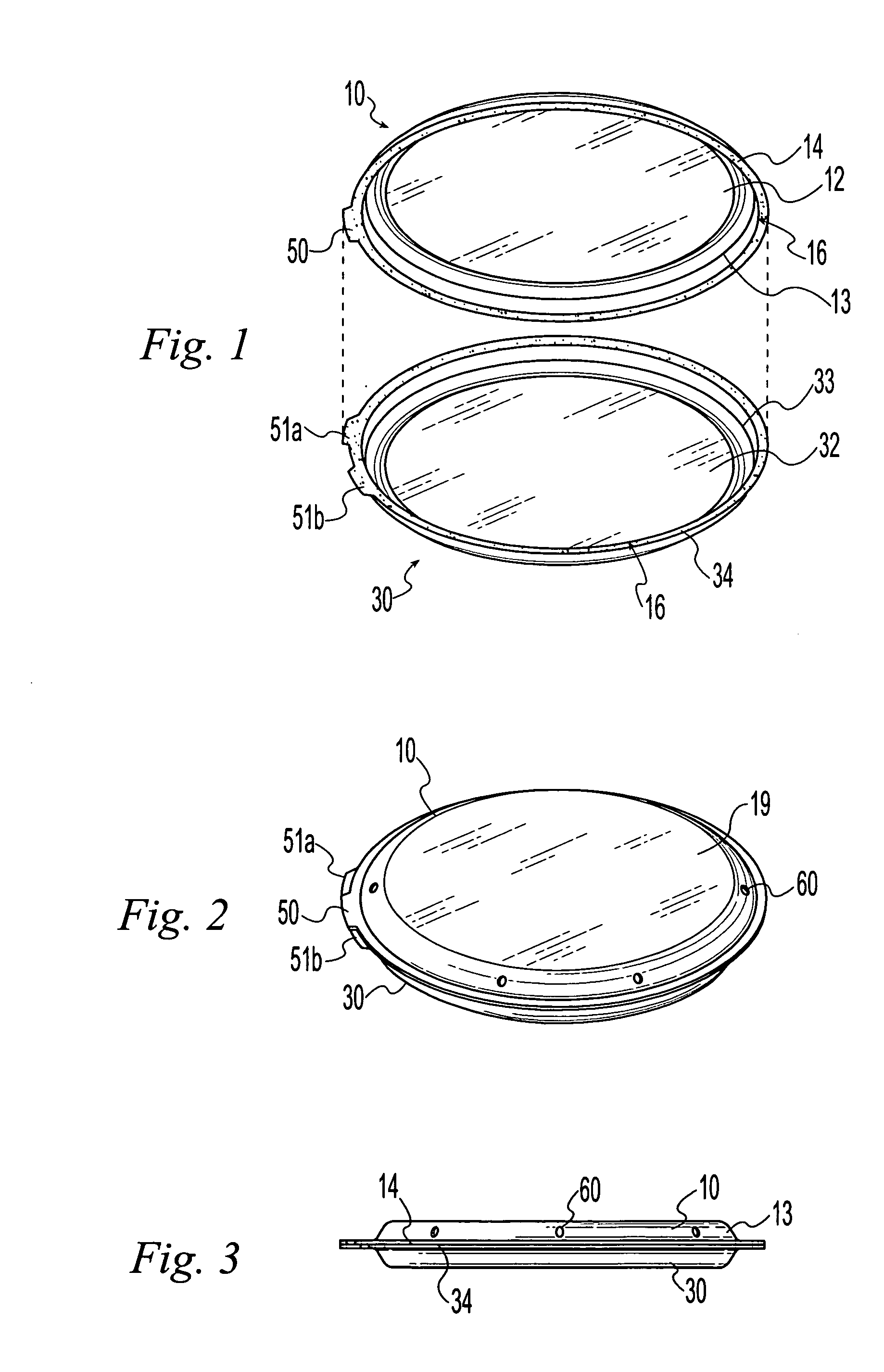
[0032] The preferred embodiment of the present invention is illustrated in FIGS. 1-6. The invention is a food enclosing container that is principally intended for pizza but can be used for a variety of food products, including restaurant carryout orders and fast food products.

[0033] The food enclosing container has a top member 10 and a bottom member 30, each formed of absorbent, corrugated paperboard having at least three, laminated layers. Importantly, with the invention, neither interior surface of the top and bottom members have a moisture impervious layer on them. In the preferred embodiment, the top member 10 and the bottom member 30 are pressformed into trays having respective sidewalls 13 and 33 and having a circular periphery, which conforms to the shape of a conventional pizza. In an operable orientation, the peripheral rims 14 and 34 of the top 10 and bottom 30 members are engageable with one another. To achieve the operable orientation, the top member 10 is rotated so i...

the structure of the environmentally friendly knitted fabric provided by the present invention; figure 2 Flow chart of the yarn wrapping machine for environmentally friendly knitted fabrics and storage devices; image 3 Is the parameter map of the yarn covering machine
Login to View More

PUM

No PUM Login to View More

Abstract

A food enclosing container that has a top member and a bottom member, each formed of absorbent, corrugated paperboard, wherein at least one of the members has pressformed sidewalls. The paperboard has at least three layers, a smooth first layer, a smooth third layer and a corrugated layer interposed between the first and third layers. The top member has an unsealed interior surface so that it can absorb moisture from a contained food product. The bottom member has a grease barrier layer within the interior of its paperboard preferably positioned on the top surface of the third layer. Each of the members have engageable peripheral rims, which have a releasable, rebondable cohesive applied to the rims to permit the members to be bonded together, separated and rebonded together.

Description

BACKGROUND OF THE INVENTION [0001] 1. Field of the Invention [0002] This invention relates generally to thermoformed, paperboard food containers, and more particularly to two part food containers which entirely enclose a prepared food product, maintain the quality of the food product and the appearance of both the food product and the container, while permitting the container to be reused multiple times for storing unconsumed portions of the food product. [0003] 2. Description Of The Related Art [0004] Many food containers, including those that hold pizza, are commonly made to be disposable after use for one food product. For example, pizza boxes are typically made from conventional, corrugated paperboard such as the pizza box illustrated in U.S. Pat. No. 4,441,626 to Hall, which discloses a pizza box formed from a double-sided corrugated blank. Other food containers, such as plates, bowls, clamshells and trays, are thermoformed or pressformed from relatively thin corrugated paperbo...

Claims

the structure of the environmentally friendly knitted fabric provided by the present invention; figure 2 Flow chart of the yarn wrapping machine for environmentally friendly knitted fabrics and storage devices; image 3 Is the parameter map of the yarn covering machine
Login to View More

Application Information

Patent Timeline
no application Login to View More
IPC IPC(8): A23L3/00B65D43/02B65D43/14B65D65/40B65D77/20B65D81/26
CPCB65D65/403B65D77/2096Y10S229/939B65D2585/366Y10S229/906B65D81/264
Inventor ALEXANDER, GAROLD W.HOBLET, BENJAMIN K.O'NEIL, ERIK A.RECHEL, SCOTT F.HARVEY, JOHN
Owner TYGAR INVESTMENTS
Features
  • R&D
  • Intellectual Property
  • Life Sciences
  • Materials
  • Tech Scout
Why Patsnap Eureka
  • Unparalleled Data Quality
  • Higher Quality Content
  • 60% Fewer Hallucinations
Social media
Patsnap Eureka Blog
Learn More