Check patentability & draft patents in minutes with Patsnap Eureka AI!

Printer driver supporting worldwide single binary font format with built in support for double byte characters

a printing driver and double byte technology, applied in the field of printing glyphs, can solve the problems of reducing the printing speed of the printer, so as to achieve the maximum utilization of printer device fonts and enhance printing performan

Inactive Publication Date: 2005-10-06
MICROSOFT TECH LICENSING LLC
View PDF2 Cites 6 Cited by
  • Summary
  • Abstract
  • Description
  • Claims
  • Application Information

AI Technical Summary

Benefits of technology

The solution enables correct and optimized printing of glyphs from all languages, reduces support and maintenance costs, and allows for a single printer driver to support multiple languages and printing formats, enhancing printing performance and reducing the need for separate drivers.

Problems solved by technology

Worldwide globalization has affected many industries, providing both tremendous opportunity and overwhelming problems.
Many of these problems are related to the complex cultural differences between nations and their people, while some lie at a more basic level.
One such basic problem is that of language.
While the computer industry has enjoyed a tremendous growth in the global market, problems relating to multi-language data input, processing, display, interchange, and printing have proved to be serious impediments to the realization of the potential growth of this industry on a worldwide scale.
Extension of these programs and drivers to other countries and other languages requires extensive redesign and re-coding, which delays the availability and increases the cost of such programs and drivers.
This problem exists because of the way that computers identify the various glyphs of worldwide languages.
While such a standard is adequate to display and print glyphs utilized in the English language, it does not include provision for many international characters used around the world.
Unfortunately, these various national and international standards cannot utilize common coding of their glyphs because only 256 separate glyphs can be addressed with 8 bits.
This lack of a common representation for a given glyph code presents serious problems when international exchange of data through, for example, e-mail is considered.
Unfortunately, a single byte coding of these characters will only be able to address a maximum of 256 of these over 20,000 glyphs by using all 8 bits in a single byte.
However, as described above, the requirement of a separate interface type function requires additional programming, increased cost, and delayed availability of many programs originally developed for western application.
While full implementation of the Unicode Standard is anticipated to overcome the problems described above, a vast majority of the computer hardware and software available and in use today does not recognize the Unicode double byte character identification standard.
While a computer printer can print any glyph, English, international, as well as Far Eastern glyphs, the mechanism by which a majority of these international characters are printed greatly handicaps the printing performance of the device.
Even with the high speed, sophisticated equipment available today, this transfer of bitmap data to allow a printer to draw an international character greatly slows the printing performance of the device.
Unfortunately, current printer drivers are unable to switch between symbol sets, requiring that separate drivers be provided to allow the enhanced printing performance of device fonts for each separate language.
As discussed above, this increases the development time, increases the cost, and delays the availability of these programs on an international basis.
This problem is acute when importation into Far East countries is considered.
Therefore, the development time and cost are greatly increased for release of these programs in the Far Eastern countries.
In addition to the tradeoff between the speed of utilizing device fonts with the associated increased development and support costs versus the reduced printing performance of printing international characters as bitmaps.
Unfortunately, current printer drivers are unable to switch between these printing formats, which results in the printed document being different than the same document viewed on a display.

Method used

the structure of the environmentally friendly knitted fabric provided by the present invention; figure 2 Flow chart of the yarn wrapping machine for environmentally friendly knitted fabrics and storage devices; image 3 Is the parameter map of the yarn covering machine
View more

Image

Smart Image Click on the blue labels to locate them in the text.
Viewing Examples
Smart Image
  • Printer driver supporting worldwide single binary font format with built in support for double byte characters
  • Printer driver supporting worldwide single binary font format with built in support for double byte characters
  • Printer driver supporting worldwide single binary font format with built in support for double byte characters

Examples

Experimental program
Comparison scheme
Effect test

Embodiment Construction

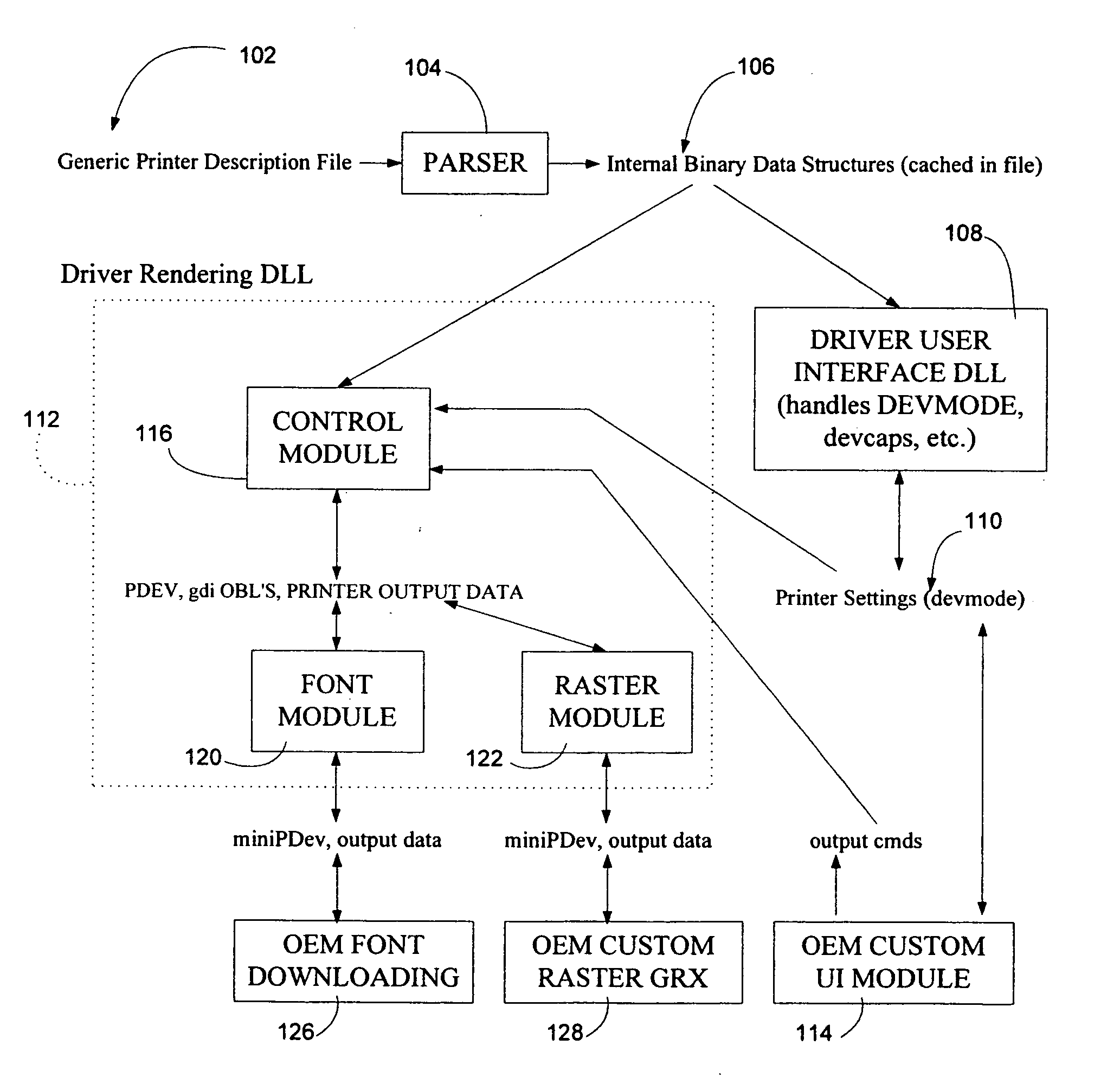
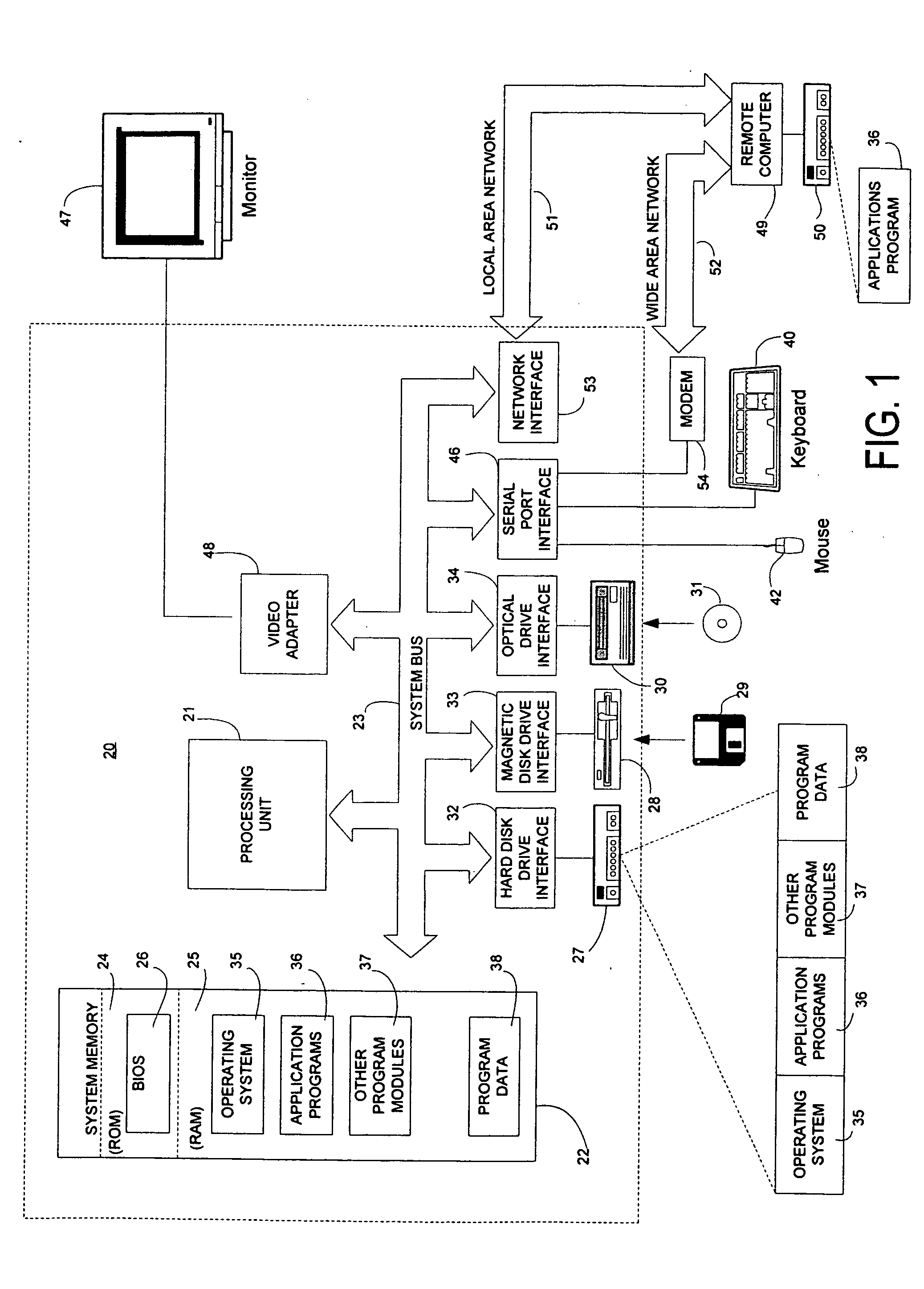
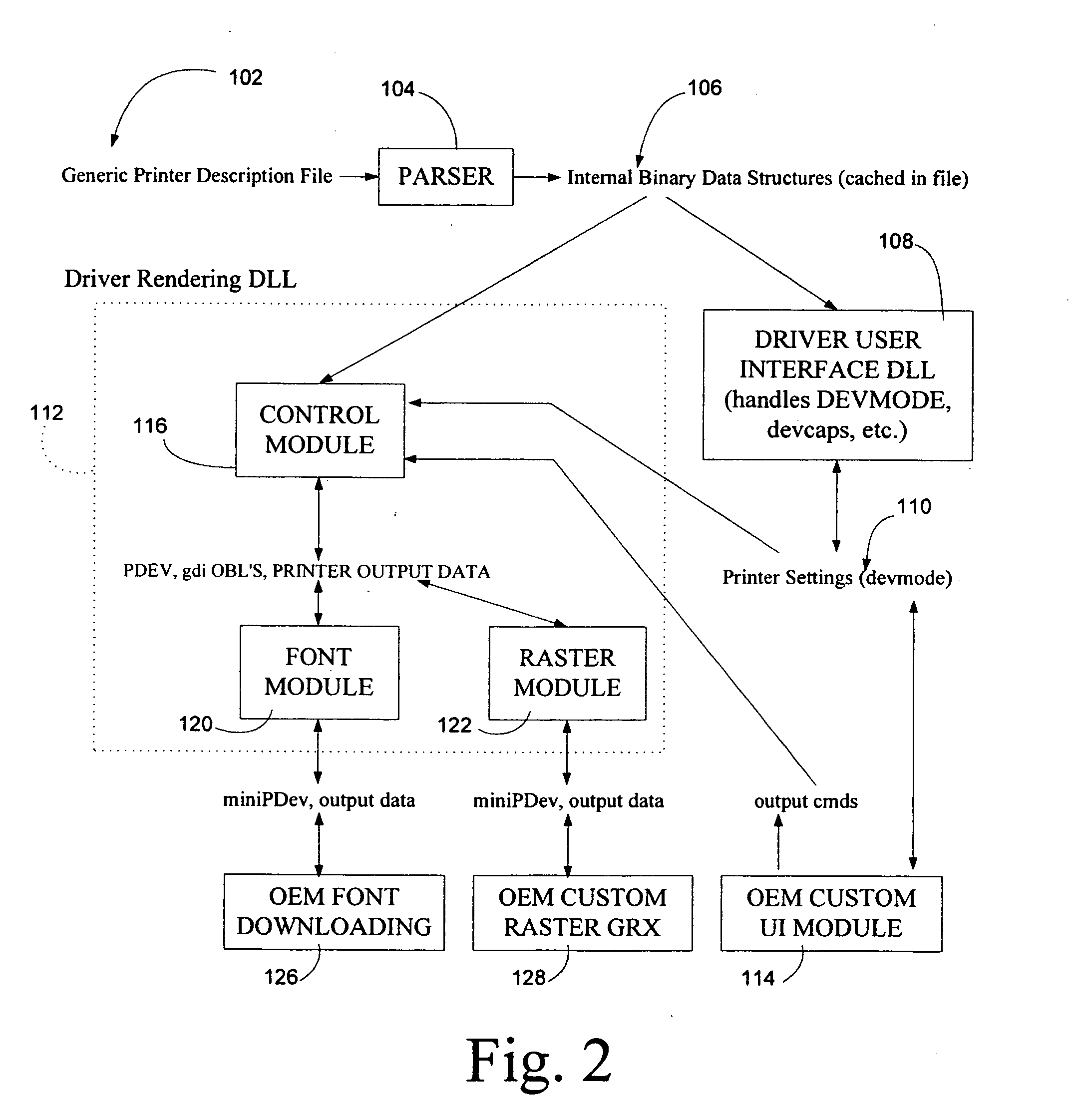
[0026]FIG. 1 in the following discussion are intended to provide a brief, general description of a suitable computing environment in which the invention may be implemented. Although not required, the invention will be described in the general context of computer-executable instructions, such as program modules, being executed by a personal computer. Generally, program modules include routines, programs, objects, components, data structures, etc. that perform particular tasks or implement particular abstract data types. Moreover, those skilled in the art will appreciate that the invention may be practiced with other computer system configurations, including hand-held devices, microprocessor systems, microprocessor-based or programmable computer electronics, network PCs, minicomputers, mainframe computers, and the like. The invention may also be practiced and distributed computing environments where tasks are performed by remote processing devices that are linked through a communicati...

the structure of the environmentally friendly knitted fabric provided by the present invention; figure 2 Flow chart of the yarn wrapping machine for environmentally friendly knitted fabrics and storage devices; image 3 Is the parameter map of the yarn covering machine
Login to View More

PUM

No PUM Login to View More

Abstract

A computer system and method for outputting printer commands to a printer in response to a print request from an application program are presented. The printer includes a device font whose characters are addressed for printing via a single, double, or n-byte code. The text data, however, utilizes the Unicode Standard to identify its characters. The system, therefore, includes a graphics device interface, which is compatible to read the Unicode data, to invoke the printer driver functions for controlling the outputting of the text data to the printer. A printer OEM supplied minidriver contains a characterization of the printer, including information identifying the device font resident in the printer and the code used to identify the individual characters of the font. A printer driver uses this information to translate the text data to be printed from the Unicode Standard to a code capable of selecting a device font provided character.

Description

CROSS REFERENCE TO RELATED APPLICATIONS [0001] This application is a continuation of and claims priority to U.S. patent application Ser. No. 10 / 262,831 which, in turn, is a continuation of U.S. application Ser. No. 09 / 157,917, now U.S. Pat. No. 6,490,051, the disclosures of which are incorporated by reference herein. CROSS-REFERENCE TO RELATED APPLICATIONS [0002] This is a continuation of co-pending application Ser. No. 09 / 157,917 filed Sep. 21, 1998, the teachings and disclosure of which are hereby incorporated in their entireties herein by reference thereto.FIELD OF THE INVENTION [0003] This invention relates to the printing of glyphs, and more particularly to the optimization of the selection and printing of glyphs whose characters are identified by multi-byte standards. BACKGROUND OF THE INVENTION [0004] Worldwide globalization has affected many industries, providing both tremendous opportunity and overwhelming problems. Many of these problems are related to the complex cultural...

Claims

the structure of the environmentally friendly knitted fabric provided by the present invention; figure 2 Flow chart of the yarn wrapping machine for environmentally friendly knitted fabrics and storage devices; image 3 Is the parameter map of the yarn covering machine
Login to View More

Application Information

Patent Timeline
no application Login to View More
Patent Type & Authority Applications(United States)
IPC IPC(8): G06F3/12G06F15/00
CPCG06F3/1206G06F3/1244G06F3/1227G06F3/1211
Inventor NGUYEN, AMANDAPANDEY, GANESHSCHOLTEN, ALVINWU, ZHANBINGSHIMIZU, EIGOWONG, PETER
Owner MICROSOFT TECH LICENSING LLC
Features
  • R&D
  • Intellectual Property
  • Life Sciences
  • Materials
  • Tech Scout
Why Patsnap Eureka
  • Unparalleled Data Quality
  • Higher Quality Content
  • 60% Fewer Hallucinations
Social media
Patsnap Eureka Blog
Learn More