Method for recognizing location move of VoIP phones

a technology of voip phones and location moves, applied in the field of telephone systems and data systems, can solve the problems of out-of-date dn to ali mappings, increased phone mobility, and lack of knowledge on the part of the administrator that the phone has been moved

a technology of voip phones and location moves, applied in the field of telephone systems and data systems, can solve the problems of out-of-date dn to ali mappings, increased phone mobility, and lack of knowledge on the part of the administrator that the phone has been moved

US20050232164A1Inactive Publication Date: 2005-10-20MITEL

Image

Smart Image Click on the blue labels to locate them in the text.
Viewing Examples
Smart Image
  • Method for recognizing location move of VoIP phones
  • Method for recognizing location move of VoIP phones

Examples

Experimental program
Comparison scheme
Effect test

Embodiment Construction

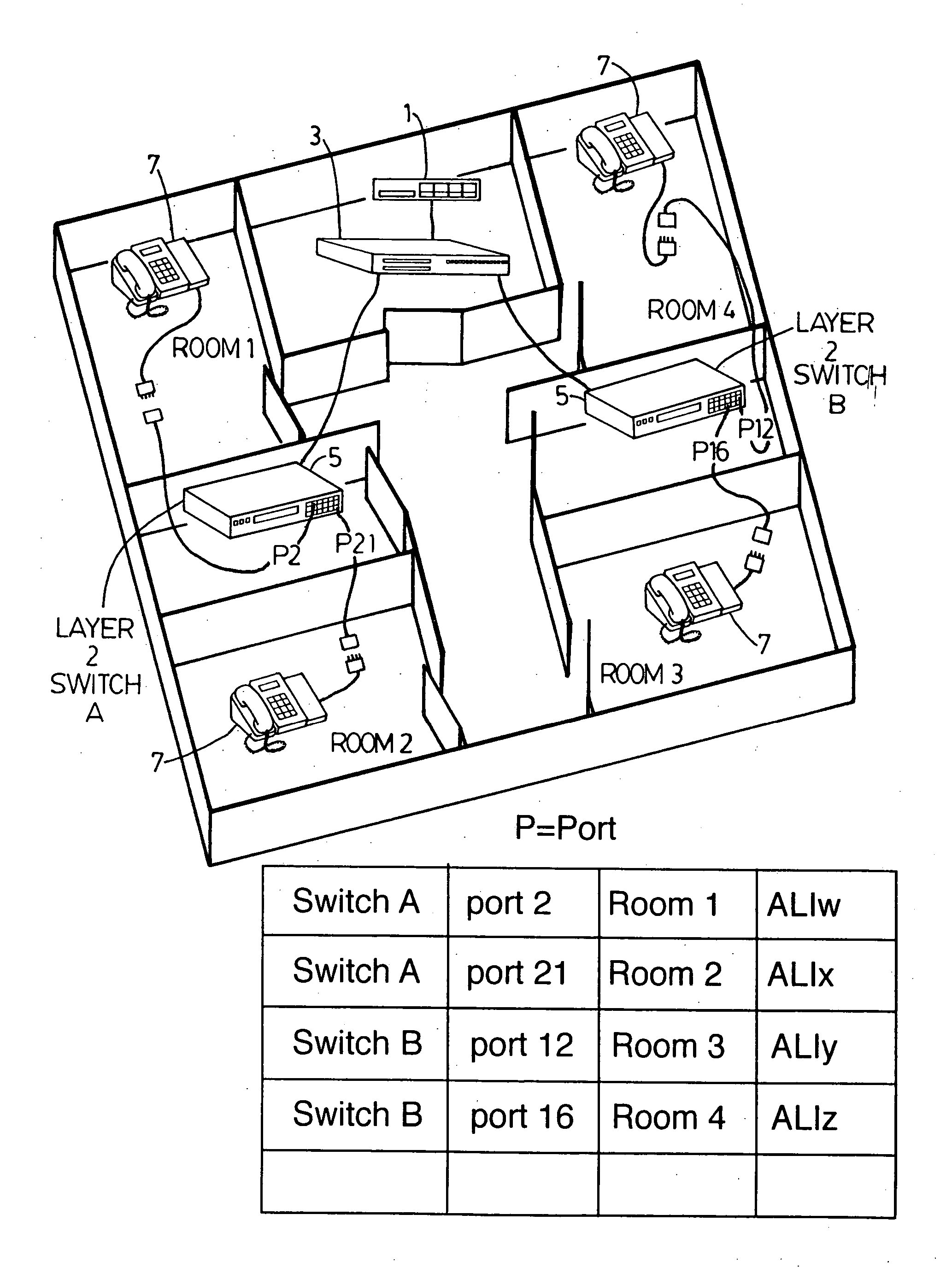
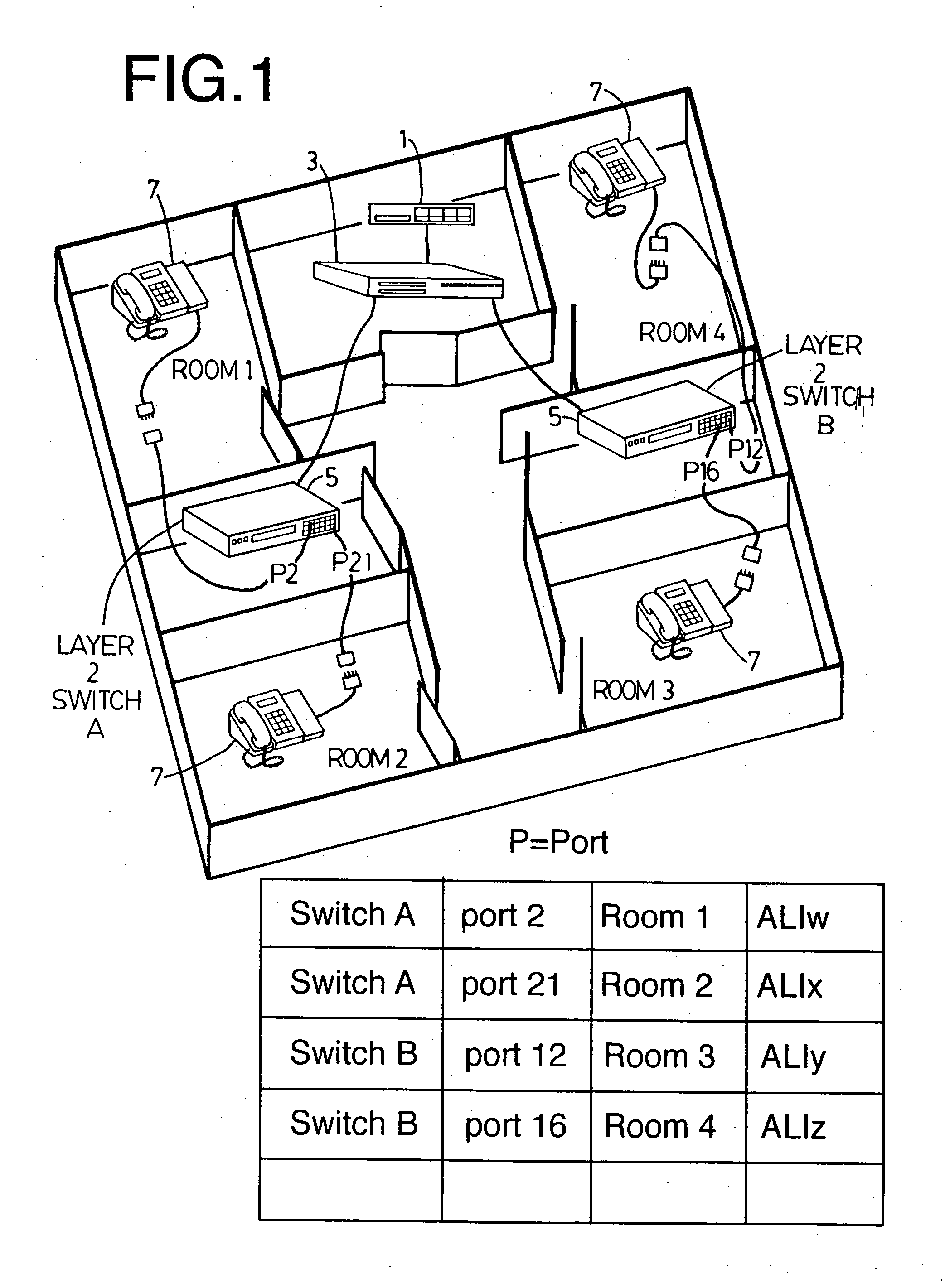
[0019]FIG. 1 depicts a communications network environment (e.g. a LAN) within a building (or spread over a number of buildings via a WAN) having a plurality of network devices such as computers, printers, and IP phones (the computers, printers, etc. not being shown). An iPBX 1, such as the MN3000 Integrated Communications Platform (ICP) manufactured by Mitel Networks Inc. provides traditional PBX functionality along with advanced features, over a data network (e.g. LAN). The iPBX 1 is connected to a router 3 in a well-known manner. A plurality of IEEE Layer 2 switches 5, each having multiple ports, are disposed in various rooms and are connected to the router 3. A plurality of IP devices, such as IP phones 7, are connected to the L2 switches 5.

[0020] In order for the IP phones to recognize where they are connected in the network hierarchy, the LAN is programmed to issue either the IEEE 802.1 Spanning Tree Protocol, the standard global 802.1ab Link Layer Discovery Protocol, or any p...

the structure of the environmentally friendly knitted fabric provided by the present invention; figure 2 Flow chart of the yarn wrapping machine for environmentally friendly knitted fabrics and storage devices; image 3 Is the parameter map of the yarn covering machine
Login to View More

PUM

No PUM Login to View More

Abstract

A method is provided for tracking the physical location of IP phones and IP devices in a network. According to the invention, the IP phone or IP device detects its own current location and then informs the PBX controller or the location database to which it is connected. The capability is integrated in every IP phone and IP device. The PBX or location database then takes appropriate action, such as updating the ALI mapping for the phone or location information for the IP device.

Description

BACKGROUND OF THE INVENTION [0001] 1. Field of the Invention [0002] The present invention relates generally to telephone systems and data systems, and more particularly to a method of tracking the physical location of VoIP phones and IP devices in a closed environment. [0003] 2. Description of the Related Art [0004] One of the benefits of VoIP technology is that an IP phone can be moved from one physical location to another without administrator intervention to, effect the change. Connectivity between the IP phone and that PBX is via IP messaging over a data network. However, this increase in phone mobility gives rise to a lack of knowledge on the part of the administrator that the phone has been moved. This can lead to problems, particularly in maintaining accurate location information for E911 services. [0005] Support of Emergency Services requires Automatic Location Identification (ALI) number to be sent to a Public Safety Answering Point (PSAP) when an emergency service number (...

Claims

the structure of the environmentally friendly knitted fabric provided by the present invention; figure 2 Flow chart of the yarn wrapping machine for environmentally friendly knitted fabrics and storage devices; image 3 Is the parameter map of the yarn covering machine
Login to View More

Application Information

Patent Timeline
20 Oct 2005
Publication
US20050232164A1
IPC
H04L12/24; H04L29/06; H04L29/08; H04L29/12; H04M3/42; H04M7/00
CPC
H04L29/06; H04L29/06027; H04L29/12839; H04L41/12; H04L61/6022; H04L69/329; H04M3/42314; H04M3/42357
Inventors
ANZAROUTH, RALPH; NASON, CHRIS