

Air flow direction neutral heat transfer device
a technology of heat transfer device and air flow direction, which is applied in semiconductor devices, lighting and heating apparatus, cooling/ventilation/heating modifications, etc., can solve the problems of limited heat sink size and unfavorable arrangemen
- Summary
- Abstract
- Description
- Claims
- Application Information
AI Technical Summary
Benefits of technology
Problems solved by technology
Method used
Image

Examples
embodiment 31
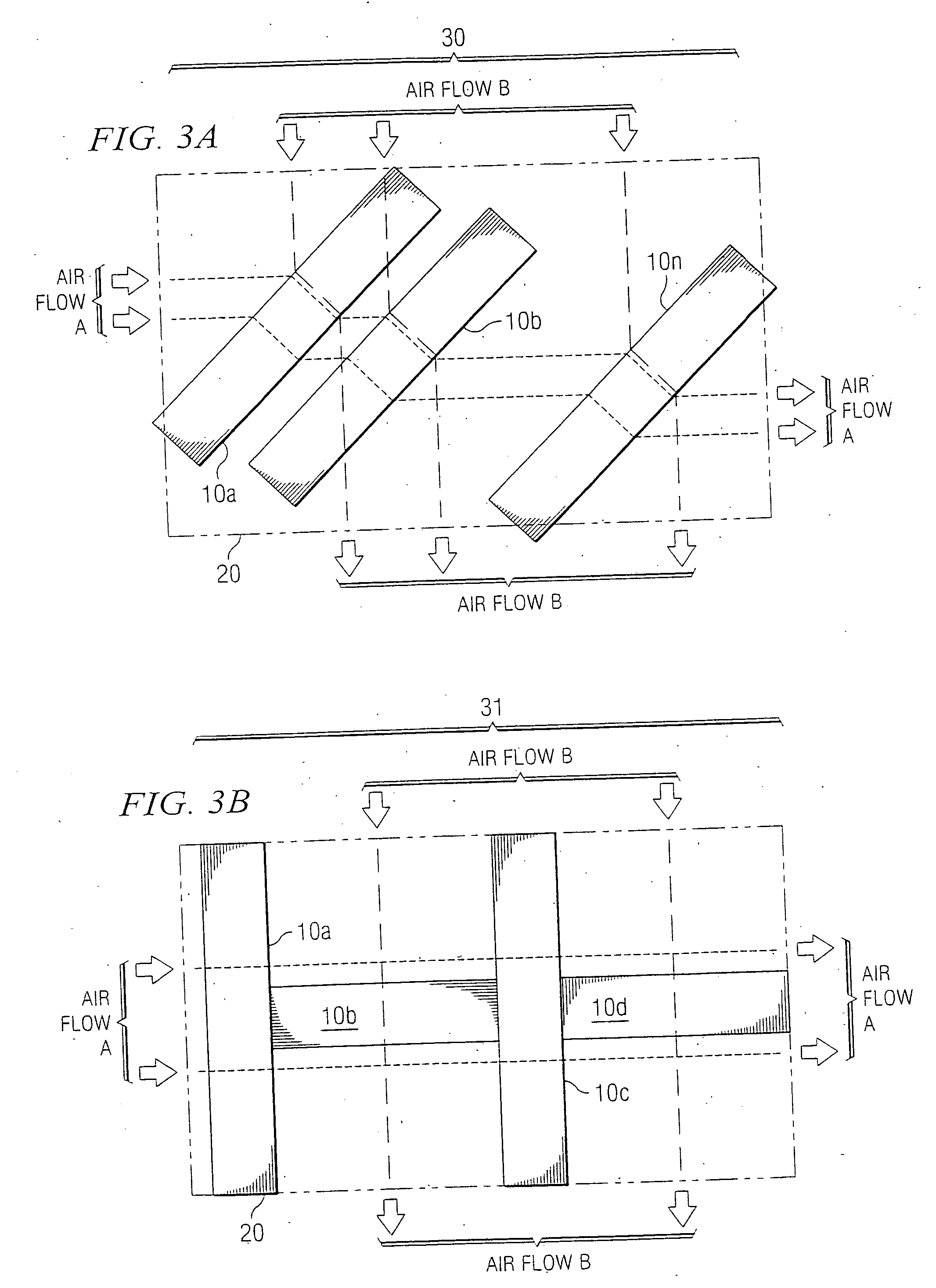
[0013]FIG. 3B illustrates embodiment 31 in which heat sinks 10a and 10c have cooling air moving there through in the A direction. Heat sinks 10b and 10d, which are angularly displaced (in the embodiment shown they are displaced 90 degrees) with respect to heat sinks 10a and 10n, have cooling air moving there through in the B direction. As shown, the heat sinks faced in the A direction form a multi pass heat sink device while those positioned in the B direction form a single pass heat sink device. In the embodiment shown, air flowing in direction A will pass through multiple devices 10, while air flowing in direction B passes through a single device. Note that in FIG. 3A, only four heat sinks are shown, but any number could be used. Accordingly, to prevent air from flowing around the heat sink it may be necessary to duct the air flow tightly. Additional fans are an alternative for solving the high impedance problem.
[0014]FIG. 3C illustrates embodiment 32 constructed with a plurality,...
embodiment 33
[0015]FIG. 3D illustrates embodiment 33 in which an air movement device, such as fan (or blower) 34, is positioned within central (core) space 301. Fan (or blower) 34 can blow air out, or suck air in. Also, the air could be blown upward (out of the page) or, the air could flow in from the top and be blown out radially through heat sinks 10a-10d. A fan would typically be above the core while a blower could be positioned within the core.
embodiment 40
[0016]FIG. 4 illustrates embodiment 40 having, for example, carbon nanotubes 42 or fibers, or any other highly conductive material, if desired, could form the nucleus of a covered fin (as shown in FIG. 1) supported by frame top 41 and frame base 43. These elements, nanotubes 42 (or other material) are shown greatly expanded, but would be sized and spaced so that there would be 30 or more fins (tubes) per inch spaced apart in the micron range.
[0017]FIG. 5 illustrates embodiment 50 where more than one row of fins 52 form the heat sink device. Embodiment 50 is a nanotube array, (for example, carbon nanotubes) but many other materials could be employed for heat transfer. Also, if desired, structure 50 can be within a frame. This structure could stand alone, or could be imbedded in a plate fin device.
PUM
 Login to View More
 Abstract
Description
Claims
Application Information
 Login to View More