
Zinc oxide-alumina-silica-based crystallized glass
a technology of zinc oxide and aluminasilica, applied in the field of crystallized glass, can solve the problems of limiting production conditions and inferior meltability, and achieve the effects of low melting point, excellent heat resistance, and high heat resistan
- Summary
- Abstract
- Description
- Claims
- Application Information
AI Technical Summary
Benefits of technology
Problems solved by technology
Method used
Image

Examples
example
[0105] The crystallized glass of the present invention will be specifically explained using the following examples, which should not be construed as limiting the crystallized glass of the present invention in any manner. The crystallized glasses of examples and comparative examples were evaluated on the four items of heat resistance, crystallinity, meltability and devitrification properties, and overall evaluation was conducted on the basis of the results of the above evaluations. The four items of heat resistance, crystallinity, meltability and devitrification properties were evaluated by the following methods.
[0106] [Heat Resistance]
[0107] Measurement samples of 3 mm×3 mm×20 mm were cut out from the crystallized glass, and thermal expansion coefficients were measured in the three temperature ranges of 40-400° C., 40-600° C. and 40-800° C. in accordance with the method described in JIS R1618. The heat resistance was evaluated in the following manner. When a crystallized glass havi...
examples 1-8
, Comparative Examples 1-4
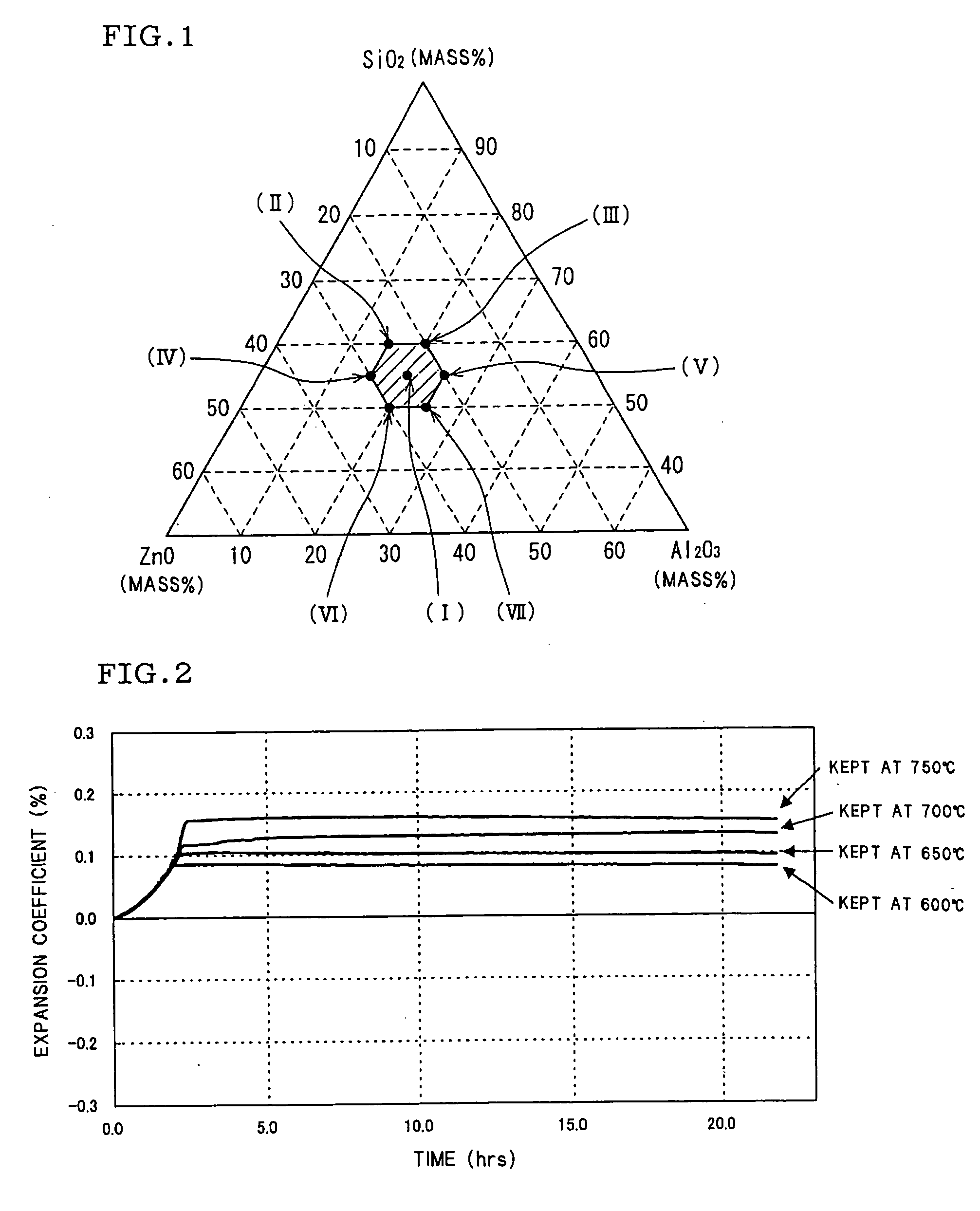
[0117] The main components, the nucleating agent and the modification component described in Table 3 were mixed at the ratio as described in Table 3 to prepare a glass raw material, this glass raw material was molten to make a glass, and the resulting glass was subjected to a heat treatment (crystallizing treatment) at 875° C. or 900° C. for 4 hours to obtain crystallized glasses of Examples 1-8 and Comparative Examples 1-4. Heat resistance, crystallinity and meltability of these crystallized glasses were evaluated and the results are shown in Table 4.
TABLE 3Main componentModification componentTotal ofTotal ofTotal of 6crystallizedMarkcomponentsNucleating agentGlass clarifierP2O5B2O3componentsglassin(Part byZrO2Sb2O3(Part by(Part by(Part by(Part bymass)(Part by mass)(Part by mass)mass)mass)mass)mass)Exam. 1(I)10050.51—1106.5Exam. 2(I)10050.53—3108.5Compar. Exam. 1(I)10050.5—1—106.5Compar. Exam. 2(I)10050.5—3—108.5Exam. 3(I)10050.5111107.5Exam. 4(I)10050.5...
examples 9-19
[0121] The main components, the nucleating agent and the modification component described in Table 5 were mixed at the ratio as described in Table 5 to prepare a glass raw material, this glass raw material was molten to make a glass, and the resulting glass was subjected to a heat treatment (crystallizing treatment) at 825° C., 850° C., 875° C. or 900° C. for 4 hours to obtain crystallized glasses of Examples 9-19. Heat resistance, crystallinity and meltability of these crystallized glasses were evaluated and the results are shown in Table 6.
TABLE 5Main componentNucleatingGlassModification componentTotal ofTotal ofagentclarifierTotal of 6crystallizedMarkcomponentsZrO2Sb2O3P2O5Li2ONa2OK2OCs2Ocomponentsglassin(Part by(Part by(Part by(Part by(Part by(Part by(Part by(Part by(Part by(Part bymass)mass)mass)mass)mass)mass)mass)mass)mass)mass)Exam. 9(VII)10050.5—0.5———0.5106.0Exam. 10(VII)10050.5——0.5——0.5106.0Exam. 11(I)10050.5—0.5———0.5106.0Exam. 12(I)10050.5——0.5——0.5106.0Exam. 13(I)10...
PUM
 Login to View More
 Abstract
Description
Claims
Application Information
 Login to View More