
Display device
a technology of display device and display screen, which is applied in the direction of static indicating device, non-linear optics, instruments, etc., can solve the problems of screen burn-in, high cost, and high cost, and achieve the effect of reducing adverse effects on display and minimizing the potential of data lines
- Summary
- Abstract
- Description
- Claims
- Application Information
AI Technical Summary
Benefits of technology
Problems solved by technology
Method used
Image

Examples
specific example
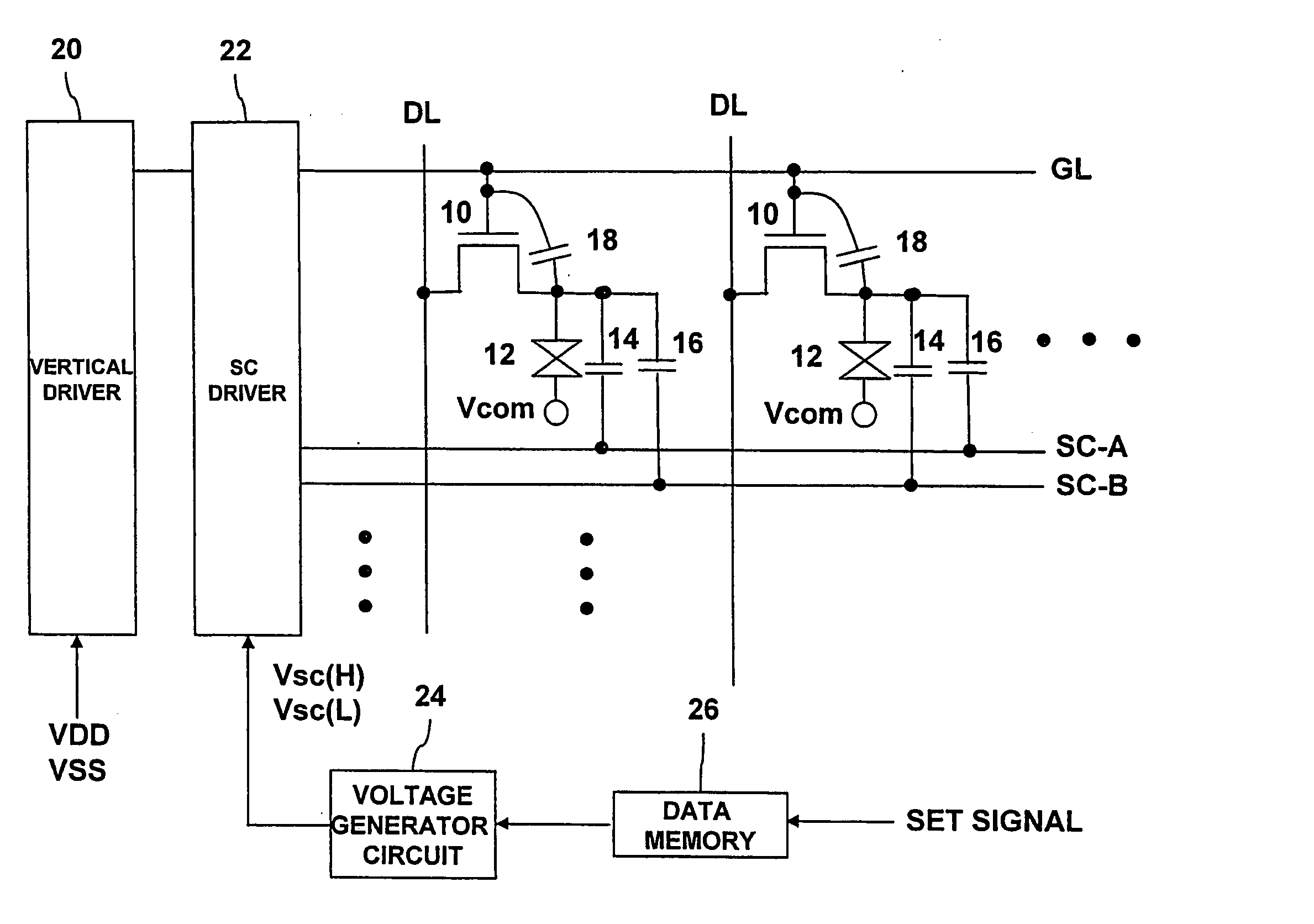
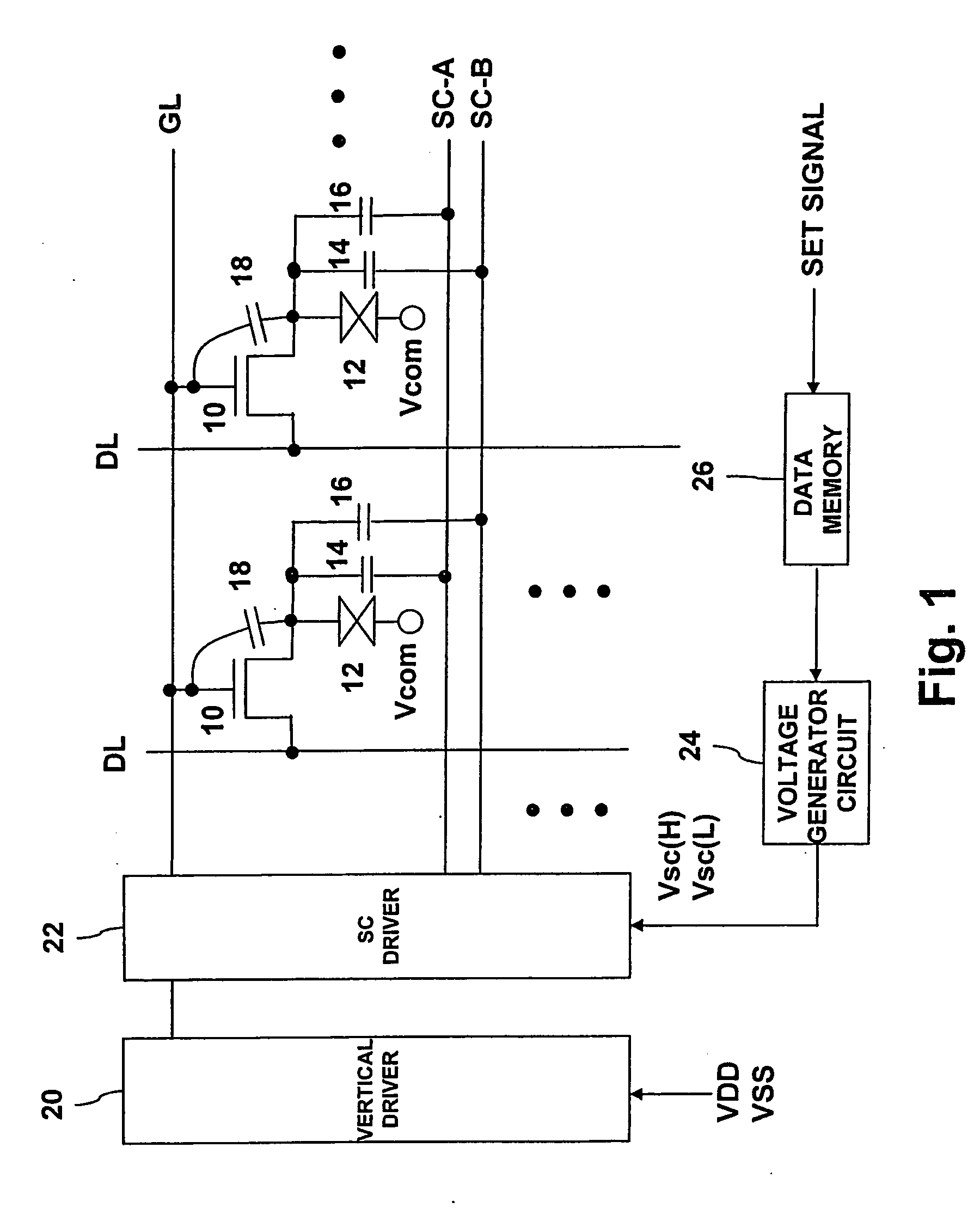
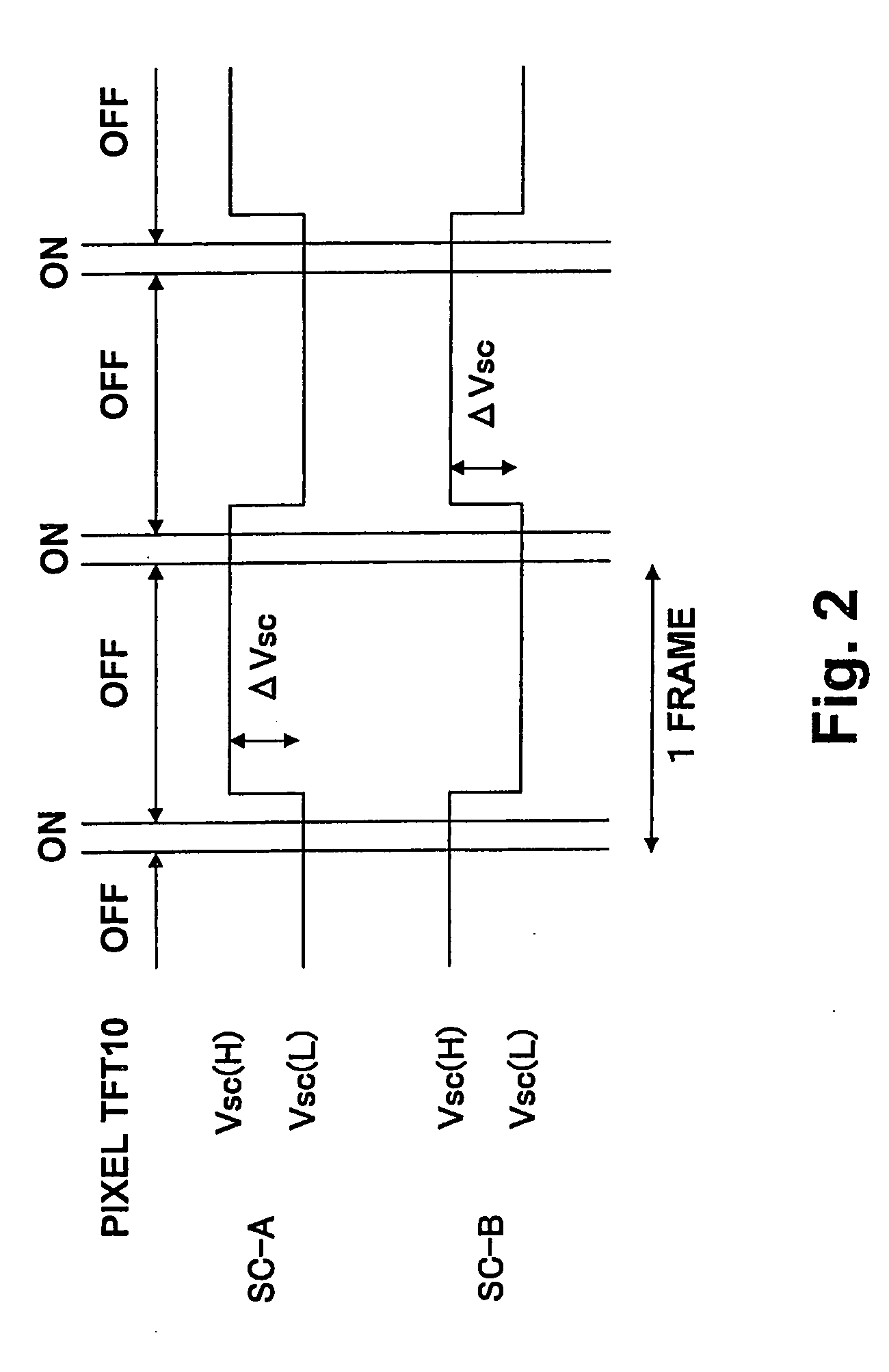
[0052] When configured so that Csc=320fF, Cpa=10fF, Clc=430fF, Cgs=3fF, ΔVsc=5.58, VB=3.5V, Vb=2.5V, and VDD=8.5V:
{(320−Cpa) / (3+430+320+Cpa)}·ΔVsc=3.5−2.5 / 2
Furthermore:
ΔVsc<8.5
[0053] Therefore, in this case, Cpa16.
[0054] For example, when Cpa is greater than or equal to 95fF and this condition is not satisfied, the shift voltage becomes insufficient and the black level display is not performed properly.
[0055] Furthermore, the voltage value Vpixel of the pixel electrode of the liquid crystal element 12 subsequent to shifting can be expressed as follows (identical to expression (1) given above):
Vpixel=Vvideo±{(Csc−Cpa} / (Cgs+Clc+Csc+Cpa)}·ΔVsc
[0056] When Cgs and Cpa are substantially smaller than Csc and Clc, Vpixel can be expressed as follows:
Vpixel□Vvideo±Csc / (Clc+Csc)·ΔVsc
[0057] Furthermore, the molecules in the TN liquid crystal are aligned in parallel with respect to the electrodes in the state where voltage is not applied, at which time the dielectric constant ε / / is s...
PUM
| Property | Measurement | Unit |
|---|---|---|
| voltage | aaaaa | aaaaa |
| voltages | aaaaa | aaaaa |
| brightness | aaaaa | aaaaa |
Abstract
Description
Claims
Application Information
 Login to View More