

Method and apparatus for pulse-by-pulse calibration of a pulse-echo ranging system
- Summary
- Abstract
- Description
- Claims
- Application Information
AI Technical Summary
Benefits of technology
Problems solved by technology
Method used
Image

Examples
Embodiment Construction
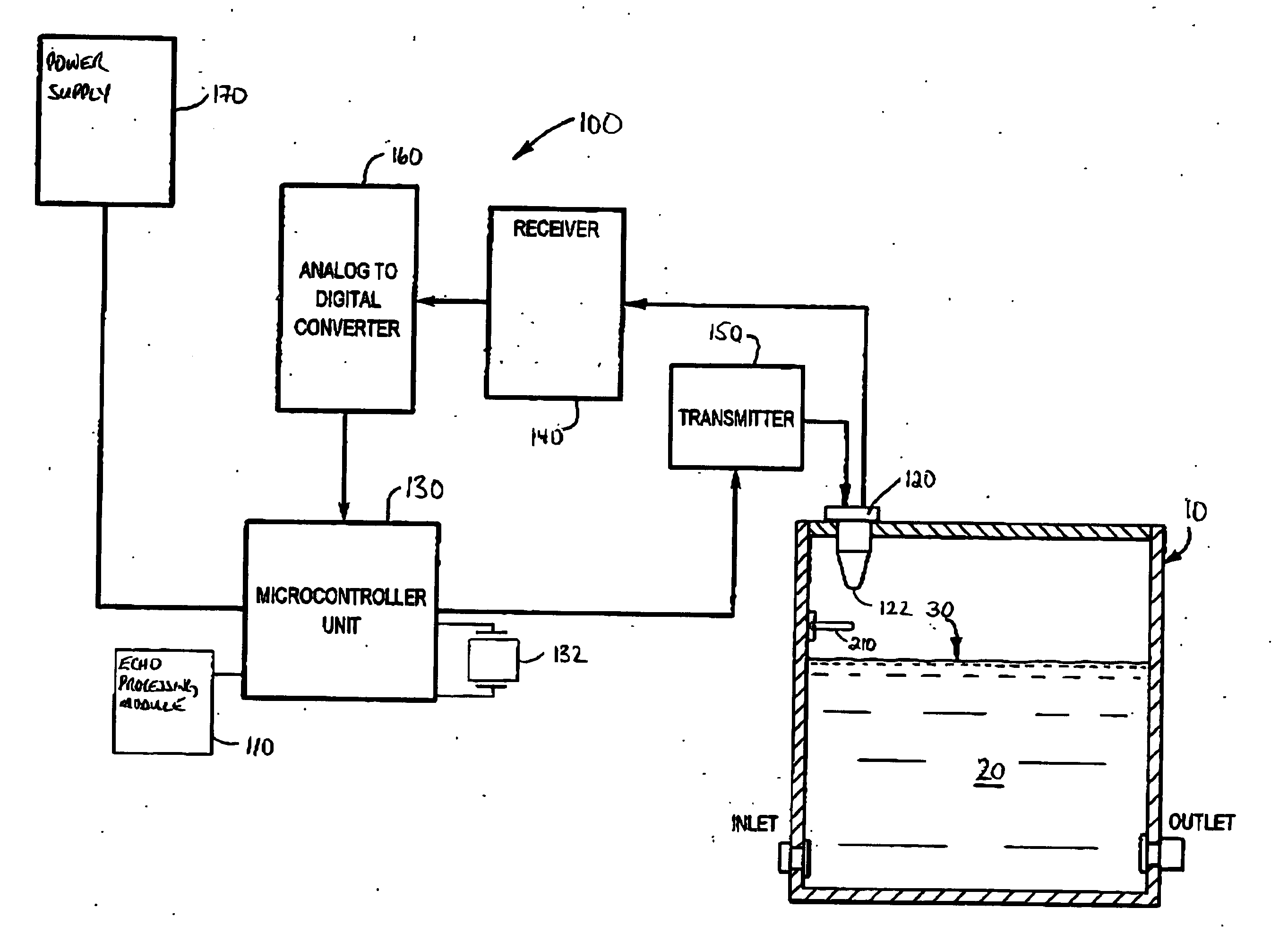
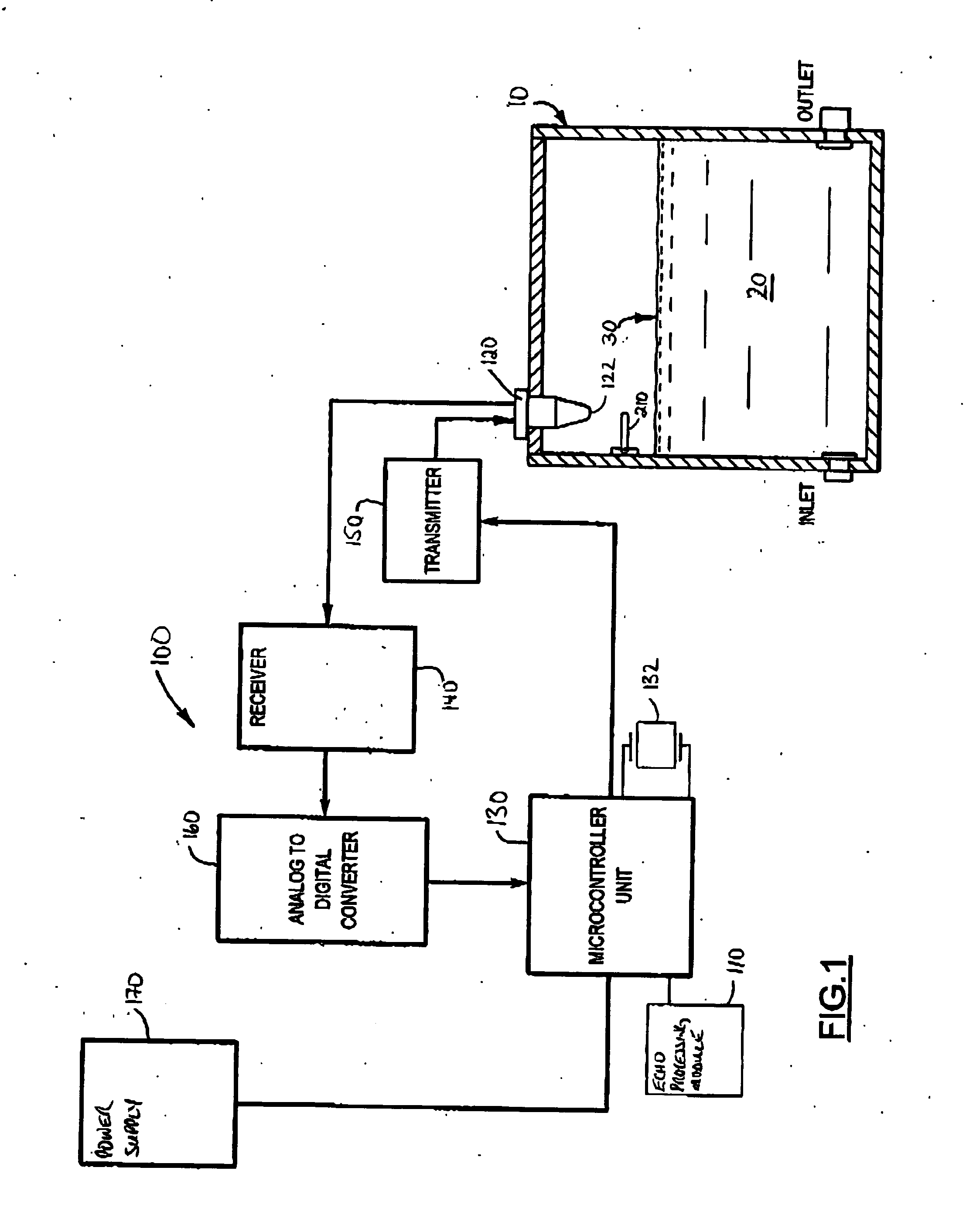
[0019] Reference is first made to FIG. 1, which shows a pulse-echo level measurement system 100 in accordance with the present invention.
[0020] As shown in FIG. 1, the pulse-echo level measurement system 100 is installed in a vessel 10, e.g. a storage tank, containing a material 20, for example, a liquid, sludge or granular material, having a level determined by the top surface of the material 20. The top surface of the material 20 provides a reflective surface or reflector, indicated by reference 30, which reflects pulses (e.g. ultrasonic pulses or radar energy bursts emitted by a transducer).
[0021] The pulse-echo level measurement system 100 includes an echo processing module 110, a transducer 120, a controller or signal processor unit 130, a receiver module 140, a transmitter module 150, an analog-to-digital (A / D) converter 160 and a power supply unit 170. In other implementations, the power supply 170 may be replaced by a loop powered interface (not shown). The controller 130,...
PUM
 Login to View More
 Abstract
Description
Claims
Application Information
 Login to View More