Check patentability & draft patents in minutes with Patsnap Eureka AI!

Method, system & apparatus for managing a data burst throughput of an optical burst switching (OBS) network

a technology of optical burst switching and data burst, applied in the field of optical networks, can solve the problems of insufficient network resources, connection blockage, conflicting connection request blockage, etc., and achieve the effect of increasing the probability of overall connection blockag

Inactive Publication Date: 2006-03-30
NOKIA SIEMENS NETWORKS GMBH & CO KG
View PDF1 Cites 0 Cited by
  • Summary
  • Abstract
  • Description
  • Claims
  • Application Information

AI Technical Summary

Benefits of technology

[0004] It is expected that, as network traffic continues to scale up and become more bursty in nature, a higher degree of multiplexing and flexibility will be required at the optical layer. Thus, lightpath establishment will become more dynamic in nature, with connection requests arriving at higher rates, and lightpaths being established for shorter time durations. In such situations, blocking due to conflicting connection requests may become an increasingly significant component of the overall connection blocking probability.

Problems solved by technology

One source of connection blocking is insufficient network resources.
If no such wavelength is available, then the connection will be blocked, even if capacity is available.
In such situations, blocking due to conflicting connection requests may become an increasingly significant component of the overall connection blocking probability.

Method used

the structure of the environmentally friendly knitted fabric provided by the present invention; figure 2 Flow chart of the yarn wrapping machine for environmentally friendly knitted fabrics and storage devices; image 3 Is the parameter map of the yarn covering machine
View more

Image

Smart Image Click on the blue labels to locate them in the text.
Viewing Examples
Smart Image
  • Method, system & apparatus for managing a data burst throughput of an optical burst switching (OBS) network
  • Method, system & apparatus for managing a data burst throughput of an optical burst switching (OBS) network
  • Method, system & apparatus for managing a data burst throughput of an optical burst switching (OBS) network

Examples

Experimental program
Comparison scheme
Effect test

Embodiment Construction

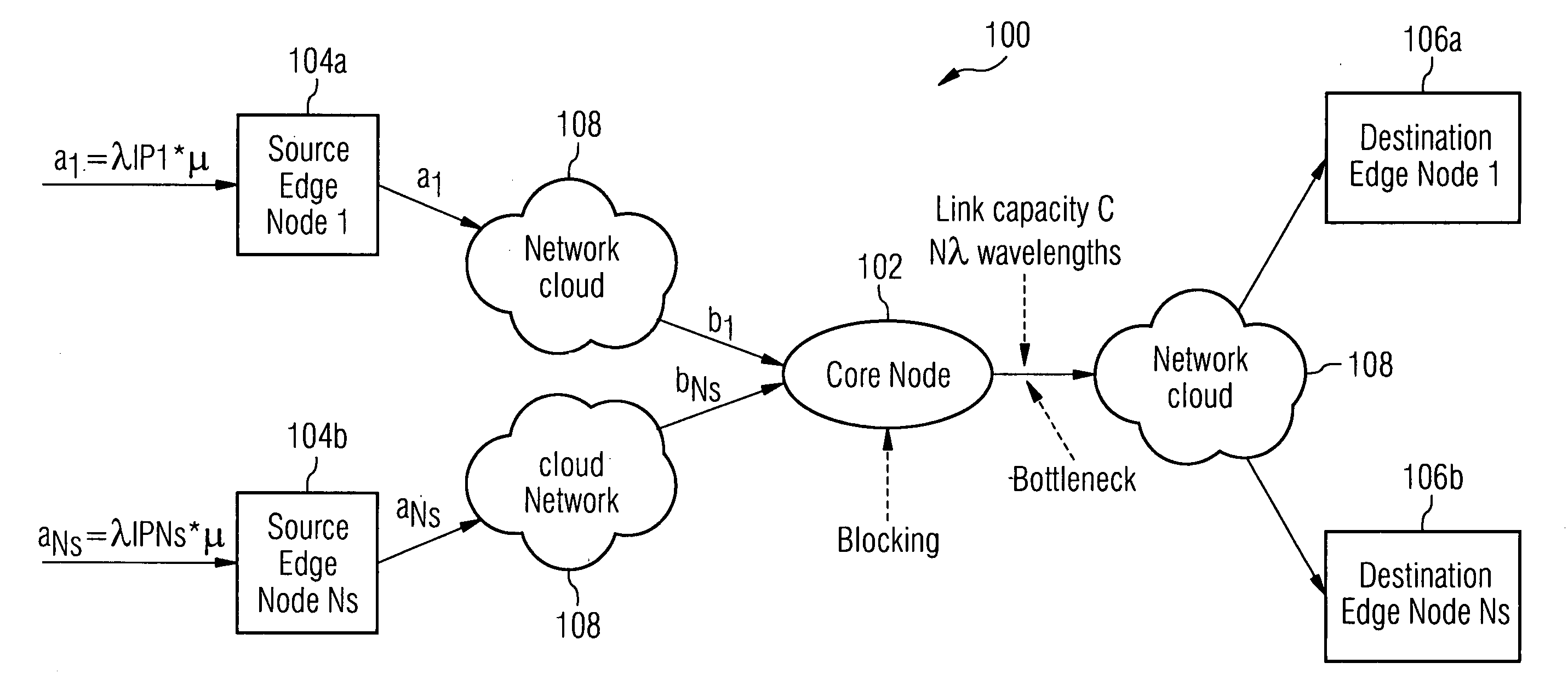
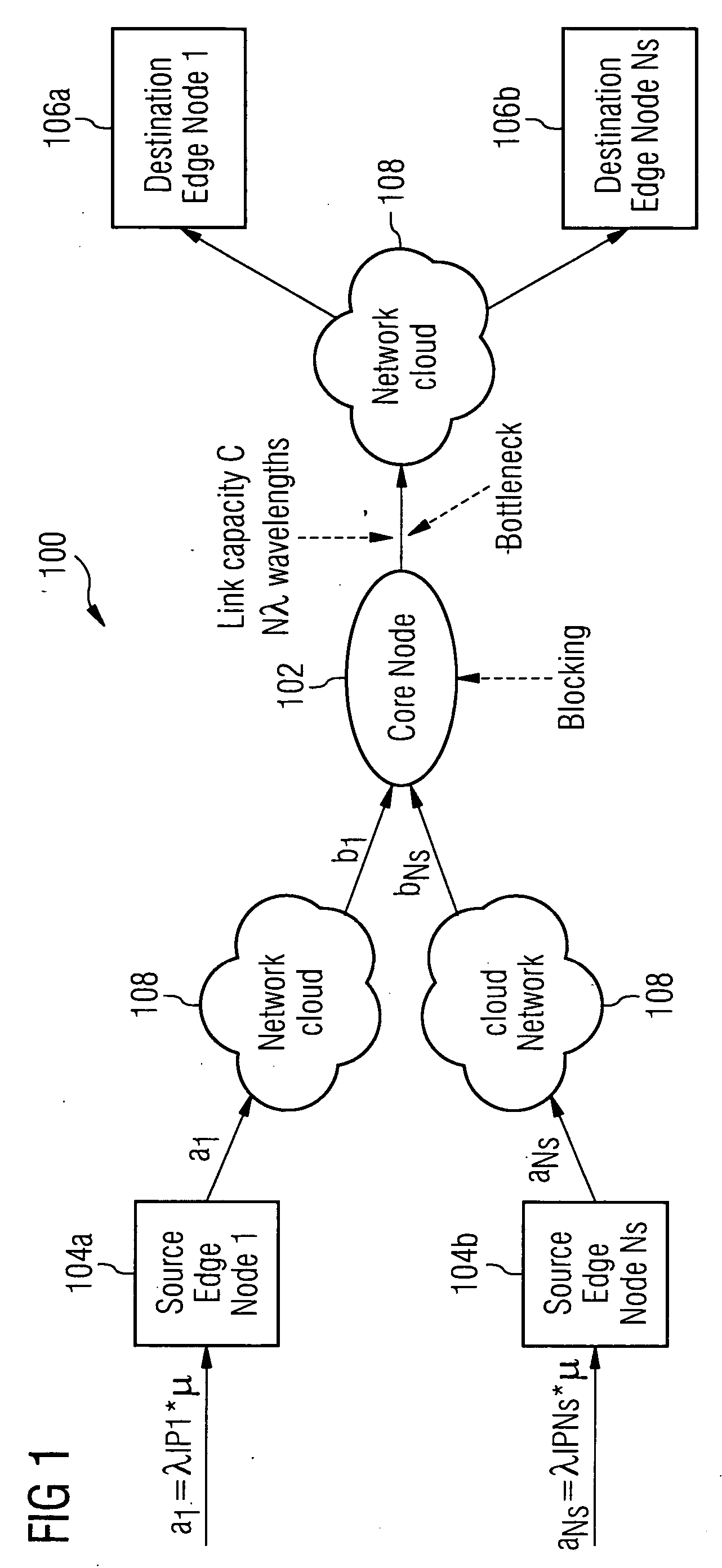
[0019]FIG. 1 illustrates the analytical model 100 of an OBS Network with non-negligible Setup Times that will be used to discuss the invention. In the figure, a core node 102, one or more edge nodes 104a, 104b, etc. (NS sources), and destination nodes 106a, 106b, etc. are shown. These elements are connected through links and, possibly, networks 108 intervening. Problematically, a number of edge nodes sending traffic causes a bottleneck 110 at the core node 102. In order to manage this bottleneck 110, it is a first step to determine the average number of new setup requests (header packets) sent per second per wavelength λλ in OBS networks.

[0020] A total number of NS sources 104a, 104b, etc. send information through a common core node 102. In particular, we focus on the traffic from the NS sources 104a, 104b, etc. that is routed to the same output fiber at the core node 102, which we shall name as the bottleneck link (see FIG. 1). This output fiber has a capacity C and Nλ wavelengths...

the structure of the environmentally friendly knitted fabric provided by the present invention; figure 2 Flow chart of the yarn wrapping machine for environmentally friendly knitted fabrics and storage devices; image 3 Is the parameter map of the yarn covering machine
Login to View More

PUM

No PUM Login to View More

Abstract

Managing a data burst throughput of an Optical Burst Switching (OBS) network (100). A setup time is determined based on a probability (Pi) that a burst at a core node (102) of the OBS network (100) was sent by an edge node (104a, 104b) coupled to the core node (102). An effective wavelength utilization (ρλ) is determined based on the set up time. The blocking probability (P) for the core node (102) is determined based on the effective wavelength utilization (ρλ).

Description

CROSS REFERENCE TO RELATED APPLICATIONS [0001] This application claims priority to the European application No. 04023352.0, filed Sep. 30, 2004 and which is incorporated by reference herein in its entirety. FIELD OF INVENTION [0002] The invention relates to optical networks comprising a number of interconnected nodes, where information is transmitted in bursts of data packets between the nodes along pathways. SUMMARY OF THE INVENTION [0003] A key measure of performance in optical networks, particularly, dynamic wavelength routed optical networks, is the blocking probability, or the probability that an incoming connection request will be denied. One source of connection blocking is insufficient network resources. If a route with sufficient capacity cannot be found between the source node and destination node, then the connection request must be blocked. Furthermore, if there are no wavelength converters in the network, then the lightpath for the connection must utilize the same wavel...

Claims

the structure of the environmentally friendly knitted fabric provided by the present invention; figure 2 Flow chart of the yarn wrapping machine for environmentally friendly knitted fabrics and storage devices; image 3 Is the parameter map of the yarn covering machine
Login to View More

Application Information

Patent Timeline
no application Login to View More
IPC IPC(8): H04J14/00
CPCH04Q2011/0084H04Q11/0066
Inventor RODRIGO, MIGUEL DE VEGA
Owner NOKIA SIEMENS NETWORKS GMBH & CO KG
Features
  • R&D
  • Intellectual Property
  • Life Sciences
  • Materials
  • Tech Scout
Why Patsnap Eureka
  • Unparalleled Data Quality
  • Higher Quality Content
  • 60% Fewer Hallucinations
Social media
Patsnap Eureka Blog
Learn More