
Split socket send queue apparatus and method with efficient queue flow control, retransmission and sack support mechanisms
a send queue and socket technology, applied in the field of communication protocols, can solve the problems of excessive resource consumption of the network stack, unreliable service provided by udp, and large amount of processor and memory resources by tcp/ip softwar
- Summary
- Abstract
- Description
- Claims
- Application Information
AI Technical Summary
Benefits of technology
Problems solved by technology
Method used
Image

Examples
Embodiment Construction
[0036] The present invention provides a distributed computing system having endnodes, switches, routers, and links interconnecting these components. The endnodes can be Internet Protocol Suite Offload Engines or traditional host software based Internet protocol suites. Each endnode uses send and receive queue pairs to transmit and receive messages. The endnodes segment the message into frames and transmit the frames over the links. The switches and routers interconnect the endnodes and route the frames to the appropriate endnode. The endnodes reassemble the frames into a message at the destination.
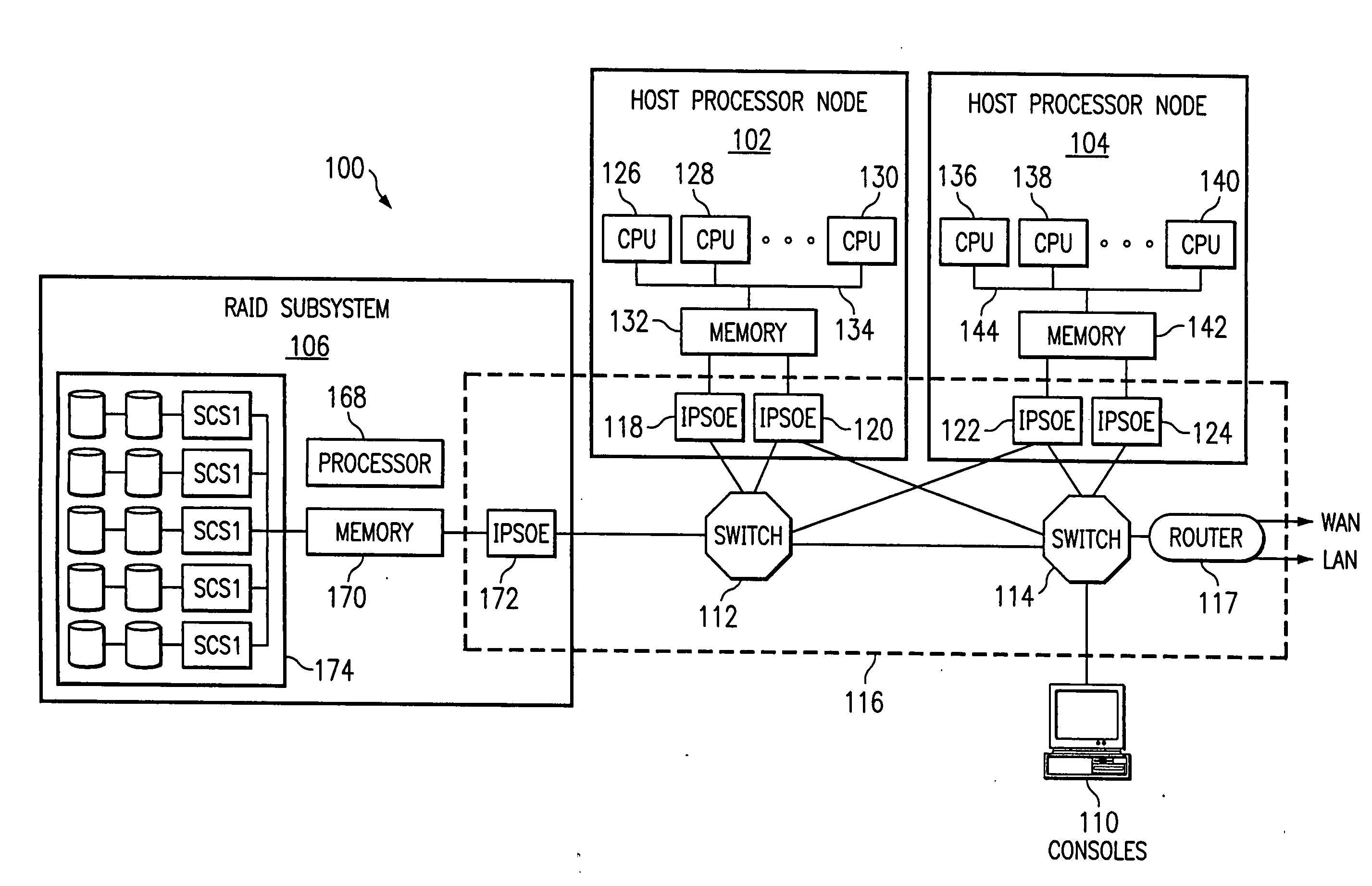
[0037] With reference now to the figures and in particular with reference to FIG. 1, a diagram of a distributed computer system is illustrated in accordance with a preferred embodiment of the present invention. The distributed computer system represented in FIG. 1 takes the form of an Internet protocol network (IP net), such as IP net 100 and is provided merely for illustrative purposes a...
PUM
 Login to View More
 Abstract
Description
Claims
Application Information
 Login to View More