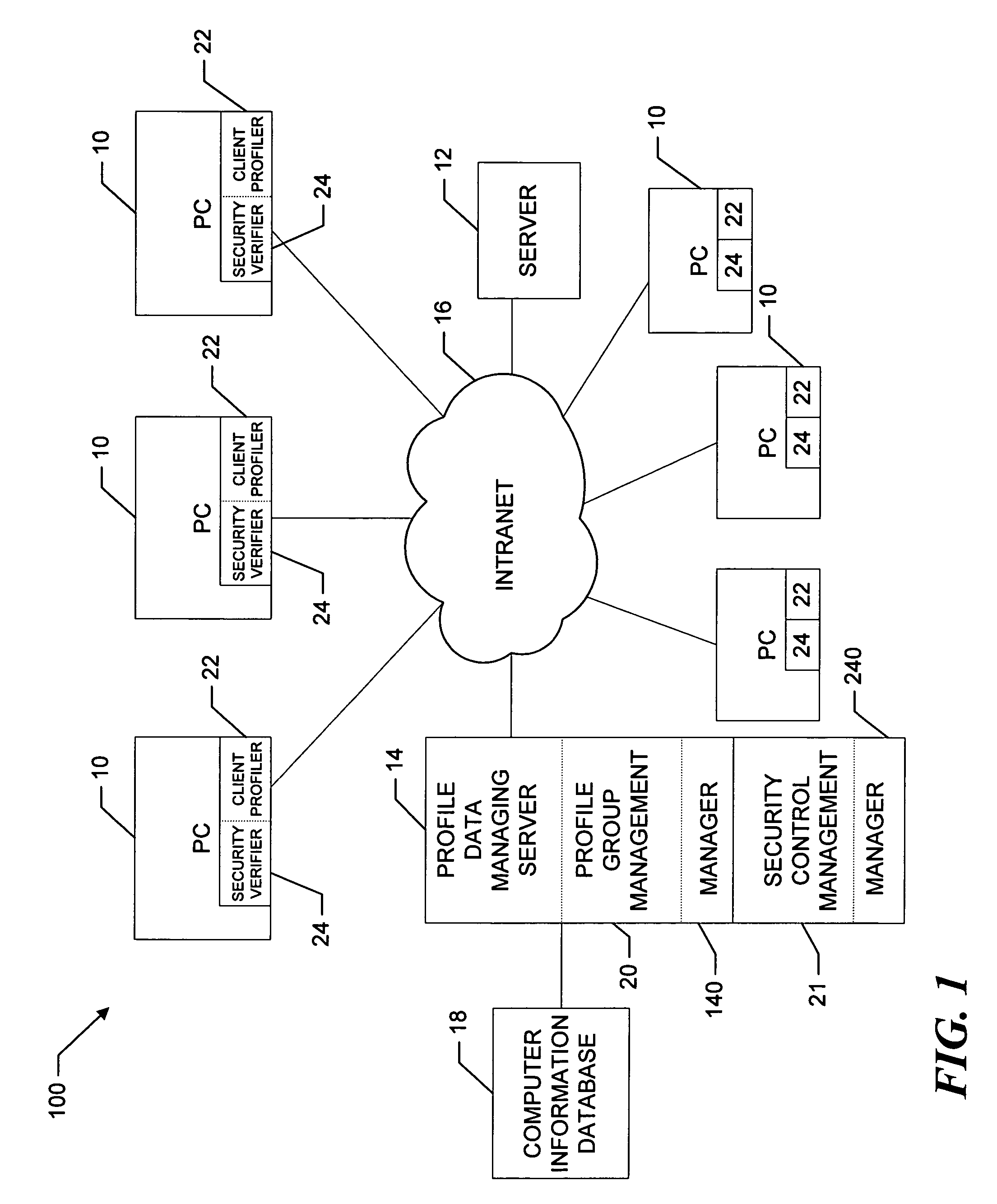
[0012] The current system includes a security control verification and monitoring subsystem that associates appropriate security control benchmarks with the respective computers and both verifies and continuously monitors compliance of the computers with the benchmarks, through a modification of the computer profile data reporting operations.
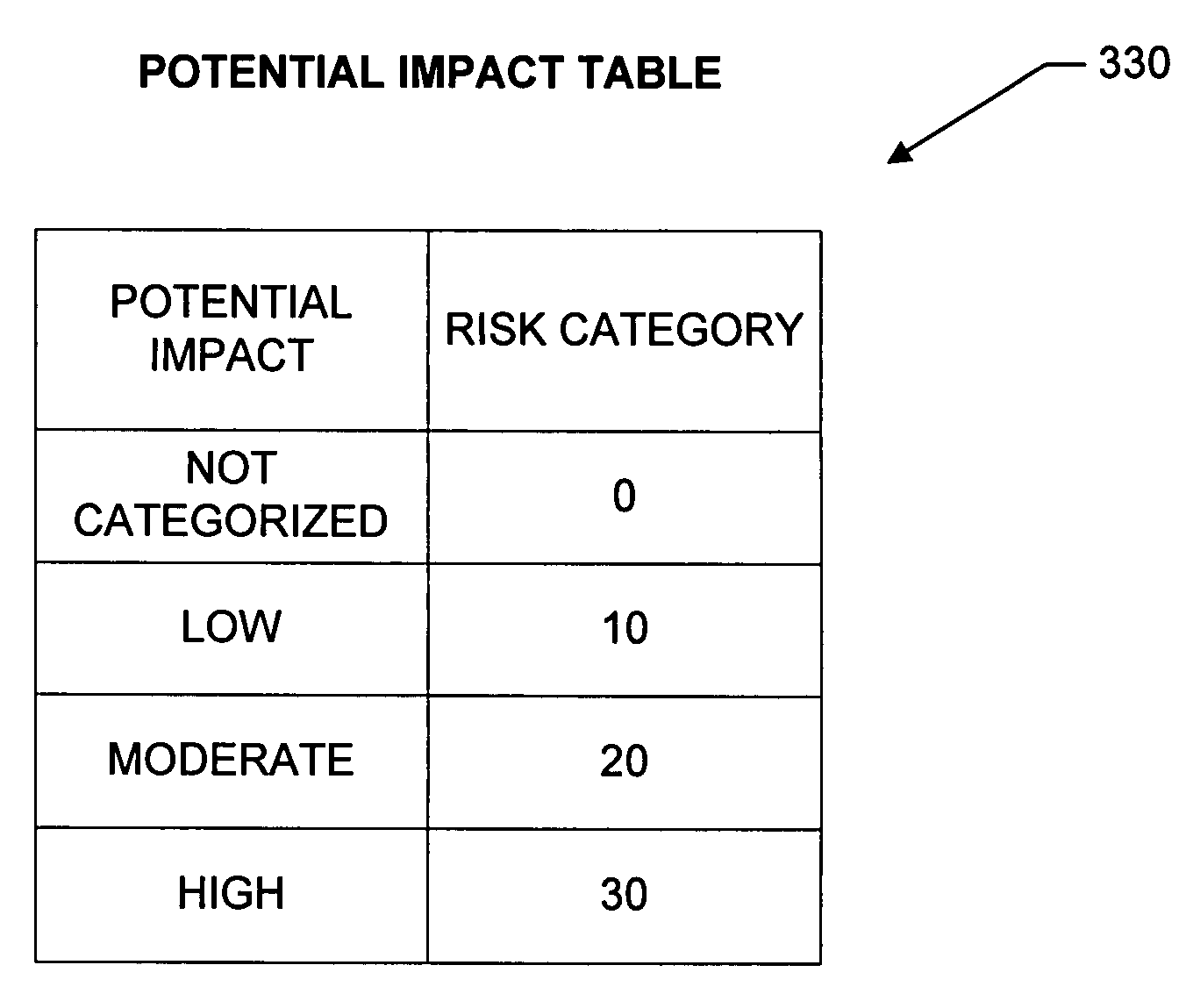
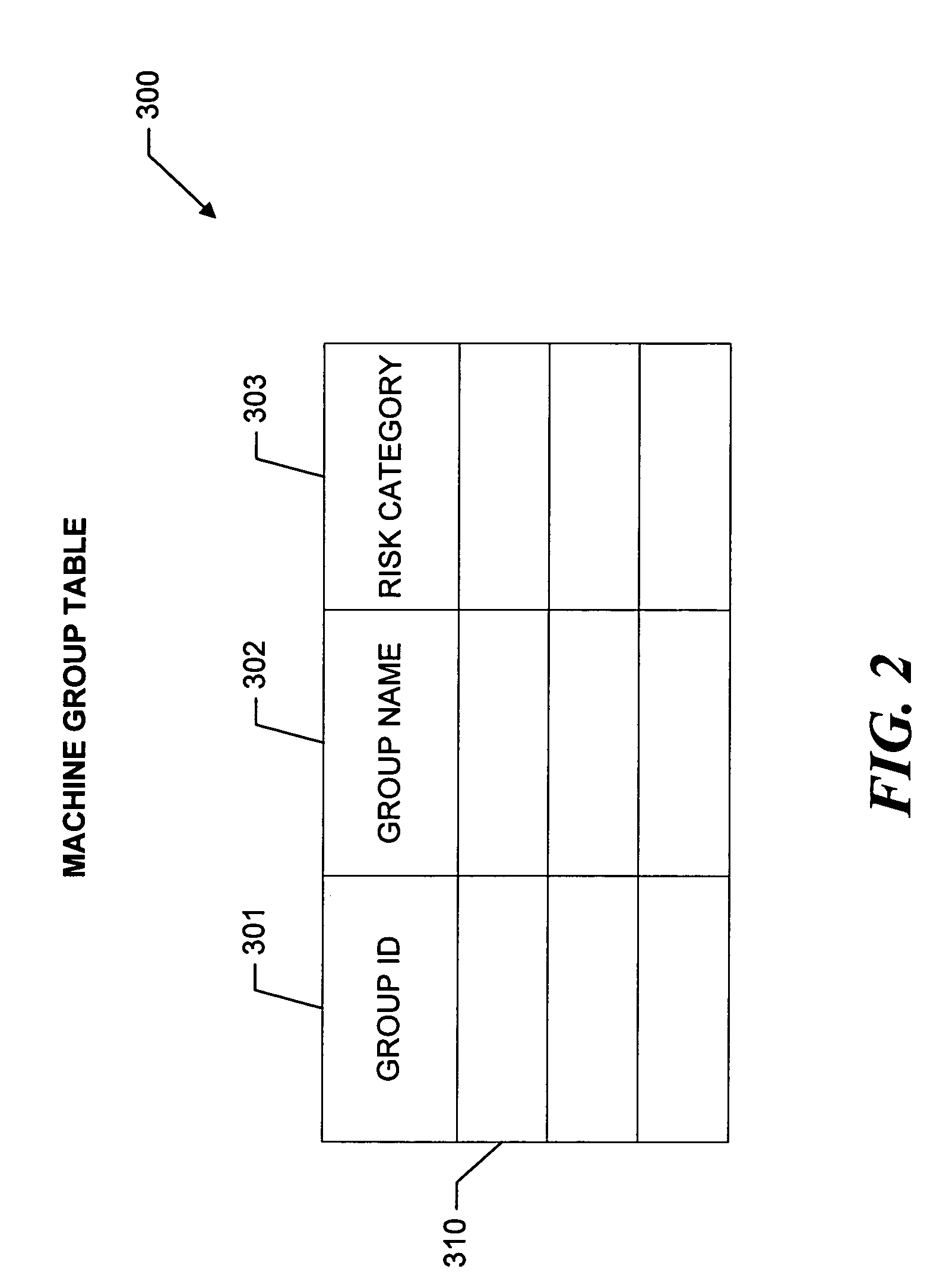
[0013] The security control verification and monitoring subsystem includes a security categorization operation through which the organization's information security officers or an overall administrator and, as appropriate, group administrators, assign security risk categories to the respective groups. The security risk category corresponds to the potential impact on the operations of the system or group, and / or on the assets of the company and / or of individuals within or outside of the company should there be a breach in security that results in a loss of the confidentiality, integrity or availability of data maintained in or manipulated by the respective computers. The security risk categories, namely, low-impact, moderate-impact or high-impact, match those of FIPS Publication 199.
[0014] For purposes of assigning the security risk categories to the respective computers, the subsystem treats in the same group for security control purposes the computers that comprise an “information system,” based on the definition of system contained in OMB Circular A-130, Appendix III. Specifically, a system is defined as “an interconnected set of information resources under the same direct management control which shares common functionality.” The security categorization operation elicits from the system or group administrator, through a series of GUIs, information that allows the subsystem to separately assign security control risk categories to the respective “information systems” within the company. As discussed in more detail below, the groups of the tree structure of computer groups preferably correspond to information systems.
[0015] As also discussed in more detail below, the security control verification and monitoring subsystem selects benchmarks for the respective computers based on the associated security risk classifications, as well as on the attributes of the computers, such as, for example, the computers' operating systems. The subsystem may use benchmarks that are specified by the Center for Internet Security (“CIS”) for the different security control levels and computer operating systems. Alternatively, or in addition, the subsystem may use custom benchmarks that are specific to the company.
[0016] The security control verification and monitoring subsystem directs a given computer, through a handshake operation, to perform a security control verification operation that consists of comparing the computer's security control settings to the appropriate benchmark. Alternatively, an administrator or script invokes a clientless profiling application that performs the security control verification operation as it creates a profile of the computer. After each security verification operation, the subsystem retains the results of the comparison as a record that indicates, for the various components of the applicable benchmark, whether the computer passed or failed. The subsystem preferably includes the pass / fail information in a managed computer information database and thereafter incorporates the results into reports prepared for the system, respective groups and / or the individual computers.
[0017] The security control verification and monitoring subsystem also continuously monitors the compliance of the computers with the applicable security control benchmarks by requiring each computer to perform the security verification operations as part of the periodic, preferably daily, operations performed to update the computer profile data contained in the computer information database. As part of each security control verification operation, the system determines for the individual computer which security benchmark is then applicable, and thus, the security control settings of each computer are tested against the appropriate benchmark's settings to verify compliance with the desired security control level.


 Login to View More
  Login to View More