Avoiding unnecessary RSVP-based preemptions

a technology of resource reservation and preemption, applied in the field of network communication, to avoid unnecessary resource reservation preemption

a technology of resource reservation and preemption, applied in the field of network communication, to avoid unnecessary resource reservation preemption

US20060274650A1Inactive Publication Date: 2006-12-07CISCO TECH INC

Image

Smart Image Click on the blue labels to locate them in the text.
Viewing Examples
Smart Image
  • Avoiding unnecessary RSVP-based preemptions
  • Avoiding unnecessary RSVP-based preemptions
  • Avoiding unnecessary RSVP-based preemptions

Examples

Experimental program
Comparison scheme
Effect test

Embodiment Construction

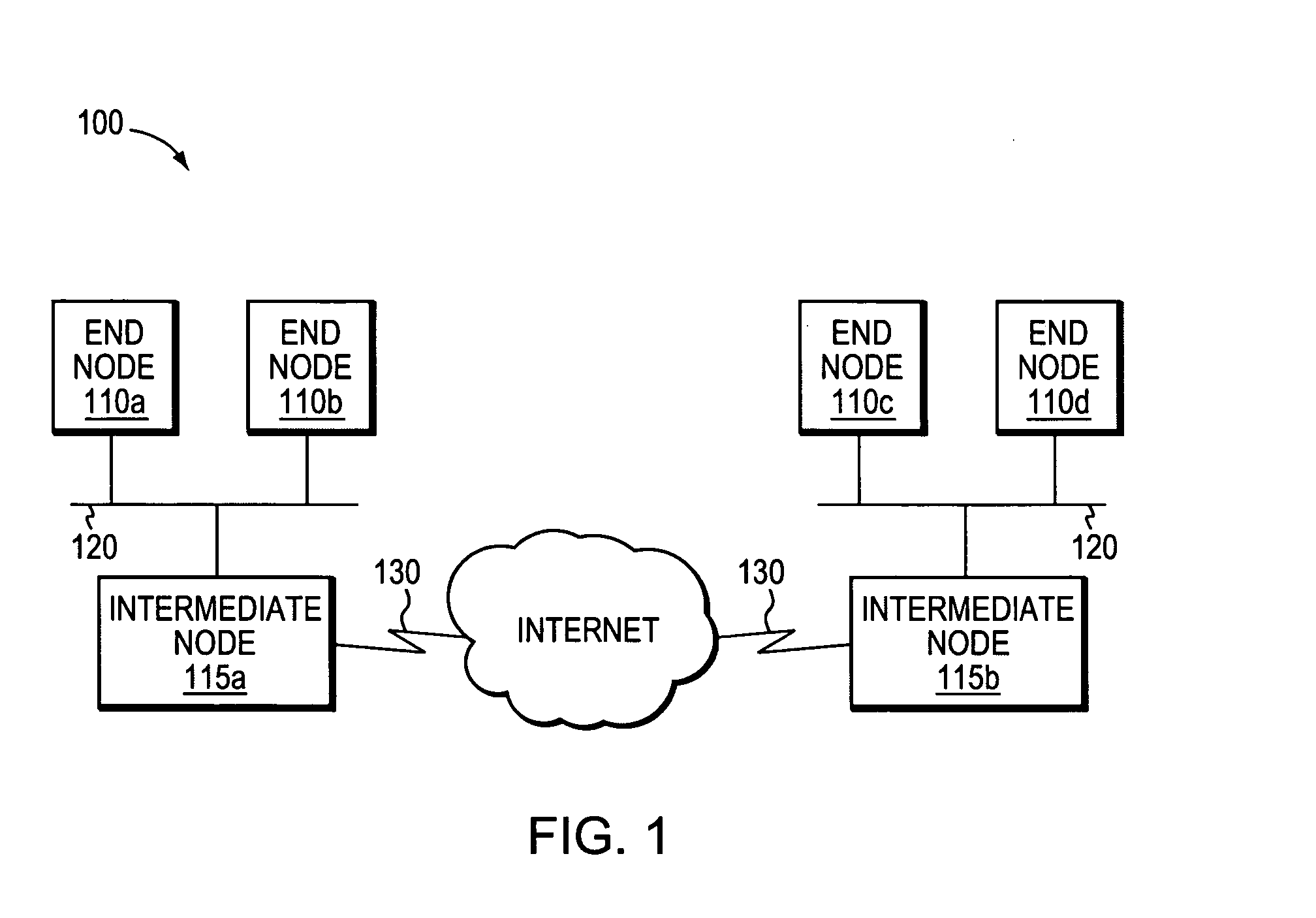
[0038]FIG. 1 is a schematic block diagram of an exemplary computer network 100 that may be advantageously used with the present invention. The network 100 comprises a plurality of interconnected network nodes, such as end nodes 110 and intermediate nodes 115. The nodes may be interconnected over local area network (LAN) links 120, point-to-point links, wide area network (WAN) links 130, wireless LANs, etc., to form the network 100. The interconnected network nodes may exchange data packets according to predefined sets of network communication protocols, such as the Transmission Control Protocol / Internet Protocol (TCP / IP) and the Resource Reservation Protocol (RSVP).

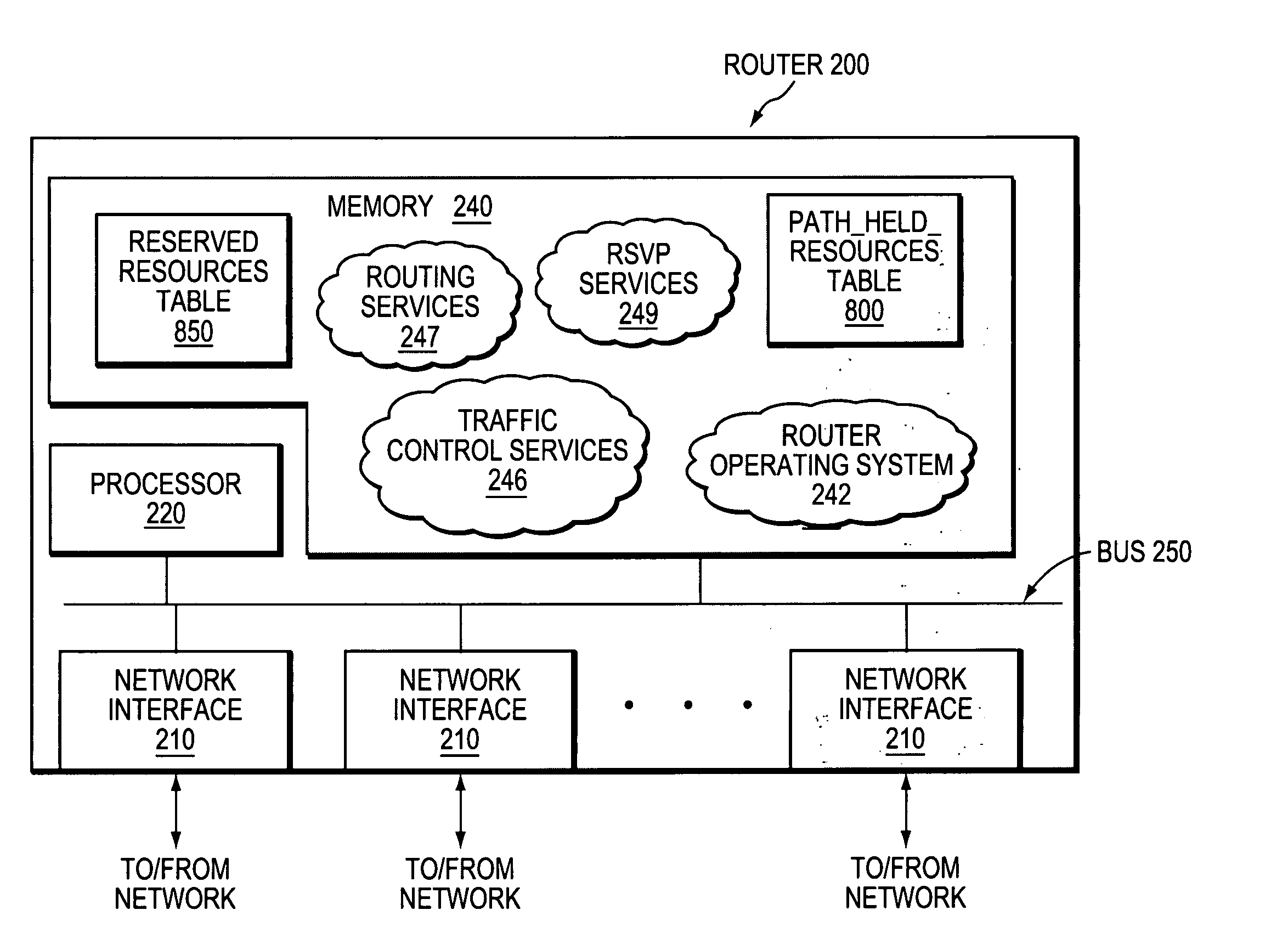
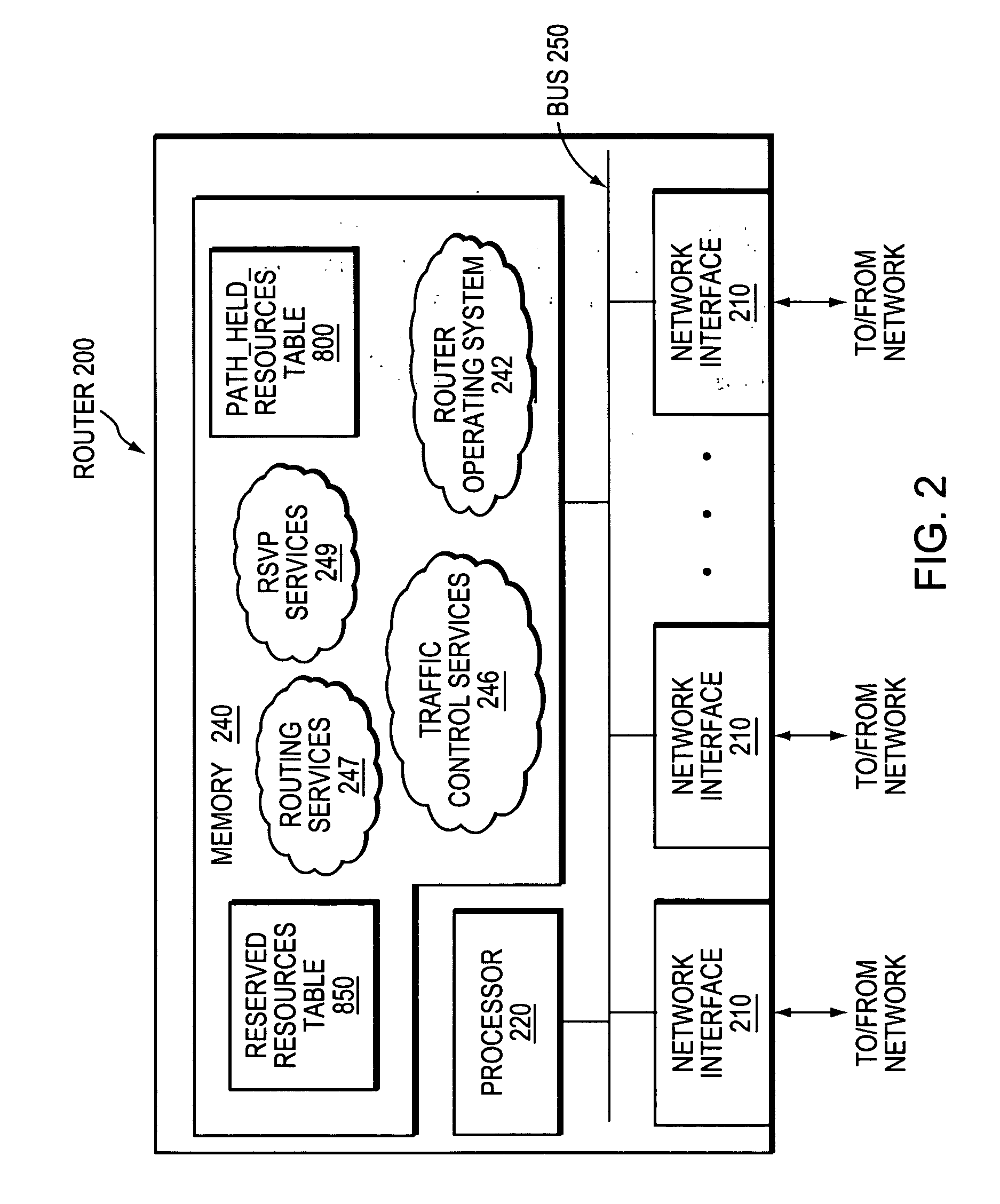
[0039]FIG. 2 is a schematic block diagram of an exemplary node 200, which is illustratively a router that may be advantageously used with the present invention as an end node or an intermediate node. The node comprises a plurality of network interfaces 210, a processor 220, and a memory 240 interconnected by a system bus...

the structure of the environmentally friendly knitted fabric provided by the present invention; figure 2 Flow chart of the yarn wrapping machine for environmentally friendly knitted fabrics and storage devices; image 3 Is the parameter map of the yarn covering machine
Login to View More

PUM

No PUM Login to View More

Abstract

A technique avoids unnecessary preemption of resource reservations along a requested flow between nodes in a computer network. A node receives priority-based resource reservation requests and determines conditions of reservation eligibility by comparing the requested resources to the amount of available resources at the node. Specifically, the node maintains a “held resources” state where available requested resources are held prior to their being assigned or reserved (confirmed) for the requested flow, such as, e.g., during an initial Resource reSerVation Protocol (RSVP) Path message. The node includes the held resources in calculations of available resources in such a way as to prevent resources from being assigned or reserved if the resources would be subsequently preempted by a request of higher priority, or if an earlier request would first utilize the resources. The node (e.g., an end node) also prevents resources from being reserved or preempted in a duplex (bi-directional) reservation on a first flow in a first direction when resources available for a second flow in a second direction indicate a failure of the second flow.

Description

BACKGROUND OF THE INVENTION [0001] 1. Field of the Invention [0002] The present invention relates to network communications and, more specifically, to allocating resources for use in network communications. [0003] 2. Background Information [0004] A computer network is a geographically distributed collection of interconnected subnetworks for transporting data between network nodes, such as computers. A local area network (LAN) is an example of such a subnetwork. The network's topology is defined by an arrangement of client nodes that communicate with one another, typically through one or more intermediate network nodes, such as routers or switches. As used herein, a client node is a network node that is configured to originate or terminate communications over the network. In contrast, an intermediate network node is a node that facilitates routing data between client nodes. Communications between network nodes are typically effected by exchanging discrete packets of data according to...

Claims

the structure of the environmentally friendly knitted fabric provided by the present invention; figure 2 Flow chart of the yarn wrapping machine for environmentally friendly knitted fabrics and storage devices; image 3 Is the parameter map of the yarn covering machine
Login to View More

Application Information

Patent Timeline
07 Dec 2006
Publication
US20060274650A1
IPC
H04J3/14; H04J1/16; H04L1/00; H04L12/26; H04L12/56; H04L12/28; H04J3/02
CPC
H04L12/5695; H04L47/2433; H04L47/822; H04L47/724; H04L47/245; H04L47/70
Inventors
TYAGI, SATYAM; DHESIKAN, SUBHASRI