Supercharge Your Innovation With Domain-Expert AI Agents!

Lithium secondary battery negative-electrode component material and lithium secondary battery

a negative-electrode component and secondary battery technology, applied in the direction of cell components, cell component details, electrochemical generators, etc., can solve the problems of battery cycling life shortened, electrode performance less efficient, and dendritic lithium growth that precipitates out of the electrode, so as to enhance the cyclability and safety of the negative-electrode component material. , the effect of avoiding such pitfalls

Inactive Publication Date: 2007-03-08
SUMITOMO ELECTRIC IND LTD
View PDF3 Cites 12 Cited by
  • Summary
  • Abstract
  • Description
  • Claims
  • Application Information

AI Technical Summary

Benefits of technology

[0007] An issue for the present invention is to eliminate such pitfalls and enhance the cyclability and safety of a negative-electrode component material for lithium secondary batteries.
[0008] The inventors discovered that by utilizing an electrical insulator as the substrate, the technical problem of concentrated growth of dendrites is resolved in a lithium secondary battery negative-electrode component material in which a metallic lithium film and a solid electrolytic film are formed onto the substrate. Effectiveness in inhibiting dendritic growth can especially be enhanced by utilizing an organic high-polymer material as the substrate.
[0012] Thus, even should a deficiency situation arise and the performance of the solid electrolytic film decline, leading to the local occurrence of dendritic growth on the negative electrode, the metallic lithium in that portion of the negative electrode becoming spent will automatically cease the supply of electrons, eliminating the hazardousness of concentrated charging / discharging repeating in that region.

Problems solved by technology

With the alternative methods, however, the lithium and the battery's organic electrolyte react, which when the battery charges / discharges turns the lithium into branchy crystals and gives rise to dendritic lithium growth that precipitates out of the electrode.
As a consequence, the electrode performs less efficiently and the battery's cycling life is shortened.
What is more, such lithium dendrites give rise to battery-internal shorting with the positive electrode, which presents a hazard that ultimately ends in the battery exploding.
When such a situation occurs, in the compromised portions of the electrode the solid electrolytic film is destroyed and dendritic growth arises, which brings on a decline in the battery's cycling life.
What is more, the encroachment of negative-electrode dendritic growth brings about battery-internal shorting between the negative and positive electrodes, which presents a hazard that ultimately ends in the battery exploding.

Method used

the structure of the environmentally friendly knitted fabric provided by the present invention; figure 2 Flow chart of the yarn wrapping machine for environmentally friendly knitted fabrics and storage devices; image 3 Is the parameter map of the yarn covering machine
View more

Image

Smart Image Click on the blue labels to locate them in the text.
Viewing Examples
Smart Image
  • Lithium secondary battery negative-electrode component material and lithium secondary battery
  • Lithium secondary battery negative-electrode component material and lithium secondary battery

Examples

Experimental program
Comparison scheme
Effect test

embodiment 1

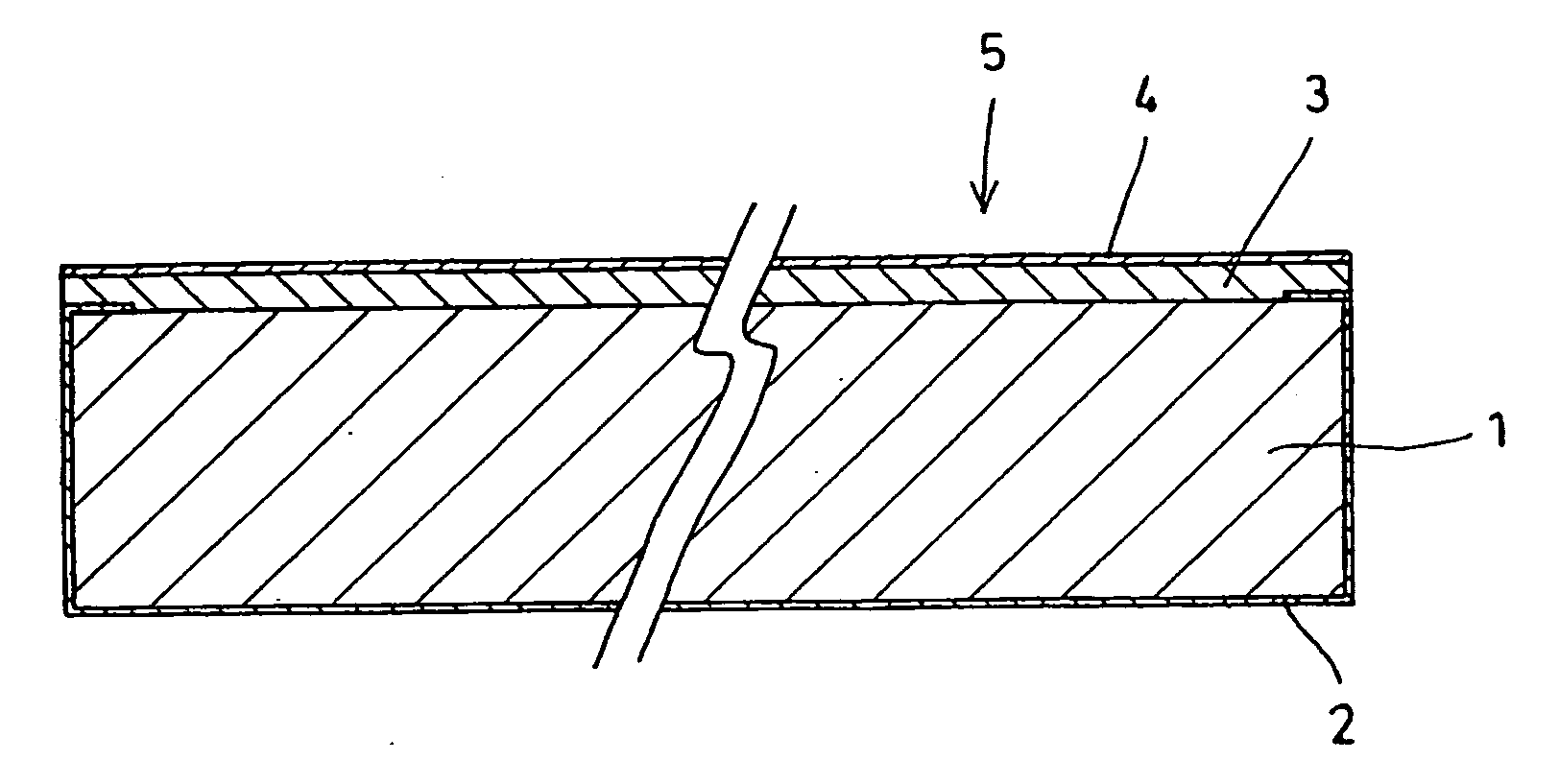
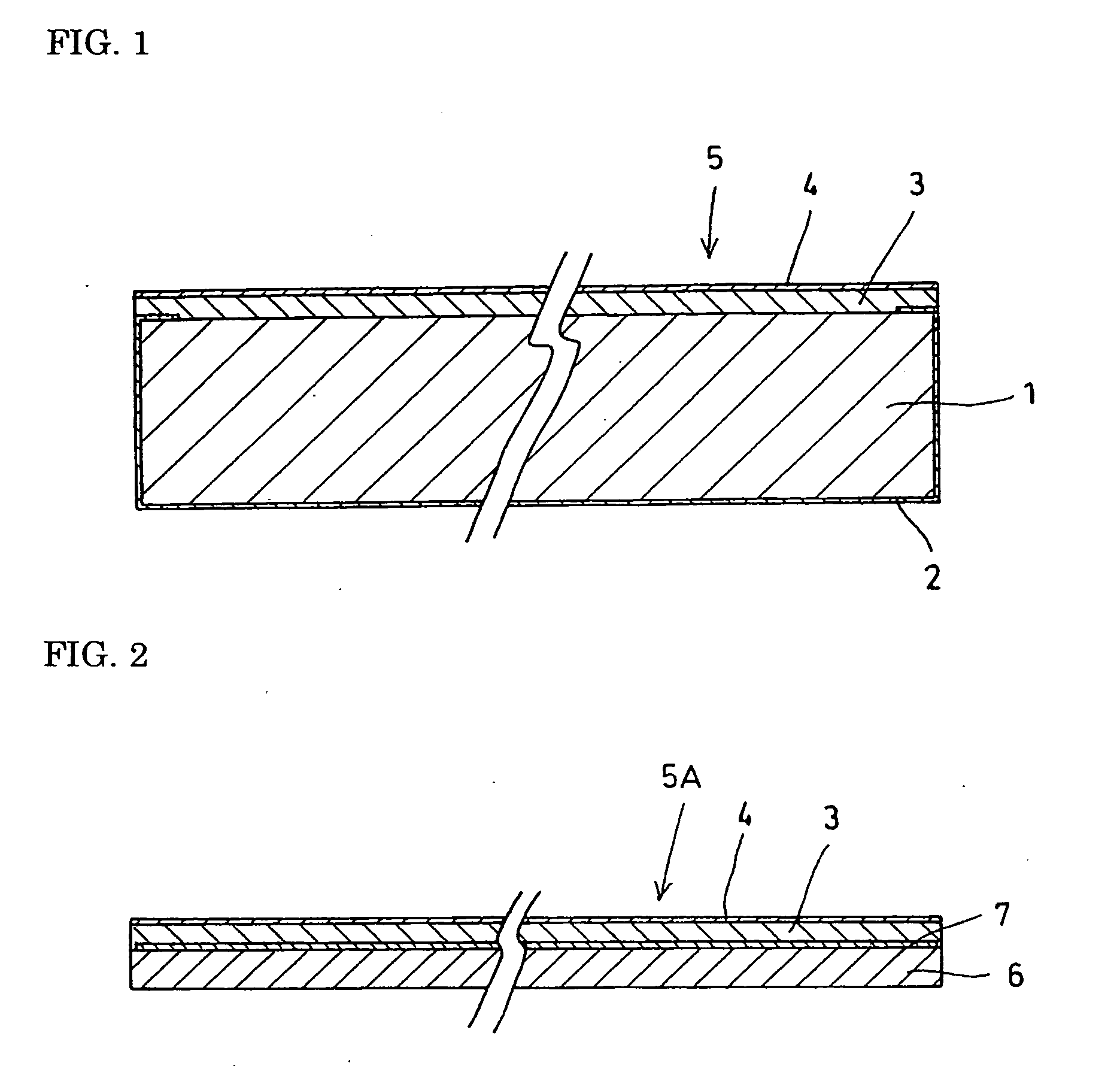
[0016] With a polyethylene film of 100 μm thickness, 30 mm diameter as a substrate, a thin copper film 2 as illustrated in FIG. 1 was formed to 0.1 μm thickness by vapor deposition over the entire back-side surface, the side surfaces, and an area of approximately 0.5 mm width along the peripheral margin of the upper surface of the polyethylene film 1.

[0017] Then a metallic lithium film 3 was subsequently formed by vapor deposition onto the entire top-side surface. The metallic lithium film 3 measured 5 μm in thickness. The film-thickness measurement was performed using a stylus profilometer. Further, a solid electrolytic film 4 that was a lithium (Li)—phosphorous (P)—sulfur (S) composition was vapor-deposited to 0.5 μm thickness onto the metallic lithium film 3, producing a negative electrode component material 5. Therein, an assay of the solid electrolytic film 4 indicated that it was in the form of a non-crystalline composition of 34 atomic % Li, 14 atomic % P, and 52 atomic % S....

embodiment 2

[0023] A polyethylene film 7 as represented in FIG. 2 was tape-cast to a thickness of 1 μm using a mask on the upper surface of copper foil 6 of 10 μm thickness, save for a strip 0.5 mm in width along the peripheral margin of the top surface.

[0024] A metallic lithium film 3 was subsequently formed by vapor deposition onto the entire top-side surface. The metallic lithium film 3 measured 5 μm in thickness. The film-thickness measurement was performed using a stylus profilometer. Further, a solid electrolytic film 4 that was a lithium (Li)—phosphorous (P)—sulfur (S) composition was vapor-deposited to 0.2 μm thickness onto the metallic lithium film 3, producing a negative electrode component material 5A. Therein, an assay of the solid electrolytic film 4 indicated that it was in the form of a non-crystalline composition of 34 atomic % Li, 14 atomic % P, and 52 atomic % S.

[0025] The positive electrode was prepared by mixing, together with an organic solvent, LiCoO2 particles to serve ...

embodiment 3

[0030] In sample sets of 100, batteries of the same configuration as those of Embodiment 1, but for each set of which the substrate was changed, were prepared. The cyclability of the batteries produced (Sample Nos. 3 through 9) was examined by the same method as in Embodiment 1. The results are set forth in Table.

[0031] With Sample Nos. 3 through 9 as well the good-product yield was 100% in every case.

TABLENegative electrode substrateSubst.Test resultsthicknessGood-product yieldSampleSubstrate substance(μm)(%)No. 1Polyethylene100100No. 2Copper / polypropylene10 / 1100No. 3Polyethylene terephthalate10100(Product name: Tetron ®)No. 4Aromatic polyamide10100(Product name: Nomex ®)No. 5Polyamide10100(Product name: nylon)No. 6Aromatic polyamide5100No. 7Polyethylene oxide10100No. 8Polyurethane15100No. 9Polycarbonate10100

the structure of the environmentally friendly knitted fabric provided by the present invention; figure 2 Flow chart of the yarn wrapping machine for environmentally friendly knitted fabrics and storage devices; image 3 Is the parameter map of the yarn covering machine
Login to View More

PUM

PropertyMeasurementUnit
thicknessaaaaaaaaaa
widthaaaaaaaaaa
thicknessaaaaaaaaaa
Login to View More

Abstract

Affords for lithium secondary batteries a negative electrode component material that enhances battery cyclability by inhibiting dendritic growth that occurs during charging / discharging due to the reaction of the metallic lithium and organic electrolyte. A substrate for a lithium-secondary-battery negative-electrode component material (5), in which a metallic lithium film (3) is formed atop the substrate and onto the metallic lithium film an inorganic solid electrolytic film (4) is formed, is created from an electrical insulator that can be a polyethylene film (1). A configuration providing an electrically insulating layer at the interface between a metal base material and the metallic lithium film may also be utilized as the substrate.

Description

TECHNICAL FIELD [0001] The present invention relates to negative-electrode component materials for superior capacity, superior safety lithium secondary batteries excelling in cyclability, and to lithium secondary batteries utilizing the component materials. BACKGROUND ART [0002] As a way of improving the volumetric and gravimetric capacity density of secondary lithium-ion batteries, production methods in which lithium in metallic form is accumulated within a negative electrode have been investigated as an alternative to the traditional methods that employ the intercalation of lithium ions into graphite. With the alternative methods, however, the lithium and the battery's organic electrolyte react, which when the battery charges / discharges turns the lithium into branchy crystals and gives rise to dendritic lithium growth that precipitates out of the electrode. As a consequence, the electrode performs less efficiently and the battery's cycling life is shortened. What is more, such lit...

Claims

the structure of the environmentally friendly knitted fabric provided by the present invention; figure 2 Flow chart of the yarn wrapping machine for environmentally friendly knitted fabrics and storage devices; image 3 Is the parameter map of the yarn covering machine
Login to View More

Application Information

Patent Timeline
no application Login to View More
Patent Type & Authority Applications(United States)
IPC IPC(8): H01M4/66H01M4/40H01M2/16H01M4/134H01M4/139H01M4/38H01M4/64H01M10/052H01M10/0562H01M10/36
CPCH01M10/0562H01M2004/027H01M2300/0025H01M2300/0068Y02E60/122H01M10/052H01M4/139H01M4/38H01M4/381H01M4/661H01M4/667H01M4/134Y02E60/10H01M4/02H01M4/66H01M10/05
Inventor OTA, NOBUHIRO
Owner SUMITOMO ELECTRIC IND LTD
Features
  • R&D
  • Intellectual Property
  • Life Sciences
  • Materials
  • Tech Scout
Why Patsnap Eureka
  • Unparalleled Data Quality
  • Higher Quality Content
  • 60% Fewer Hallucinations
Social media
Patsnap Eureka Blog
Learn More