Unlock instant, AI-driven research and patent intelligence for your innovation.

Process and extruder nozzle for producing tubular extruded products

Inactive Publication Date: 2007-05-03
PELCZ ANTAL +2
View PDF2 Cites 10 Cited by
  • Summary
  • Abstract
  • Description
  • Claims
  • Application Information

AI Technical Summary

Benefits of technology

[0019] The primary object of the present invention is to eliminate the deficiencies mentioned above, that is, to create an improved solution by which extruded products, e.g. plastic foils—particularly blown foil hoses—can be produced more economically and in considerably more even and better product quality than by known technologies.
[0020] A further object of the invention is to provide completely homogeneous material flow in the nozzle, that is, evenly distributed and of identical temperature within the structurally simplified extruder nozzle, and to have the size of the outlet cross-section, that is, the drawing aperture constant throughout the operation.

Problems solved by technology

In practice, it is a serious problem to ensure a continuous uniform thermoplastic material flow.
A basic precondition for producing foil of uniform thickness is an uniform cooling of the blown foil hose exiting from the extruder nozzle; this means that the solidification points of the foil hose must be in the same horizontal plane, otherwise some parts of the product will extend and swell differently, therefore crawling may occur, which may lead to serious problems when rolling of the product.
Further application problems of the known foil blower extruder nozzles primarily come from the fact that extruder screws are generally installed in a horizontal arrangement, while foil blowing and thus the extruder nozzle has a vertical axis.
Although a substantially homogeneous material flow is generated at the extruder screw outlet, transition from the horizontal to the vertical direction frequently produces inhomogeneous parts in the plastic material flow, inevitably leading to finished product quality deterioration.
A further problem of the known extruder nozzles is that the structural units of the external and the inner components of the nozzle are fastened to each other, therefore their relative position (concentricity, coaxiality) is determined by the fit, as well as the shape and position tolerance of the respective component parts.
Accuracy, however, is limited by the present manufacturing technology, and inaccuracies generally result in non-constant drawing opening size.
As known, plastics are prone to sticking as a matter of course.
However, this entails that further particles stick to the already stuck particles, therefore they swell and “leave a trail” in the material flow.
And this may result in as much as ±20% differences in foil hose thickness.
Thickness differences in the foil hose will result in conical rolls at the time of rolling up.
In the event of major defects, rolling up is made practically impossible.
However, the co-rotation of the outer and inner nozzle components brings up further problems as well.
Thus, the structural design, operation, and maintenance of the extruder nozzle become too complicated.
The problems described above in relation with the rotation of the outer and inner nozzle parts appear here as well, on the one hand, and rotation into different directions requires a much more complex rotating drive system, which further increases costs and structural complexity.
Furthermore, a “trailing” phenomenon arises in the material pressed through the gaps between the bearing balls as in the case of the spiral channels mentioned above, which is to the detriment of product quality.
Perfect product could be produced only, if the material was completely homogeneous and the size of the drawing aperture was constant; this, however, cannot be guaranteed by the known solutions of the prior art.

Method used

the structure of the environmentally friendly knitted fabric provided by the present invention; figure 2 Flow chart of the yarn wrapping machine for environmentally friendly knitted fabrics and storage devices; image 3 Is the parameter map of the yarn covering machine
View more

Image

Smart Image Click on the blue labels to locate them in the text.
Viewing Examples
Smart Image
  • Process and extruder nozzle for producing tubular extruded products
  • Process and extruder nozzle for producing tubular extruded products
  • Process and extruder nozzle for producing tubular extruded products

Examples

Experimental program
Comparison scheme
Effect test

second embodiment

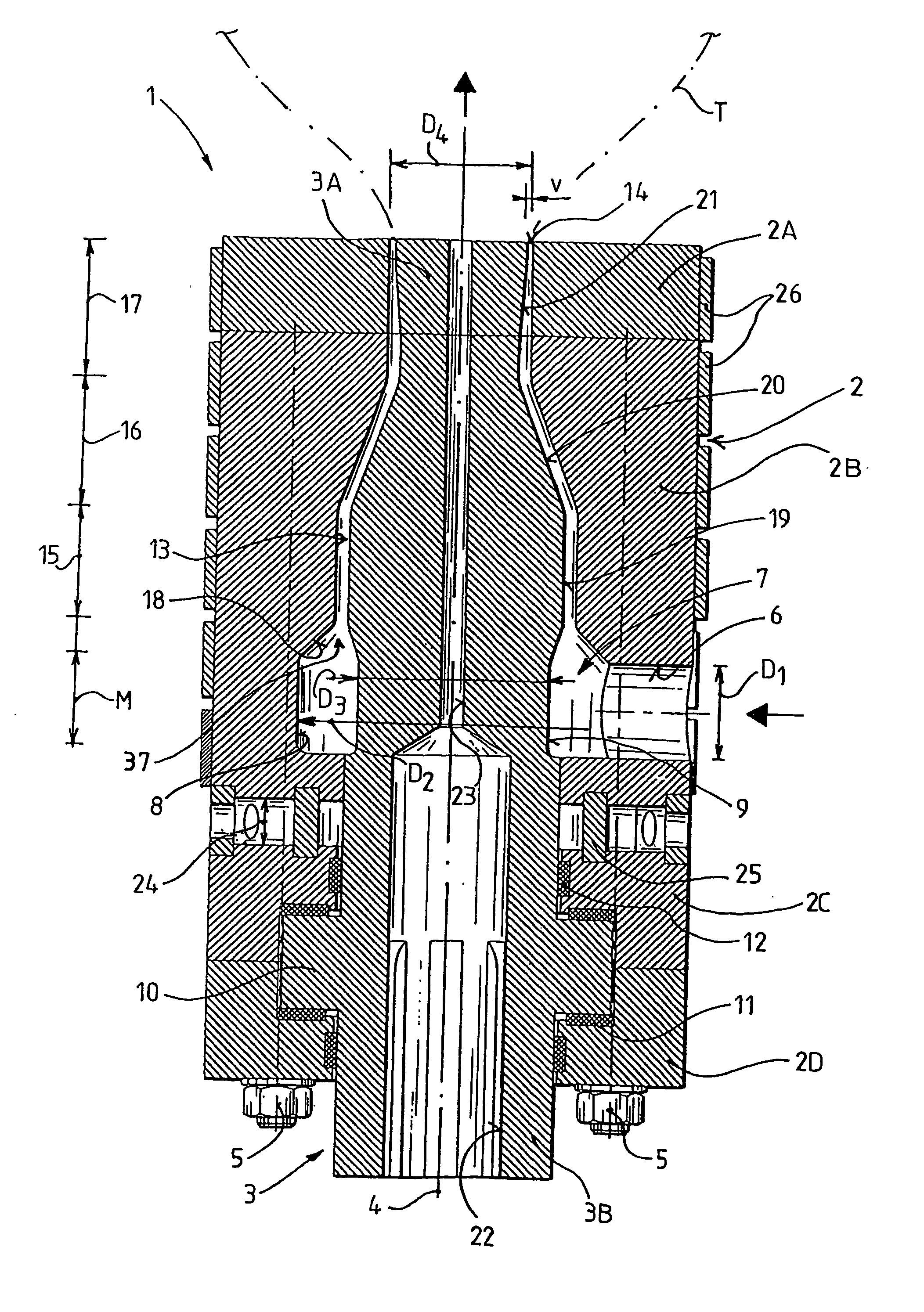
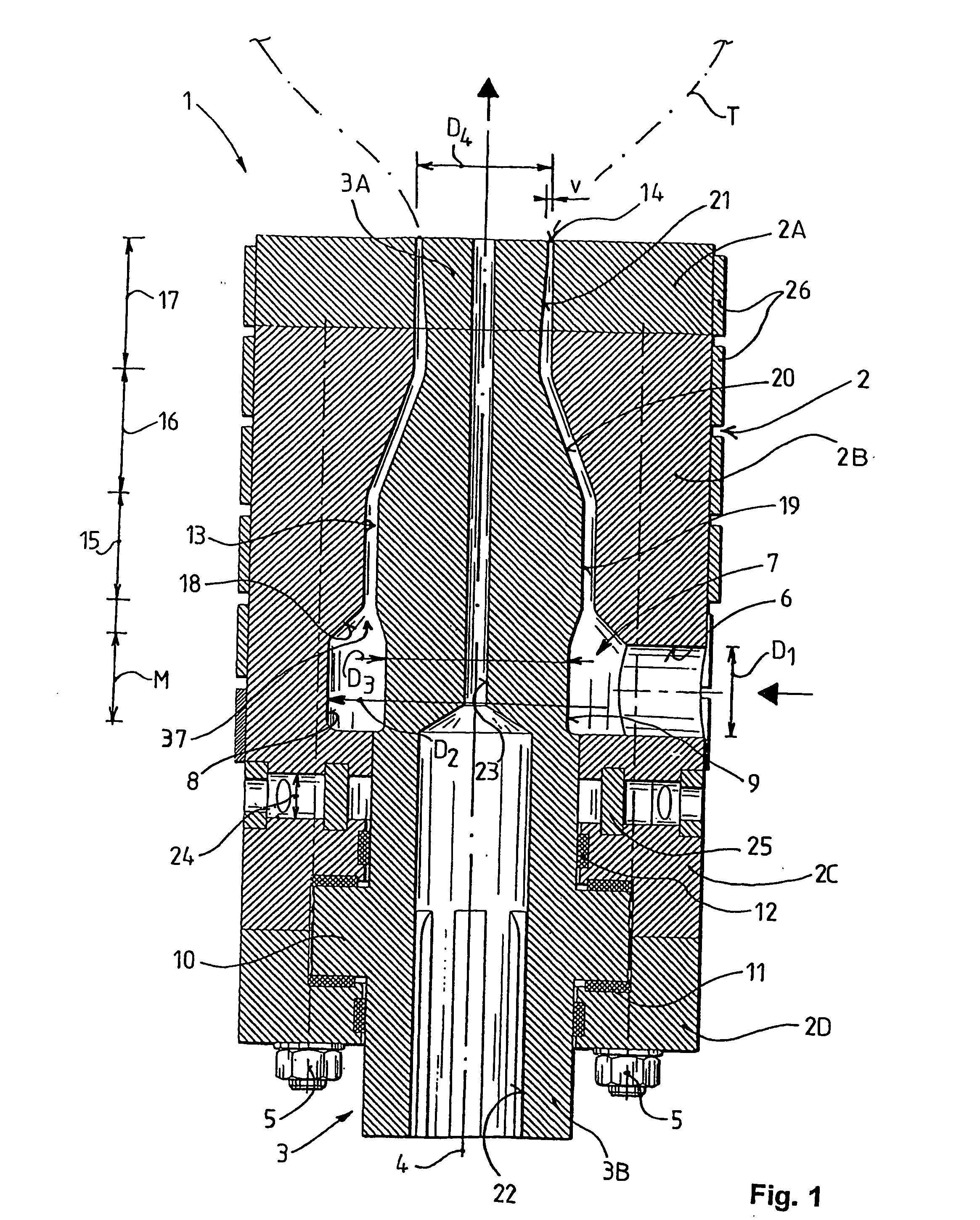
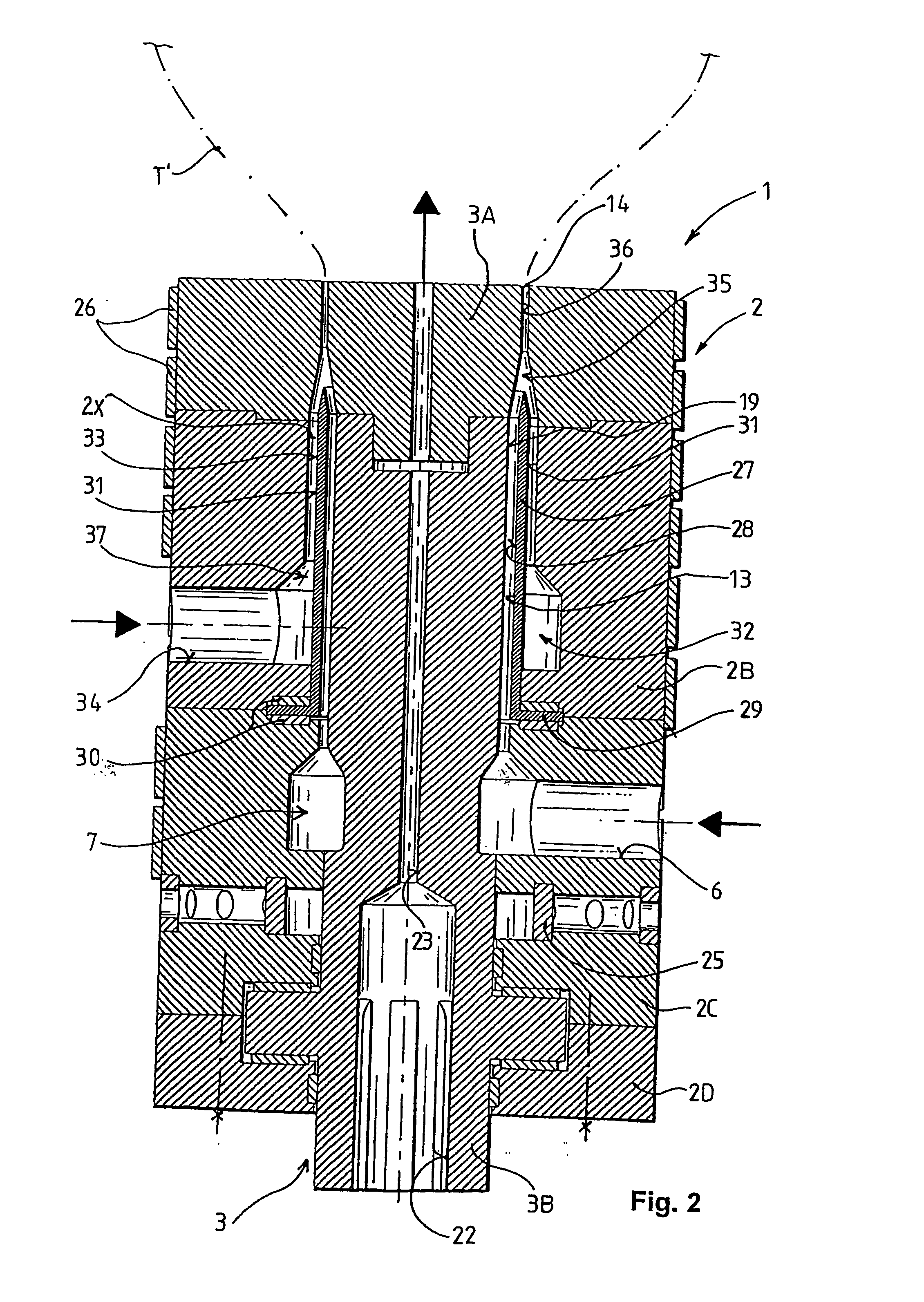
[0059] The second embodiment, shown in FIG. 2, of the extruder nozzle in accordance with the present invention is suitable for producing such two-layered foil hose. Similar parts in FIG. 2 have been designated with identical reference characters (as in FIG. 1) for simplicity and better comparability.

[0060] The extruder nozzle 1 as shown in FIG. 2 substantially corresponds to the solution according to FIG. 1 both in terms of structure and principle of operation. Said extruder nozzle 1 also comprises two main component parts: a standing outer nozzle component 2 and an inner nozzle core 3 rotatable embedded within said outer component 2. The external nozzle component 2 is axially divided, consisting of parts 2A, 2B, 2C, and 2D, respectively. The rotating nozzle core 3 is to be connected to a rotary drive in a known manner (not shown).

[0061] The standing external nozzle component 2 is also provided with a radial first inlet 6 to feed in a first melted plastic material flow under pressu...

first embodiment

[0064] The standing nozzle component 2 is provided with a second inlet 34 leading radially into the second annular expansion chamber 32 at a part of opposite the first inlet 6 in the present case. Through said second inlet 34 a second melted (approx. 250° C.) plastic material flow is fed in under pressure from another extruder screw (not illustrated). It is to be noted that the cross-section proportions of the second inlet 34, the second annular expansion chamber 32, and the second homogenizing ring channel 33 substantially correspond to those mentioned at the

[0065] At the time of putting into operation, the extruder nozzle 1 is heated up to an operating temperature of about 250° C. by the electric heater device 26. Then the first plastic melt is fed in at high pressure through the first inlet 6, simultaneously with feeding the second plastic melt through the second inlet 34, and during these steps the nozzle core 3 is rotated at 20 revolutions per minute by the rotary drive. The fi...

the structure of the environmentally friendly knitted fabric provided by the present invention; figure 2 Flow chart of the yarn wrapping machine for environmentally friendly knitted fabrics and storage devices; image 3 Is the parameter map of the yarn covering machine
Login to View More

PUM

PropertyMeasurementUnit
Electric chargeaaaaaaaaaa
Currentaaaaaaaaaa
Currentaaaaaaaaaa
Login to View More

Abstract

A process and an extruder nozzle for tubular products includes the steps of feeding pressurized material into an extruder nozzle through an inlet, and forcing this material flow through a duct formed between outer and inner nozzle components, and pressing the material flow through an annular aperture at the duct end. Material entering the extruder nozzle is distributed first by feeding into an annular expansion chamber whose cross-section is much greater than the inlet's. When the expansion chamber is completely filled with material whose pressure has become higher than the flow resistance of a homogenizing ring channel having a cross-section narrowed to and connected to the annular expansion chamber then in the homogenizing ring channel the material flow is forced to move across its entering direction, and is homogenized by the relative rotation of surfaces of the homogenizing ring channel. Helical forced movement leads the material to a drawing aperture.

Description

FIELD OF THE INVENTION [0001] The present invention relates to a process and an extruder nozzle for production of extruded tubular products, particularly blown tubular plastic foils (film hoses). Such plastic foils can be used e.g. for packaging of different products. BACKGROUND OF THE INVENTION [0002] There are processes and devices known in practice, used for producing blown foil hoses from thermoplastic materials using an extruder nozzle. Such nozzles are mainly vertically arranged, having a radial inlet for the thermoplastic material connected to an outlet of a generally horizontal extruder screw. In practice, it is a serious problem to ensure a continuous uniform thermoplastic material flow. The tubular product, mainly foil hose exiting from the annular extruder nozzle is stretched to reach a required diameter and wall thickness. In order to provide with an air chamber required for blowing, the foil hose is led through two pinch rolls, which also exert a force required for take...

Claims

the structure of the environmentally friendly knitted fabric provided by the present invention; figure 2 Flow chart of the yarn wrapping machine for environmentally friendly knitted fabrics and storage devices; image 3 Is the parameter map of the yarn covering machine
Login to View More

Application Information

Patent Timeline
no application Login to View More
IPC IPC(8): B29C47/20A21C11/16B29C35/02B29C48/10B29C48/32B29C48/33B29C48/335B29C48/34
CPCA21C11/16B29C35/0255B29C47/0023B29C47/0026B29C47/0057B29C47/025B29C47/065B29C47/24B29C47/26B29C47/268B29C47/28B29C47/86B29C2035/0211B29L2009/00B29L2023/001B29C48/0018B29C48/09B29C48/10B29C48/154B29C48/21B29C48/33B29C48/335B29C48/338B29C48/86B29C48/865B29C48/34
Inventor PELCZ, ANTALILLES, TAMASSZABO, LAJOS
Owner PELCZ ANTAL
Features
  • R&D
  • Intellectual Property
  • Life Sciences
  • Materials
  • Tech Scout
Why Patsnap Eureka
  • Unparalleled Data Quality
  • Higher Quality Content
  • 60% Fewer Hallucinations
Social media
Patsnap Eureka Blog
Learn More