Catalyst composition comprising shuttling agent for ethylene copolymer formation
Active Publication Date: 2007-07-19
DOW GLOBAL TECH LLC
View PDF1 Cites 98 Cited by
Summary
Abstract
Description
Claims
Application Information
AI Technical Summary
This helps you quickly interpret patents by identifying the three key elements:
Problems solved by technology
Method used
Benefits of technology
Benefits of technology
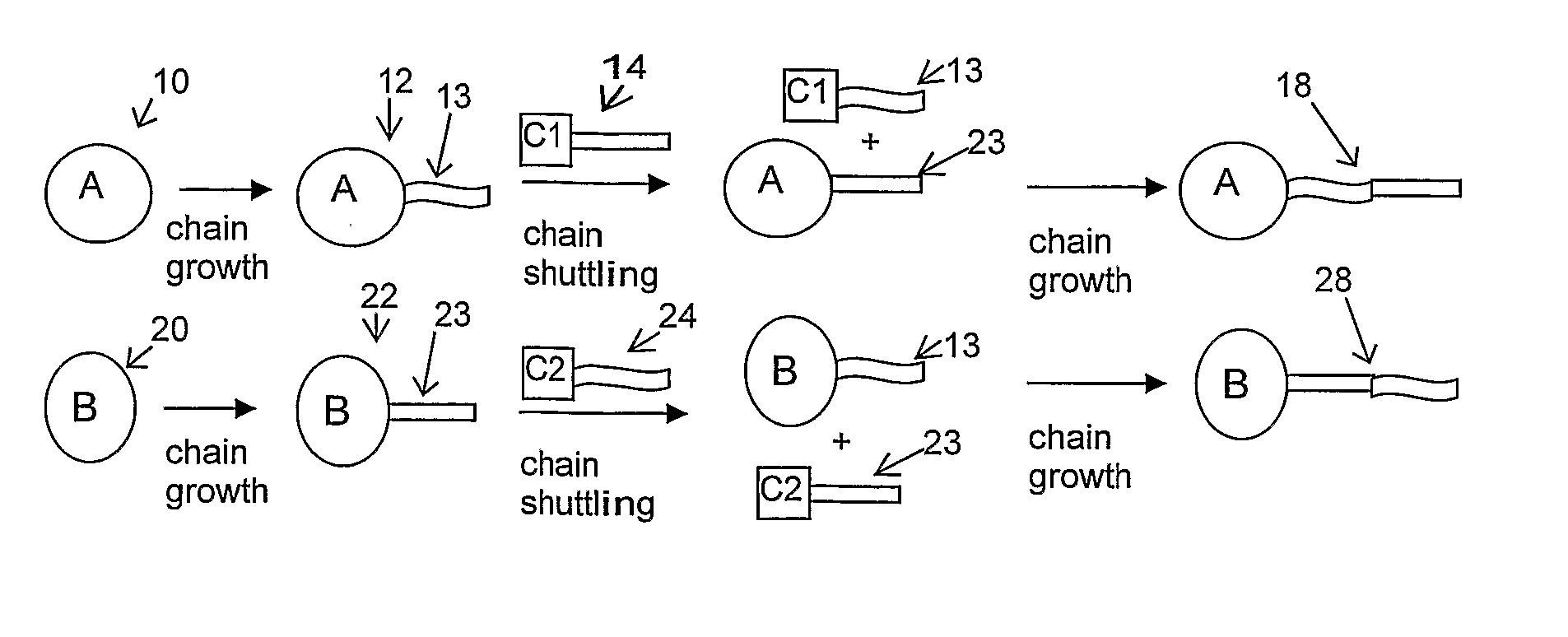
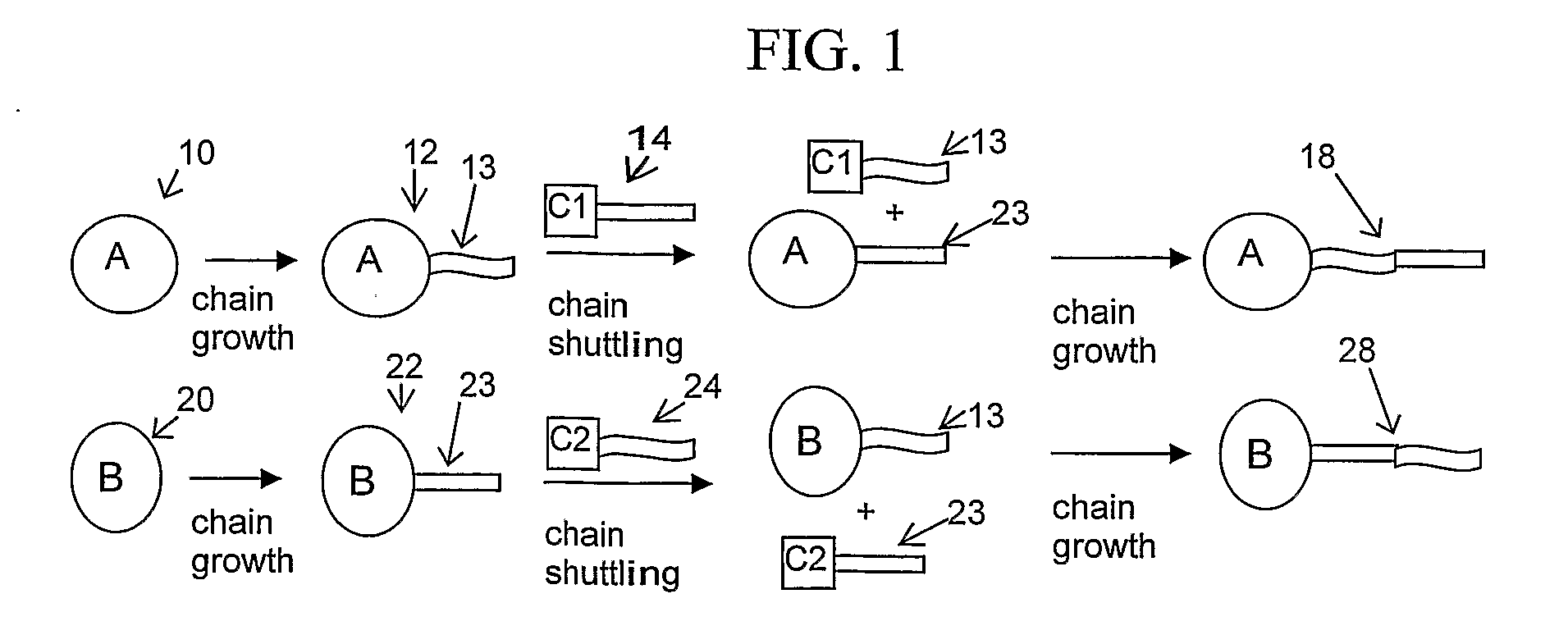
[0030] Preferably, the foregoing process takes the form of a continuous solution process for forming block copolymers, especially multi-block copolymers, preferably linear multi-block copolymers, using multiple catalysts that are incapable of interconversion. That is the catalysts are chemically distinct. Under continuous solution polymerization conditions, the process is ideally suited for polymerization of ethylene at high monomer conversions. Under these polymerization conditions, shuttling from the chain shuttling agent to the catalyst becomes advantaged compared to chain growth, and multi-block copolymers, especially linear multi-block copolymers according to the invention are formed in high efficiency.
Problems solved by technology
Unfortunately, these methods of preparing block copolymers require sequential monomer addition and batch processing and the types of monomers that can be usefully employed in such methods are relatively limited.
Additionally, anionic and free-radical processes are relatively slow, resulting in poor process economics.
However, after analysis of time-dependent product distribution, the authors concluded this reaction was, “not a simple catalyzed chain growth reaction.” The reference fails to disclose the use of two or more catalysts in combination with a chain shuttling agent to make multi-block copolymers.
It is known that random defects occur in polymers prepared from single monomers using, for example, Ni and Pd-diimine catalysts.
Method used
the structure of the environmentally friendly knitted fabric provided by the present invention; figure 2 Flow chart of the yarn wrapping machine for environmentally friendly knitted fabrics and storage devices; image 3 Is the parameter map of the yarn covering machine
View more
Image
Smart Image Click on the blue labels to locate them in the text.
Viewing Examples
Smart Image
Click on the blue label to locate the original text in one second.
Reading with bidirectional positioning of images and text.
Smart Image
Examples
Experimental program
Comparison scheme
Effect test
specific embodiments
[0546] The following specific embodiments of the invention and combinations thereof are especially desirable and hereby delineated in order to provide detailed disclosure for the appended claims.
[0547] 1. A composition comprising the admixture or reaction product resulting from combining:
[0549] (B) a second olefin polymerization catalyst capable of preparing polymers differing in chemical or physical properties from the polymer prepared by catalyst (A) under equivalent polymerization conditions,
[0550] at least one of catalyst (A) or catalyst (B) being capable of forming a branched polymer by means of chain walking or reincorporation of in situ formed olefinic polymer chains, and
[0551] (C) a chain shuttling agent.
[0552] 2. A composition comprising the admixture or reaction product resulting from combining:
[0553] (A) a first olefin polymerization catalyst capable of forming a highly crystalline ethylene homopolymers by ethylene ...
example 1
[0627] A 6-mL reaction vessel containing a glass vial insert is charged with mixed alkanes (3.295 mL), and then pressurized to 200 psi (1.4 MPa) with ethylene. Cocatalyst 1 (1.23 mM in toluene, 0.205 mL, 2.52 μmol) and DEZ (2.5 mM in toluene, 0.200 mL, 0.5 μmol) are sequentially added via syringe. A mixture of catalyst A1 (1.0 mM in toluene, 0.10 mL, 100 nmol) and B1 (10 mM in toluene, 0.20 mL, 2.0 μmol) is added via syringe. After 1200 seconds, the reaction is quenched by addition of CO. The glass insert is removed and volatile components removed under vacuum. GPC analysis shows PDI<2.0.
example 2
[0628] A 6-mL reaction vessel containing a glass vial insert is charged with mixed alkanes (3.296 mL), and then pressurized to 200 psi (1.4 MPa) with ethylene. Cocatalyst 1 (1.23 mM in toluene, 0.205 mL, 2.52 μmol) and TOA (2.5 mM in toluene, 0.200 mL, 0.5 μmol) are sequentially added via syringe. A mixture of catalyst A1 (1.0 mM in toluene, 0.10 mL, 100 nmol) and B1 (10 mM in toluene, 0.20 mL, 2.0 μmol) is added via syringe. After 1200 seconds, the reaction is quenched by addition of CO. The glass insert is removed and volatile components removed under vacuum. GPC analysis shows PDI<2.0.
Comparative A
[0629] A 6-mL reaction vessel containing a glass vial insert is charged with mixed alkanes (3.292 mL), and then pressurized to 200 psi (1.4 MPa) with ethylene. Cocatalyst 1 (1.23 mM in toluene, 0.205 mL, 2.52 mmol) and MMAO (50 mM in toluene, 0.210 mL, 10.5 mmol) are sequentially added via syringe. A mixture of catalysts A1 (1.0 mM in toluene, 0.10 mL, 100 nmol) and B1 (10 mM in tolu...
the structure of the environmentally friendly knitted fabric provided by the present invention; figure 2 Flow chart of the yarn wrapping machine for environmentally friendly knitted fabrics and storage devices; image 3 Is the parameter map of the yarn covering machine
Login to View More
PUM
Property
Measurement
Unit
Fraction
aaaaa
aaaaa
Elastomeric
aaaaa
aaaaa
Thermoplasticity
aaaaa
aaaaa
Login to View More
Abstract
A composition for use in forming a multi-block copolymer from a single polymerizable monomer, said copolymer containing therein two or more segments or blocks differing in branching index, a polymerization process using the same, and the resulting polymers, wherein the composition comprises the admixture or reaction product resulting from combining: (A) a first olefin polymerization catalyst, (B) a second olefin polymerization catalyst capable of preparing polymers differing in chemical or physical properties from the polymer prepared by catalyst (A) under equivalent polymerization conditions, at least one of catalyst (A) or catalyst (B) being capable of forming a branched polymer by means of chain walking or reincorporation of in situ formed olefinic polymer chains, and (C) a chain shuttling agent.
Description
CROSS REFERENCE STATEMENT [0001] This application claims the benefit of U.S. Provisional Application No. 60 / 553,906, filed Mar. 17, 2004. For purposes of United States patent practice, the contents of this provisional application are herein incorporated by reference.BACKGROUND OF THE INVENTION [0002] The present invention relates to compositions for polymerizing ethylene, to form an interpolymer product having unique physical properties, to a process for preparing such interpolymers, and to the resulting polymer products. In another aspect, the invention relates to methods of using these polymers in applications requiring unique combinations of physical properties. In still another aspect, the invention relates to the articles prepared from these polymers. The inventive polymers comprise two or more differing regions or segments (blocks) causing the polymer to possess unique physical properties. These multi-block copolymers and polymeric blends comprising the same are usefully emplo...
Claims
the structure of the environmentally friendly knitted fabric provided by the present invention; figure 2 Flow chart of the yarn wrapping machine for environmentally friendly knitted fabrics and storage devices; image 3 Is the parameter map of the yarn covering machine
Login to View More
Application Information
Patent Timeline
Application Date:The date an application was filed.
Publication Date:The date a patent or application was officially published.
First Publication Date:The earliest publication date of a patent with the same application number.
Issue Date:Publication date of the patent grant document.
PCT Entry Date:The Entry date of PCT National Phase.
Estimated Expiry Date:The statutory expiry date of a patent right according to the Patent Law, and it is the longest term of protection that the patent right can achieve without the termination of the patent right due to other reasons(Term extension factor has been taken into account ).
Invalid Date:Actual expiry date is based on effective date or publication date of legal transaction data of invalid patent.



 Login to View More