Very little has been done over the years to improve such handheld
impact weapons, other than changing the
mass of different portions to impart greater force upon impact.
Such devices are quite effective in subduing a threatening individual, or even a small crowd, as the audible and
visual impression generated by the electrical arc across the contacts is quite intimidating.
For example, it has been found that extremely
bright light focused relatively closely in the eyes of a potentially threatening individual, particularly in relatively darkened areas, greatly reduces the
threat due to the temporary obscuration of the threatening individual's vision.
An obvious example is where the assailant has a weapon, and it is not desirable to approach the individual close enough to contact him or her with an impact baton or electrical
stun device.
Obviously, the weight and bulk of such multiple systems would greatly impede the movement of such security personnel and could put such security personnel at greater risk due to the physical handicap imposed by such an excessive load of equipment.
In any event, the device of the Burton '549 U.S. Patent is quite long and thin, and is not adapted for use as an impact weapon in addition to its electrical prod function.
However, Hansen et al. do not disclose a relatively massive
barrel portion for use as an impact weapon, nor other means (blades, etc.) for such impact function.
In any case, Mongan does not provide any means for using his device as an impact weapon, and further teaches away from the first embodiment of the present stun device by providing an open circuit until one of the contacts is pushed in.
If an assailant or
threat grabs the
barrel of the stick, he or she applies pressure to the guard, causing the guard to retract and the spikes to be exposed.
Larsen et al. disclose a transistorized circuit for controlling electrical power in their nightstick, but no means of providing
alternating current to produce a continuing series of discharges is disclosed.
Also, while Shimizu provides an axially placed light in one end of his nightstick, the light cannot be directed radially from the side of the device.
Also, Jordan does not provide any form of lighting means, impact enhancing means, or interchangeable modules for different functions with his stick.
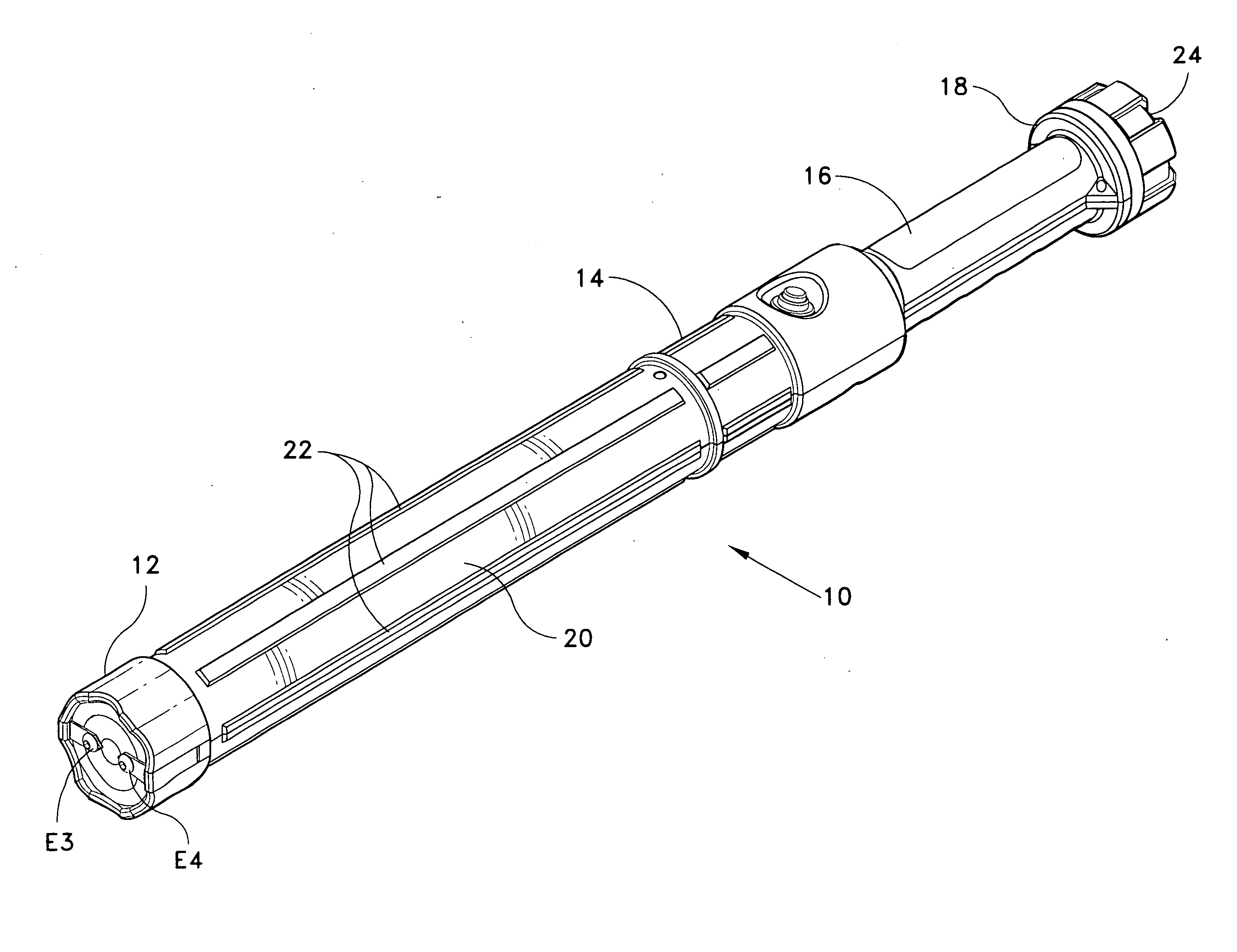
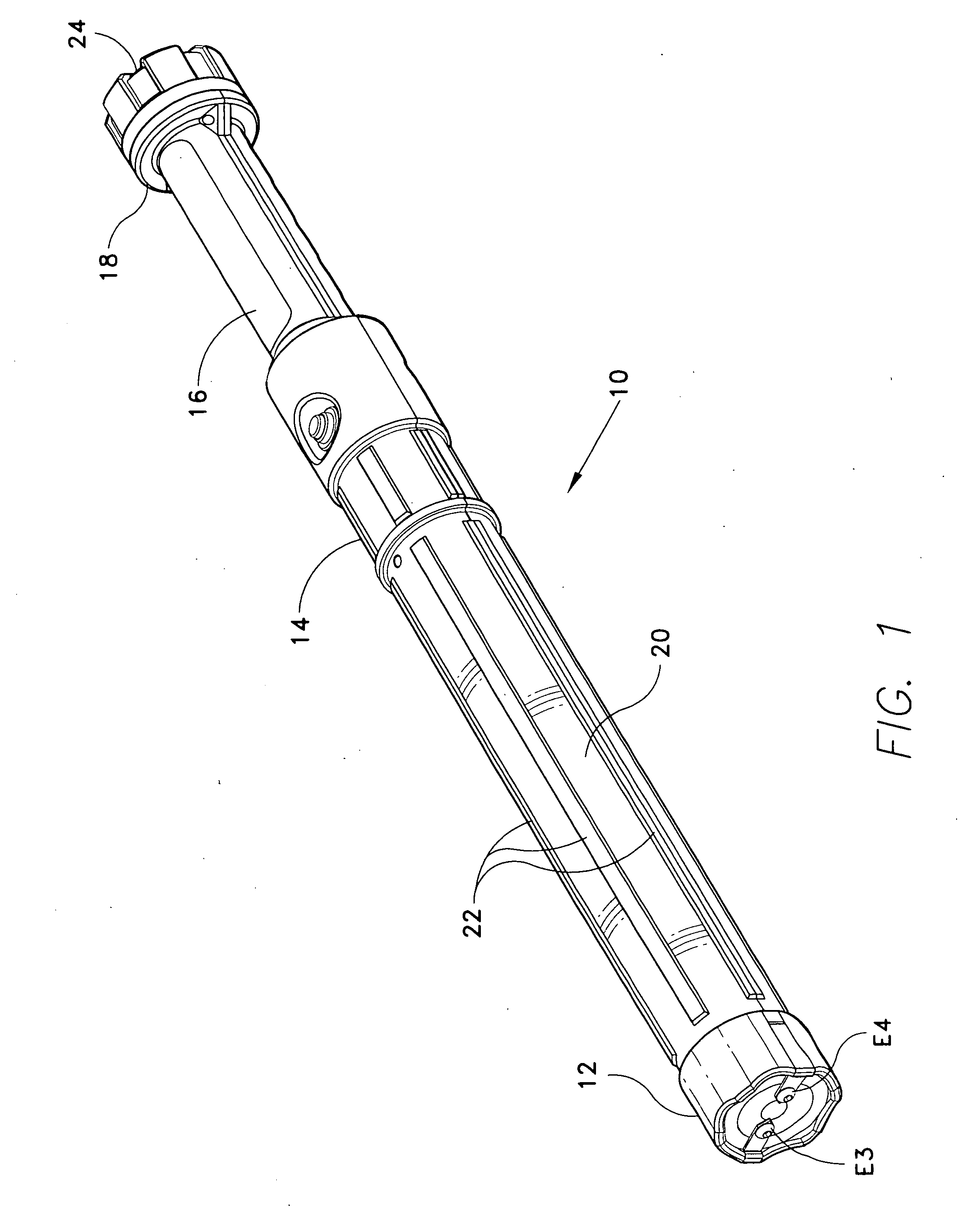
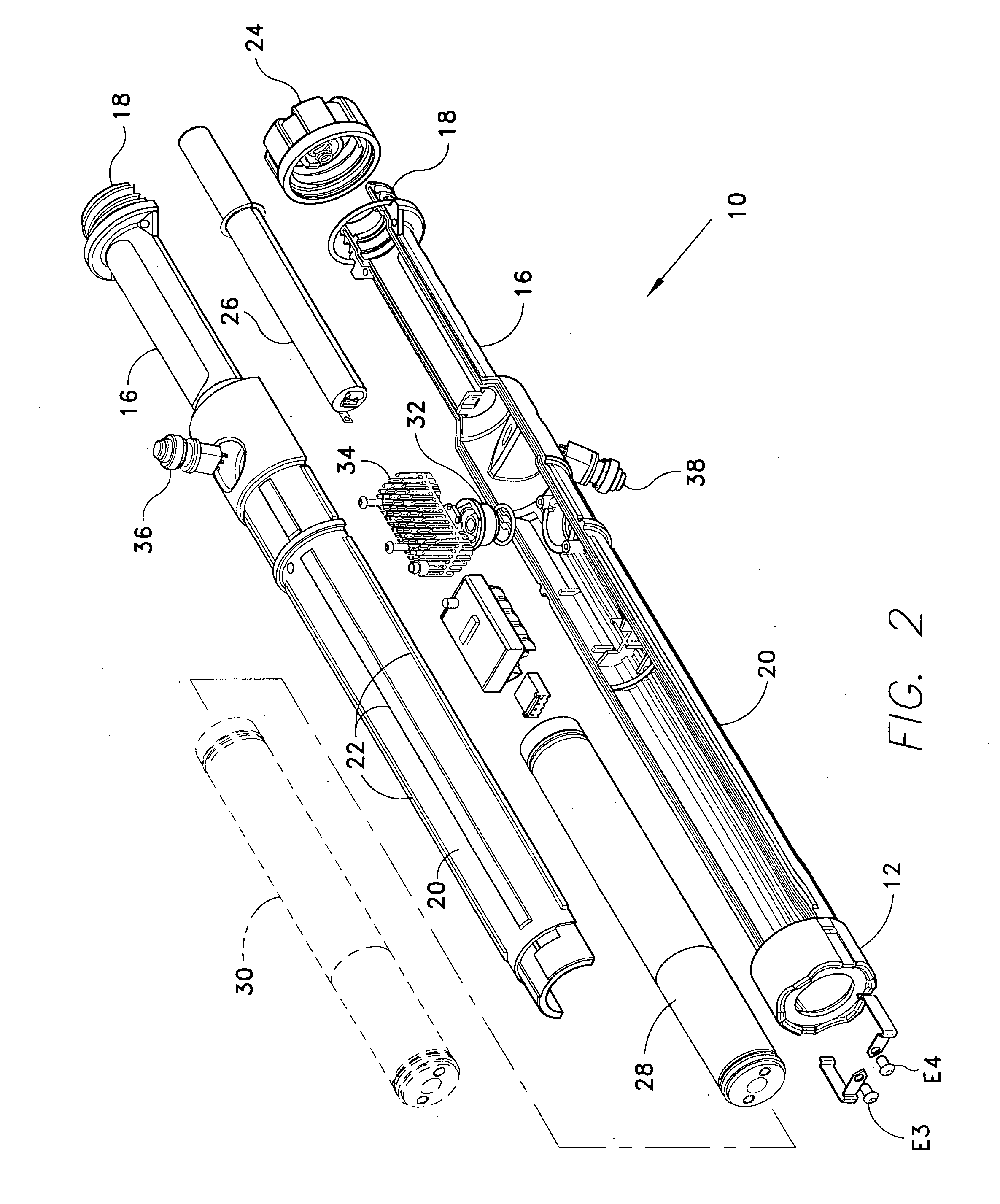
Such size and weight is not suitable for use as an impact weapon, nightstick, or billy club, whereas the present device provides sufficient
mass and size to be useful as an impact weapon as well.
Allen does not disclose any form of lighting for his prod device.
Yanez includes a light with his electrical
discharge apparatus, but the light is not intended to provide any real degree of illumination for the person using the device.
Moreover, Ward does not provide any form of lighting with his device.
LaCroix also provides a light having sufficient intensity to temporarily blind a potential assailant, rather than to provide any useful illumination for the user of the device.
The
lateral extension of the LaCroix device does not facilitate its use as an impact weapon, as provided by the generally cylindrical configuration of the present device.
Moreover, de Anda et al. do not disclose any form of lighting with their device, and the concealed
electrical contacts cannot provide a visible display of electrical
discharge to dissuade a potential attacker.
The physical configuration of the Murray device does not enable it to be used as an impact weapon, e.g., nightstick, etc., as can the present device.
Thus, the electrical device cannot be controlled once it leaves the weapon.
Moreover, while Chaput provides additional electrodes along the sides of the impact sleeve, he does not provide any additional ribs or blades to increase the effectiveness of the device as an impact weapon, as provided by the present personal defense device.
The Chang
assembly cannot be used as an impact weapon, as it is relatively short and compact, with the operating switches located at the approximate midpoints along the opposite sides thereof.
Moreover, the hollow telescoping tubes of the Lin device do not appear to provide sufficient strength for use as an impact weapon (baton, etc.), and Lin makes no disclosure or claim of such function for his device.
However, the relatively
short length of the McNulty stun device is not suitable for use as an impact weapon or baton, and no lighting means is provided by McNulty for his device.


 Login to View More
  Login to View More