
Methods and apparatus for handling processing errors in a multi-processing system
a multi-processing system and processor technology, applied in the direction of multi-programming arrangements, instruments, fault response, etc., can solve the problems of affecting the overall performance of the multi-processing system, application requirements that require extremely fast processing speeds, and cannot generally match the processing speeds of multi-processor architectures
- Summary
- Abstract
- Description
- Claims
- Application Information
AI Technical Summary
Benefits of technology
Problems solved by technology
Method used
Image

Examples
Embodiment Construction
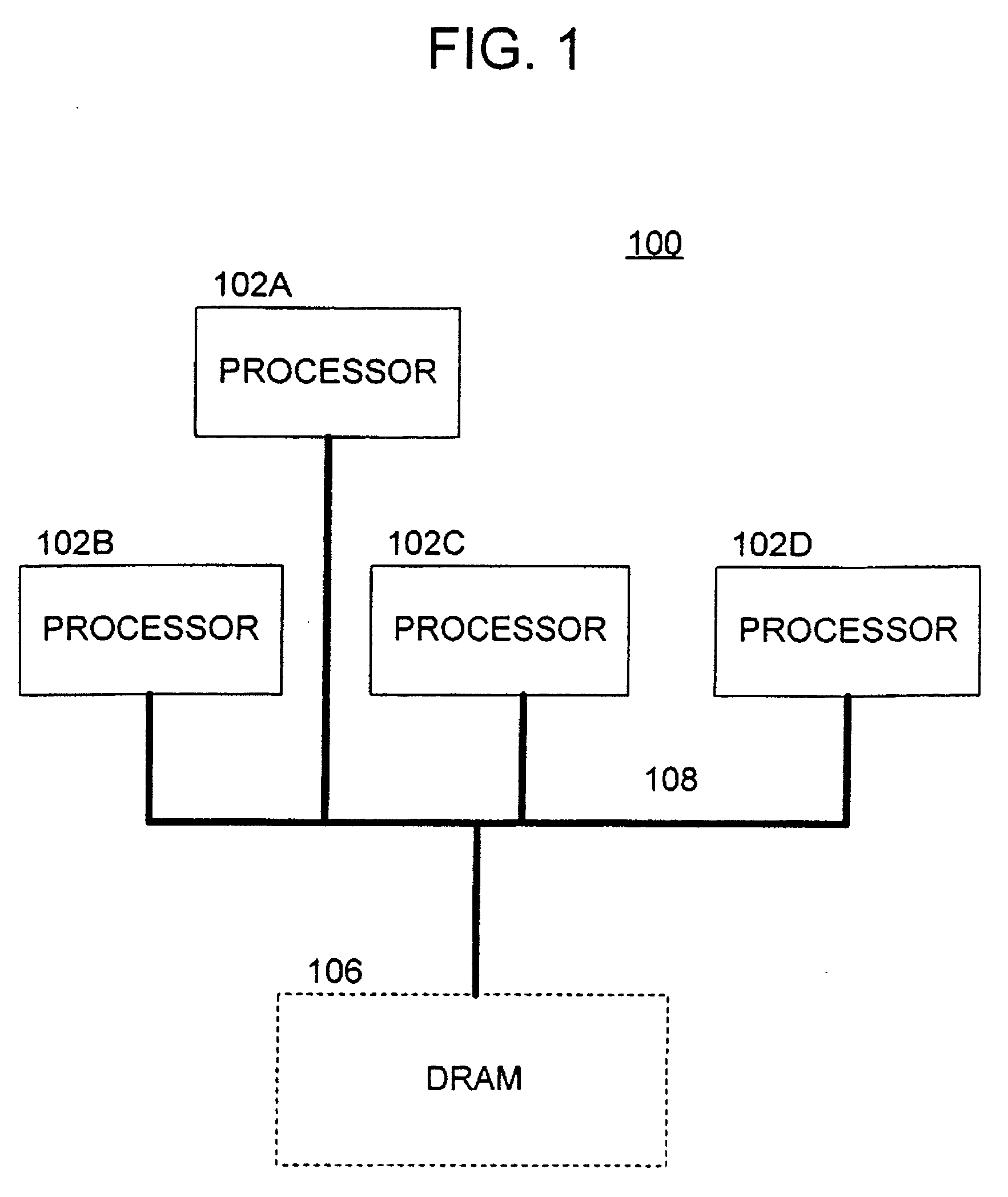
[0081] With reference to the drawings, where like numerals indicate like elements, there is shown in FIG. 1 a multi-processing system 100 in accordance with the present invention. The multi-processing system 100 includes a plurality of processors 102 (any number may be used) coupled to a shared memory 106, such as a DRAM, over a bus 108. It is noted that the shared DRAM memory 106 is not required (and thus is shown in dashed line). Indeed, one or more of the processing units 102 may employ its own memory (not shown) and have no need for the shared memory 106.
[0082] One of the processors 102 is preferably a main processing unit, for example, processing unit 102A. The other processing units 102 are preferably sub-processing units (SPUs), such as processing unit 102B, 102C, 102D, etc. The processing units 102 may be implemented using any of the known computer architectures. All of the processing units 102 need not be implemented using the same architecture; indeed they may be of heter...
PUM
 Login to View More
 Abstract
Description
Claims
Application Information
 Login to View More