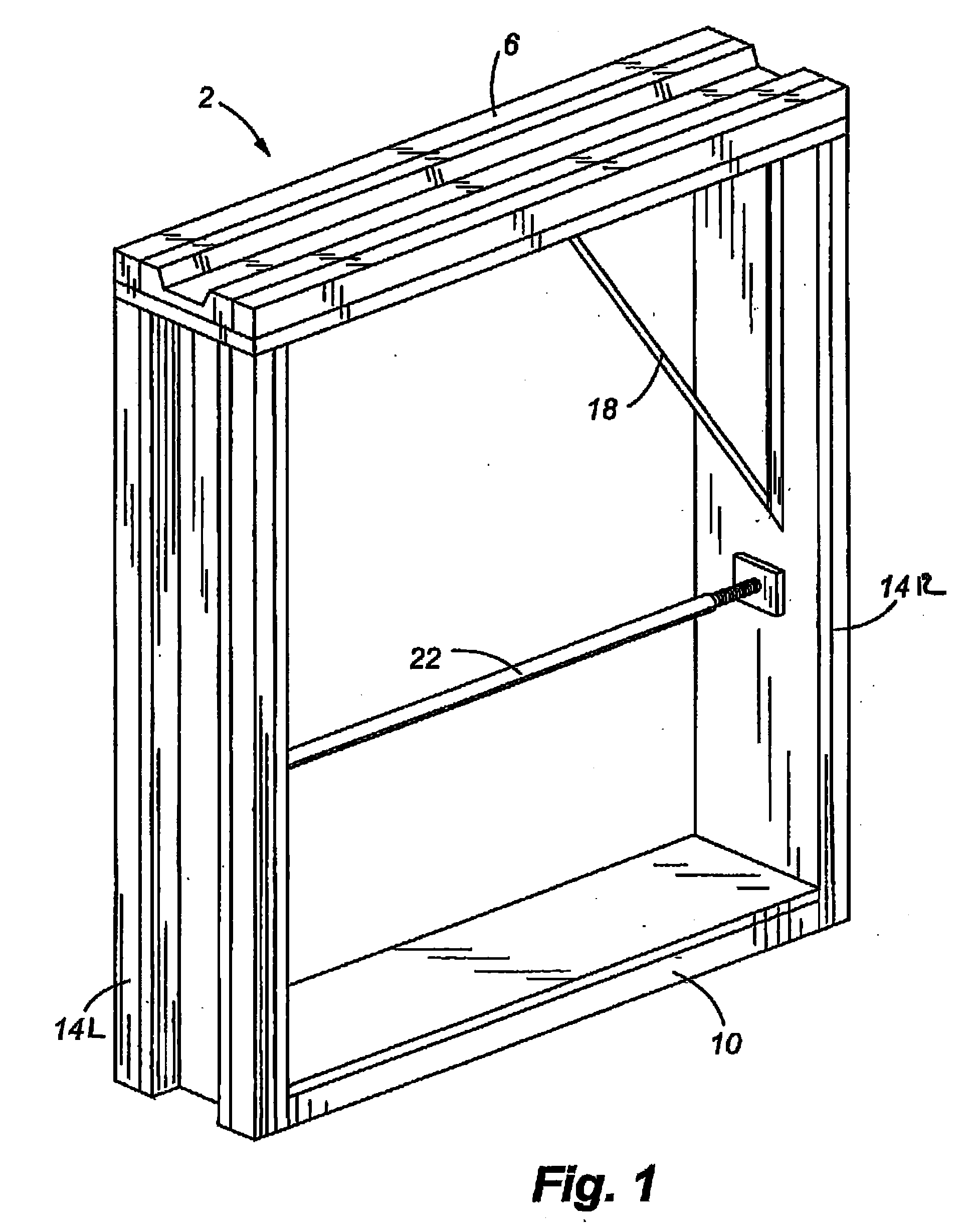
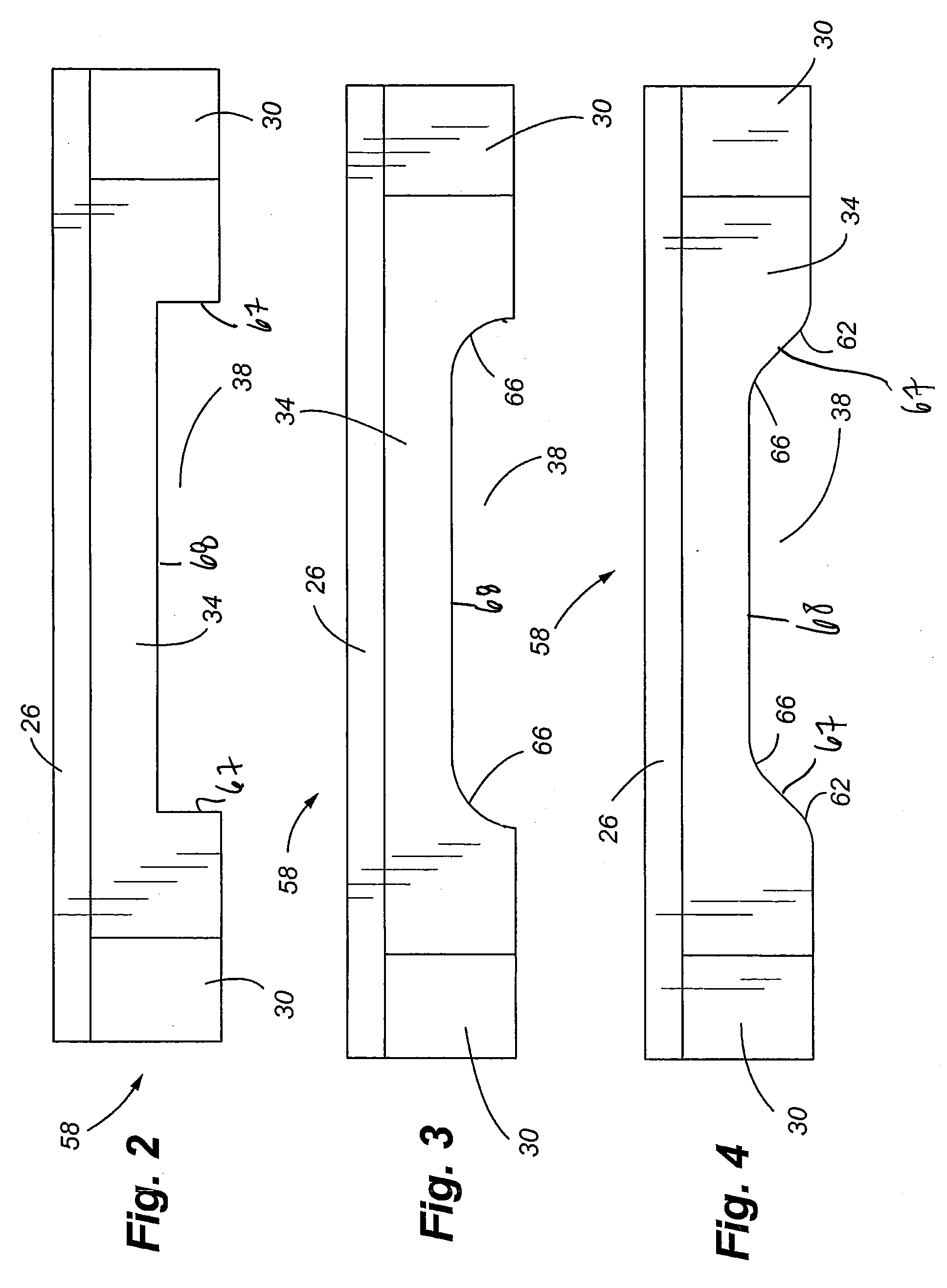
[0004]It is one aspect of the present invention to provide a customizable window and / or door buck. More specifically, embodiments of the present invention are constructed of members that are composed of wood and insulation that interconnect to form the window or door buck. In addition, the individual members of the window or door buck may be
cut to any desired size thereby reducing waste and increasing design flexibility. More specifically, in the case of cast-in-place wall panel construction, often chemically treated wood, usually larger that what is required to form the members of a buck, are cut at the job site and assembled to form bucks wherein any excess wood is discarded. One
advantage of embodiments of the present invention is that the individual buck members, as described in greater detail below, are assembled off-site using materials of dimensions that generally coincide with the desired window, door, or other opening shape wherein
scrap at the jobsite is reduced or eliminated. More specifically, in the United States, timber is generally cut in the forest in 24 foot lengths. At the mill the timber is cut into three 8 foot lengths, an 8 foot and a 16 foot length, a 10 foot and a 14 foot length or two 12 foot lengths. These standard lengths must be modified at the job site to yield the desired opening wherein the excess is discarded. Conversely, the buck material of a customized length may be delivered to the job site and cut into separate buck members wherein the excess is significantly reduced. Embodiments of the present invention employ 47% less wood than bucks constructed of dimensional lumber. Furthermore, the buck members retain the advantages of wood, thereby facilitating sawing, drilling and general workability while being less expensive than wood alone or vinyl. The buck members are also eco-friendly because they eliminate the need for chemically treated wood products as the wood incorporated into the buck members does not contact the concrete. Another
advantage of the buck members as described herein is that less
heat transfer occurs because the buck material includes insulation as opposed to a wood / concrete interface. The present buck
system is typically less costly, including material and labor costs, than buck systems of the prior art and provides greater design options.
[0005]It is another aspect of the present invention to provide bucks that may be employed in various concrete wall construction schemes, such as cast-in-place walls, prefabricated tilt-up walls (which may include a
low density insulated core), or concrete walls that employ
interlocking insulated concrete forms, as described in detail below. In the case of a cast-in-place wall, after a first wall form and associated reinforcement are located, the window buck is placed and secured to the reinforcing members and a second wall form. Yet another
advantage of this building method, in addition to reduction in waste and omission of shims, is that workers can help ensure concrete is sufficiently placed under the window buck. More specifically, an aperture, in some embodiments about 1.5 to 6 inches in
diameter, can be integrated on-site into a lower member of a buck to allow for vibrational concrete manipulation that causes the concrete to fill in the area under the window buck. The aperture can then be plugged to prevent excess concrete from escaping and / or to restore the continuity of the lower buck member.
[0006]One skilled in the art will appreciate that embodiments of the present invention may be incorporated into prefabricated concrete wall panels. For example, prior to placing the concrete into a horizontally-oriented form, a window buck may be located to define the desired
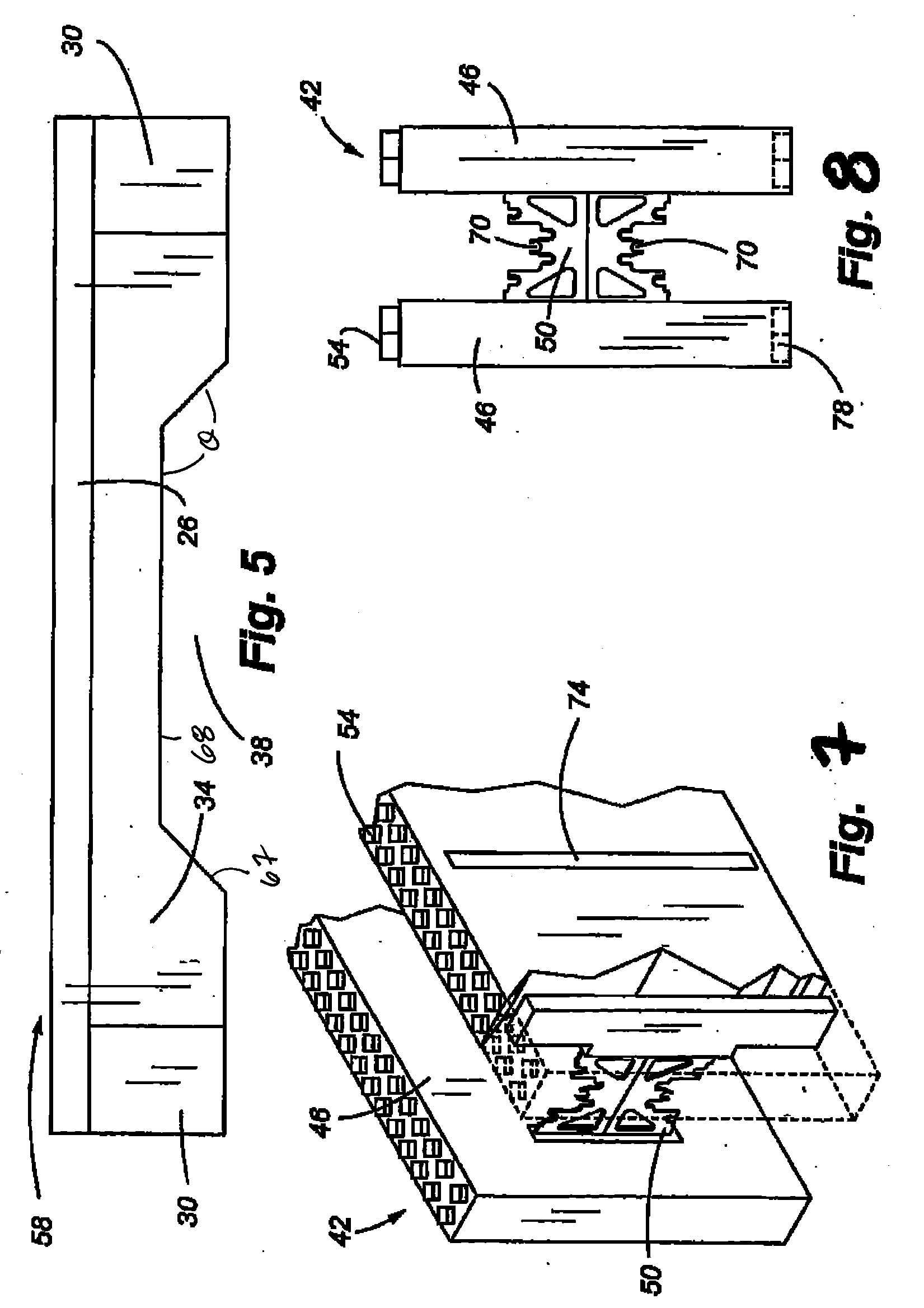
window opening. Further, some embodiments of the present invention are adapted to be used with insulated panels spaced by a web. These insulated concrete forms (“ICF”) are usually light and stackable, thereby allowing workers to easily construct a wall of substantial size without the aid of heavy machinery. Embodiments of the present invention additionally provide a novel way of including a
rebar securing member within the space between the two adjacent parallel insulation panels that make up the ICF.
[0007]It is yet another aspect of the invention to provide an indication of buck member length. That is, embodiments of the invention include ruled markings to help workers to easily estimate or customize the length of individual buck members prior to buck
assembly. The markings maybe spaced in any common
unit of length, including every inch,
centimeter,
yard, foot, meter, etc. In addition, other markings or colors may be employed to indicate size, such as buck depth, or to designate compatibility with other building materials, or to enhance
assembly. Trademarks may also be included.



 Login to View More
  Login to View More